We unleash your business potential by maximize the business innovation.
Send EmailCerium Metal, Elemental Cerium, Metallic Cerium, 7440-45-1
CERIUM METAL
1. PRODUCT IDENTIFICATION AND CHEMICAL IDENTITY
| Parameter | Information |
|---|---|
| Product Name | Cerium Metal |
| Chemical Name | Elemental Cerium, Metallic Cerium |
| Other Names | Cerium Metal, Silver Cerium, Rare Earth Metal, Ferrocerium Alloy Component |
| CAS Number | 7440-45-1 |
| EC Number (EINECS) | 231-154-9 |
| Chemical Symbol | Ce |
| Atomic Number | 58 |
| Atomic Weight | 140.12 g/mol |
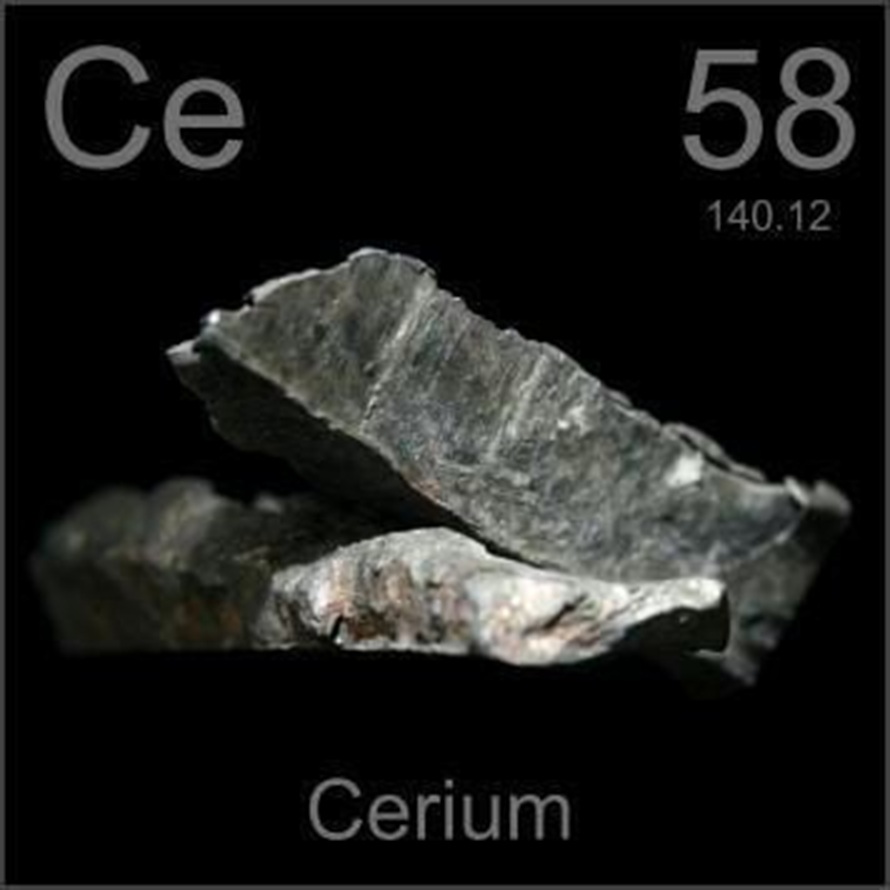
| Appearance | Silver-gray metal, soft and ductile |
| Odor | Odorless |
| Physical State (20°C) | Solid (metal) |
2. CHEMICAL STRUCTURE
2.1. Atomic Structure
Cerium is a lanthanide (rare earth) element with electron configuration [Xe] 4f¹ 5d¹ 6s². It is the most abundant of the rare earth elements. Cerium exhibits two common oxidation states: +3 (cerous) and +4 (ceric). The metal has a face-centered cubic (FCC) crystal structure and is soft, ductile, and highly reactive.
Atomic Properties:
| Property | Value |
|---|---|
| Electron Configuration | [Xe] 4f¹ 5d¹ 6s² |
| Oxidation States | +3 (most stable), +4 |
| Electronegativity (Pauling) | 1.12 |
| Ionization Energy (1st) | 534.4 kJ/mol |
| Atomic Radius | 181.8 pm |
| Ionic Radius (Ce³⁺) | 102 pm |
| Magnetic Ordering | Paramagnetic |
2.2. Crystal Structure
| Parameter | Value |
|---|---|
| Crystal System | Face-Centered Cubic (FCC) |
| Lattice Parameter (a) | 5.160 Å |
| Space Group | Fm3̄m (No. 225) |
| Coordination Number | 12 |
| Allotropic Transformation | γ-Ce → β-Ce at ~95 K |
3. PHYSICAL AND CHEMICAL PROPERTIES
3.1. Physical Properties
| Property | Value | Description |
|---|---|---|
| Appearance | Silver-gray metal, soft and ductile | - |
| Atomic Number | 58 | - |
| Atomic Weight | 140.12 g/mol | - |
| Density | 6.77 g/cm³ | - |
| Melting Point | 798 °C | - |
| Boiling Point | 3443 °C | - |
| Hardness (Mohs) | 2.5 | Soft metal |
| Electrical Resistivity | 73 µΩ·cm | - |
| Thermal Conductivity | 11.3 W/(m·K) | - |
| Specific Heat Capacity | 192 J/(kg·K) | - |
| Heat of Fusion | 5.46 kJ/mol | - |
| Heat of Vaporization | 398 kJ/mol | - |
| Magnetic Susceptibility | Paramagnetic | - |
3.2. Chemical Properties
| Property | Description |
|---|---|
| Oxidation States | +3 (most stable), +4 |
| Reaction with Air | Rapidly oxidizes; forms Ce₂O₃ and CeO₂ |
| Reaction with Water | Reacts slowly with cold water, rapidly with hot water |
| Reaction with Acids | Dissolves readily in dilute acids |
| Reaction with Halogens | Reacts with all halogens at elevated temperatures |
| Reaction with Hydrogen | Forms cerium hydride (CeH₂/CeH₃) |
| Reaction with Nitrogen | Forms cerium nitride at high temperatures |
| Pyrophoricity | In finely divided form (powder), pyrophoric |
3.3. Chemical Reactions
Oxidation in Air:
4Ce + 3O₂ → 2Ce₂O₃ (slow oxidation at RT)
Ce + O₂ → CeO₂ (at elevated temperatures)
Reaction with Water:
2Ce + 6H₂O → 2Ce(OH)₃ + 3H₂↑
Reaction with Acid (HCl):
2Ce + 6HCl → 2CeCl₃ + 3H₂↑
Reaction with Hydrogen:
Ce + 2H₂ → CeH₄ (at elevated temperatures)
4. PURITY GRADES
| Parameter | Industrial Grade | High Purity Grade | Ultra High Purity Grade |
|---|---|---|---|
| Purity | ≥ 99.0% | ≥ 99.5% | ≥ 99.9% |
| Ce Content | ≥ 99.0% | ≥ 99.5% | ≥ 99.9% |
| Oxygen (O) | ≤ 0.5% | ≤ 0.1% | ≤ 0.05% |
| Carbon (C) | ≤ 0.1% | ≤ 0.05% | ≤ 0.02% |
| Iron (Fe) | ≤ 0.2% | ≤ 0.1% | ≤ 0.05% |
| Silicon (Si) | ≤ 0.1% | ≤ 0.05% | ≤ 0.02% |
| Other Rare Earths | ≤ 1.0% | ≤ 0.5% | ≤ 0.1% |
| Nitrogen (N) | ≤ 0.05% | ≤ 0.02% | ≤ 0.01% |
5. FORMS AND AVAILABILITY
| Form | Description | Typical Purity |
|---|---|---|
| Ingots / Chunks | Irregular metal pieces | 99.0-99.5% |
| Rods / Bars | Cylindrical metal forms | 99.0-99.9% |
| Powder | Fine metal powder (pyrophoric) | 99.0-99.5% |
| Granules | Small spherical particles | 99.0-99.5% |
| Turnings | Machined metal shavings | 99.0-99.5% |
| Sputtering Targets | For thin film deposition | 99.0-99.99% |
| Ferrocerium Alloy | Ce + Fe + other REEs | Variable |
6. APPLICATION AREAS
6.1. Ferrocerium and Pyrotechnics
| Application | Function | Details |
|---|---|---|
| Ferrocerium Production | Spark igniter | Used in lighter flints (mischmetal + iron) |
| Pyrotechnics | Spark generation | Fireworks and ignition devices |
| Defense Applications | Special igniters | Military pyrotechnic systems |
| Survival Tools | Fire starters | Emergency fire starting devices |
6.2. Alloy Additive
| Application | Function | Details |
|---|---|---|
| Aluminum Alloys | Grain refiner | Improves casting quality |
| Magnesium Alloys | Grain refinement | Increases corrosion resistance |
| Iron Alloys | Nodularization | Helps form nodular graphite in cast iron |
| Specialty Alloys | Performance enhancer | High-temperature applications |
6.3. Catalyst Support
| Application | Function | Details |
|---|---|---|
| Automotive Catalysts | Catalyst support | Three-way catalyst oxygen storage |
| Petrochemical Catalysts | Support material | Refinery applications |
| Environmental Catalysis | DeNOx systems | Emission control |
| Fluid Catalytic Cracking | Catalyst component | Petroleum refining |
6.4. Electronics and Vacuum Tubes
| Application | Function | Details |
|---|---|---|
| Electron Emission Surfaces | Electron emitter | Vacuum tube cathodes |
| Gettering Material | Gas absorber | Vacuum tube manufacturing |
| Thin Film Deposition | Sputtering target | Semiconductor manufacturing |
| Phosphor Precursor | Phosphor production | Lighting and displays |
6.5. Nuclear Applications
| Application | Function | Details |
|---|---|---|
| Reactor Control Rods | Neutron absorber | Limited use in nuclear reactors |
| Nuclear Research | Research material | Nuclear physics studies |
6.6. Metallurgy
| Application | Function | Details |
|---|---|---|
| Oxygen Scavenger | Deoxidizer | Steel and alloy production |
| Grain Size Control | Grain refiner | Casting quality improvement |
| Flux Agent | Flux | Metal processing |
7. SECTOR SUITABILITY TABLE
| Sector | Suitability | Description |
|---|---|---|
| Metallurgy | ✅ | Alloy additive and oxygen scavenger |
| Automotive | ✅ | Catalyst support and ferrocerium |
| Electronics | ✅ | Vacuum tubes and emission surfaces |
| Defense | ✅ | Pyrotechnics and specialty alloys |
| Cosmetics | ❌ | Not suitable for direct use |
| Food & Pharmaceutical | ❌ | Elemental form prohibited |
8. ALTERNATIVE MATERIALS COMPARISON
| Application Area | Alternative Materials | Notes |
|---|---|---|
| Ferrocerium | Lanthanum Metal, Mischmetal | Similar sparking properties |
| Grain Refinement | Neodymium, Lanthanum | Similar grain refining properties |
| Catalyst Support | Zirconium, Lanthanum | Different oxygen storage capacity |
| Alloy Additive | Lanthanum, Yttrium | Similar alloying properties |
9. SAFETY AND TOXICOLOGY
| Parameter | Value |
|---|---|
| Acute Oral Toxicity (LD50, Rat) | > 2,000 mg/kg |
| Dermal Toxicity | Low |
| Skin Irritation | Mechanical irritant |
| Eye Irritation | Mechanical irritant |
| Inhalation | Dust may cause respiratory irritation |
| Carcinogenicity | Not classified as a carcinogen |
| Mutagenicity | Not mutagenic |
| Environmental Hazards | Low to moderate toxicity to aquatic life |
| Pyrophoricity | Powder form is pyrophoric (spontaneously ignites in air) |
10. GHS CLASSIFICATION
| Hazard Class | Category | H-Statement |
|---|---|---|
| Flammable Solid | Category 1 | H228: Flammable solid |
| Substances which in contact with water emit flammable gases | Category 2 | H261: In contact with water releases flammable gas |
| Skin Irritation | Category 2 | H315: Causes skin irritation |
| Eye Irritation | Category 2 | H319: Causes serious eye irritation |
| Specific Target Organ Toxicity | Category 3 | H335: May cause respiratory irritation |
Signal Word: DANGER
Hazard Pictograms: GHS02 (Flame), GHS07 (Exclamation Mark)
UN Number: 3089 (Metal powder, flammable, n.o.s.)
11. PRECAUTIONARY STATEMENTS (P-CODES)
| Code | Statement |
|---|---|
| P210 | Keep away from heat/sparks/open flames/hot surfaces. No smoking |
| P233 | Keep container tightly closed |
| P240 | Ground/bond container and receiving equipment |
| P241 | Use explosion-proof electrical equipment |
| P261 | Avoid breathing dust |
| P264 | Wash hands thoroughly after handling |
| P280 | Wear protective gloves/protective clothing/eye protection/face protection |
| P302+P352 | IF ON SKIN: Wash with plenty of soap and water |
| P304+P340 | IF INHALED: Remove person to fresh air and keep comfortable for breathing |
| P305+P351+P338 | IF IN EYES: Rinse cautiously with water for several minutes. Remove contact lenses if present |
| P335+P334 | Brush off loose particles. Store in a cool, ventilated area |
| P337+P313 | If eye irritation persists: Get medical advice/attention |
| P370+P378 | In case of fire: Use dry sand, dry chemical, or Class D fire extinguisher |
| P402+P404 | Store in a dry place. Store in a closed container |
| P501 | Dispose of contents/container in accordance with local regulations |
12. FIRST AID MEASURES
| Route of Exposure | Action to Be Taken |
|---|---|
| Inhalation | Move to fresh air. If symptoms persist, seek medical attention |
| Skin Contact | Wash with plenty of soap and water. Remove contaminated clothing |
| Eye Contact | Rinse thoroughly with plenty of water for at least 15 minutes. Remove contact lenses. If irritation persists, seek medical attention |
| Ingestion | Rinse mouth. If conscious, drink water. Do not induce vomiting. Seek medical attention |
13. STORAGE AND SHELF LIFE
| Parameter | Condition |
|---|---|
| Storage Conditions | Store in a cool, dry, well-ventilated area |
| Container Requirements | Sealed, moisture-proof containers under inert gas |
| Moisture Protection | Keep away from water and moisture |
| Temperature | Room temperature (15-25°C) |
| Shelf Life | 24 months under proper conditions |
| Stability Note | Rapidly oxidizes in air; must be stored in inert atmosphere or under oil |
14. PACKAGING OPTIONS
| Packaging Type | Quantity | Material |
|---|---|---|
| Steel Drum | 25 kg, 50 kg | Sealed, inert gas purged |
| Plastic Drum | 25 kg, 50 kg | HDPE drum with inert gas |
| Glass Ampoule | 10 g, 50 g, 100 g | Sealed under inert gas |
| Vacuum Bag | 1 kg, 5 kg | Aluminum foil, vacuum-sealed |
| Steel Canister | Bulk quantities | Sealed with oil or inert gas |
15. TRANSPORT INFORMATION
| Parameter | Information |
|---|---|
| UN Number | 3089 (Metal powder, flammable, n.o.s.) |
| Hazard Class | 4.1 (Flammable solids) |
| Packing Group | II / III |
| ADR/RID | Regulated |
| IMDG | Regulated |
| IATA | Regulated |
| HS Code | 2805.30.10.00.11 |
16. REGULATORY STATUS
| Region / Authority | Status |
|---|---|
| European Union (REACH) | Registered |
| Turkey (KKDIK) | Compliance required |
| TSCA (USA) | Registered |
| EINECS | 231-154-9 |
| Food / Cosmetics | Not approved |
17. OTHER NAMES AND SYNONYMS
-
Elemental Cerium
-
Metallic Cerium
-
Cerium Metal
-
Silver Cerium
-
Rare Earth Metal
-
Ferrocerium Alloy Component
-
Ce Metal
18. QUICK REFERENCE TABLE
| Property | Value |
|---|---|
| CAS Number | 7440-45-1 |
| EC Number | 231-154-9 |
| HS Code | 2805.30.10.00.11 |
| Chemical Symbol | Ce |
| Atomic Number | 58 |
| Atomic Weight | 140.12 g/mol |
| Appearance | Silver-gray metal, soft and ductile |
| Density | 6.77 g/cm³ |
| Melting Point | 798 °C |
| Boiling Point | 3443 °C |
| Crystal Structure | Face-Centered Cubic (FCC) |
| UN Number | 3089 |
| Hazard Class | 4.1 |
| GHS Signal Word | DANGER |
19. CRITICAL NOTICES AND BEST PRACTICES
CRITICAL NOTICES:
-
Pyrophoric Hazard: Cerium powder is pyrophoric and can spontaneously ignite in air. Must be handled under inert atmosphere.
-
Rapid Oxidation: Cerium metal oxidizes rapidly in air. Must be stored in inert atmosphere or under oil.
-
Reaction with Water: Reacts with water to release hydrogen gas, which is explosive.
-
Flammability: Fine powders and dust can form explosive mixtures in air.
-
Reaction with Acids: Reacts vigorously with acids, releasing hydrogen gas.
-
Storage Requirement: Must be stored in sealed containers under inert gas (argon) or mineral oil.
-
Environmental Hazard: May be harmful to aquatic life.
BEST PRACTICE RECOMMENDATIONS:
Storage:
-
Store in a cool, dry, well-ventilated area
-
Use sealed containers under inert gas (argon) or mineral oil
-
Keep away from water, moisture, and acids
-
Store away from oxidizers and halogens
Handling:
-
Use in well-ventilated areas or glove boxes
-
Use protective goggles, gloves, and flame-resistant clothing
-
Ground all equipment to prevent static discharge
-
Avoid dust formation
-
Use explosion-proof equipment
Waste Management:
-
Dispose in accordance with local regulations
-
Do not discharge into water bodies
-
Consider rare earth recovery for large quantities
LEGAL DISCLAIMER
This Technical Data Sheet (TDS) is for informational purposes only and is prepared based on available technical data. The user is solely responsible for determining the suitability of the product for their specific application and for complying with all local, national, and international regulations. For complete safety, storage, handling, transport, waste, and regulatory compliance information, the official Safety Data Sheet (SDS/MSDS) provided by the manufacturer/supplier must be consulted. This document does not substitute professional advice. Cerium metal is a reactive and flammable material; appropriate precautions must be taken during handling.