We unleash your business potential by maximize the business innovation.
Send EmailSalcaprozate Sodium, SNAC, E1414, 203787-91-1
Salcaprozate Sodium (SNAC)
CAS Number: 203787-91-1
Chemical Formula: C₁₅H₂₀NNaO₄
Molecular Weight: 303.33 g/mol
E Number: E414 (in some references)
Synonyms: SNAC, Sodium 8-(2-hydroxybenzamido)octanoate, Octanoic acid, 8-[(2-hydroxybenzoyl)amino]-, monosodium salt
1. CHEMICAL IDENTITY
| Parameter | Information |
|---|---|
| Product Name | Salcaprozate Sodium |
| IUPAC Name | Sodium 8-[(2-hydroxybenzoyl)amino]octanoate |
| CAS Number | 203787-91-1 |
| Molecular Formula | C₁₅H₂₀NNaO₄ |
| Molecular Weight | 303.33 g/mol |
| Chemical Class | Amino acid derivative, Absorption enhancer, Excipient |
| Synonyms | SNAC, Sodium 8-(2-hydroxybenzamido)octanoate, Octanoic acid, 8-[(2-hydroxybenzoyl)amino]-, monosodium salt |
2. PHYSICAL PROPERTIES
| Parameter | Value |
|---|---|
| Physical State | Solid |
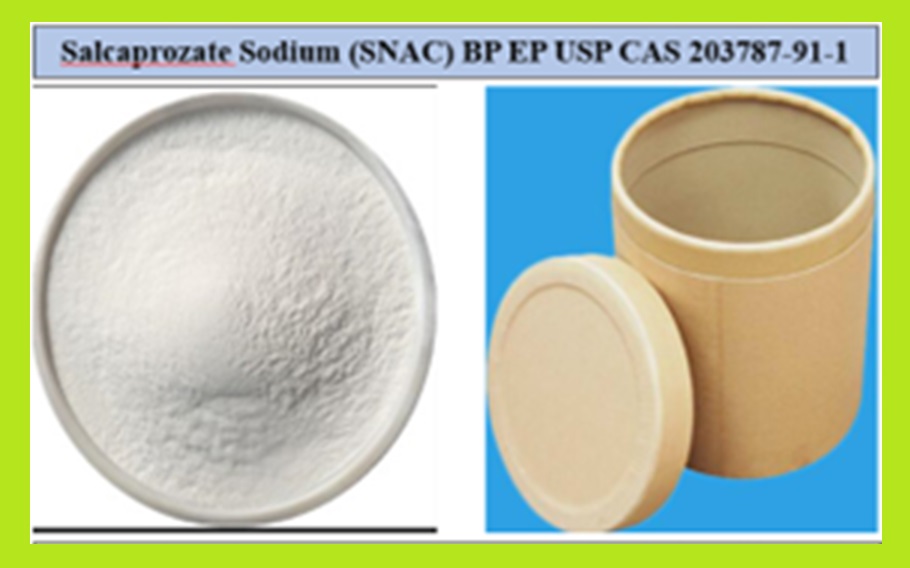
| Color | White to off-white |
| Appearance | Crystalline powder |
| Odor | Characteristic |
| Melting Point | 183 – 185 °C |
| Density | ~1.2 g/cm³ (estimated) |
| Hygroscopicity | Hygroscopic (absorbs moisture from air) |
| Particle Size (typical) | Varies by grade; typically micronized for pharmaceutical use |
3. SOLUBILITY PROPERTIES
| Solvent | Solubility |
|---|---|
| Water | ~33 mg/mL (moderately soluble) |
| DMSO (Dimethyl Sulfoxide) | Slightly soluble |
| Methanol | Slightly soluble |
| Ethanol | Slightly soluble |
| Acetone | Practically insoluble |
Note: SNAC has moderate aqueous solubility, which is sufficient for most pharmaceutical formulations.
4. CHEMICAL STRUCTURE
| Component | Structure |
|---|---|
| Salcaprozate | 8-(2-hydroxybenzamido)octanoate |
| Functional Groups | Amide, carboxylic acid (as sodium salt), phenolic OH |
| Structure Features | Aromatic ring (salicylamide derivative) + C8 aliphatic chain |
| Molecular Characteristics | Amphiphilic (both hydrophilic and lipophilic regions) |
Structural Note: The amphiphilic nature of SNAC (hydrophilic head from the sodium carboxylate and salicylamide, hydrophobic C8 tail) is critical for its absorption-enhancing mechanism. It interacts with cell membranes to facilitate paracellular and transcellular transport of poorly absorbed drugs.
5. SPECIFICATIONS (Typical – Pharmaceutical Grade)
| Parameter | Specification | Method |
|---|---|---|
| Assay (dried basis) | 98.0 – 102.0% | HPLC |
| Identification | Positive (IR, HPLC retention time) | IR / HPLC |
| Water Content (Karl Fischer) | ≤3.0% | Karl Fischer |
| pH (1% solution, 25°C) | 8.0 – 9.5 | Potentiometric |
| Heavy Metals (as Pb) | ≤10 ppm | AAS/ICP |
| Arsenic (As) | ≤1.5 ppm | AAS |
| Lead (Pb) | ≤1.5 ppm | AAS |
| Cadmium (Cd) | ≤1.0 ppm | AAS |
| Mercury (Hg) | ≤0.1 ppm | AAS |
| Residue on Ignition | ≤0.5% | Gravimetric |
| Loss on Drying | ≤3.0% | Gravimetric |
| Related Substances (HPLC) | ≤1.0% total | HPLC |
| Microbial Total Plate Count | ≤100 cfu/g | Plate Count |
| Yeast and Mold | ≤50 cfu/g | Plate Count |
| E. coli | Negative | PCR/Culture |
| Salmonella | Negative | PCR/Culture |
| Staphylococcus aureus | Negative | PCR/Culture |
6. MECHANISM OF ACTION
| Mechanism | Description |
|---|---|
| Membrane Fluidity Enhancement | SNAC intercalates into cell membranes, increasing fluidity and permeability |
| Paracellular Transport Enhancement | Temporarily opens tight junctions between epithelial cells |
| Transcellular Transport Enhancement | Facilitates transport across cell membranes via amphiphilic properties |
| Inhibition of Proteolytic Enzymes | May inhibit digestive enzymes (trypsin, chymotrypsin) in the GI tract |
| pH Modulation | Alters local pH microenvironment to reduce drug degradation |
| Micelle Formation | Forms micelles that encapsulate and protect drug molecules |
Primary Clinical Application: SNAC enables oral absorption of macromolecules (peptides, proteins) that are normally not absorbed orally due to their size, polarity, and susceptibility to enzymatic degradation.
7. FUNCTIONAL PROPERTIES
| Function | Description |
|---|---|
| Absorption Enhancer | Facilitates oral absorption of poorly permeable drugs (peptides, proteins, macromolecules) |
| Permeation Enhancer | Increases paracellular and transcellular transport across intestinal epithelium |
| Enzyme Inhibitor | Reduces proteolytic degradation of peptide drugs in the GI tract |
| Solubility Enhancer | Improves solubility of hydrophobic drugs |
| Stabilizer | Protects sensitive drug molecules from degradation |
| GRAS Status | Generally Recognized as Safe by FDA for use in medical foods |
8. APPLICATIONS – PHARMACEUTICAL (ORAL PEPTIDE DELIVERY)
| Drug/Therapeutic | Application | Clinical Status |
|---|---|---|
| Oral Semaglutide (Rybelsus®) | GLP-1 agonist for Type 2 diabetes | Approved (FDA, EMA) |
| Oral Insulin | Diabetes management | Clinical trials |
| Oral Heparin | Anticoagulation | Research stage |
| Oral Vitamin B12 | Supplement (with improved absorption) | Formulation use |
| Oral Calcitonin | Osteoporosis treatment | Research stage |
| Oral Octreotide | Acromegaly, neuroendocrine tumors | Research stage |
Key Success Story: SNAC is the enabling excipient in Rybelsus® (oral semaglutide), the first approved oral GLP-1 receptor agonist for Type 2 diabetes.
Typical Oral Semaglutide Formulation: SNAC content ~300 mg per tablet (co-formulated with semaglutide)
9. APPLICATIONS – OTHER PHARMACEUTICAL FORMULATIONS
| Application | Description |
|---|---|
| Solid Oral Dosage Forms | Tablets, capsules |
| Oral Solutions | Liquid formulations |
| Medical Foods | FDA-approved GRAS applications |
| Nutraceuticals | Absorption enhancement for supplements |
| Fixed-Dose Combinations | Co-formulation with proteolytic enzyme inhibitors |
10. FORMULATION CONSIDERATIONS
| Parameter | Recommendation |
|---|---|
| Dosage Form | Tablet (most common), capsule, or powder |
| Typical SNAC Content per Unit | 50 – 300 mg (depending on API and application) |
| Formulation pH | Near-neutral to slightly basic (SNAC salt form) |
| Compatibility | Compatible with most excipients; avoid strong acids |
| Processing | Direct compression, dry granulation, or wet granulation |
| Protection | Hygroscopic – use in dry environment with desiccant |
11. SYNERGISTIC COMPONENTS
| Component | Synergy Effect |
|---|---|
| Proteolytic Enzyme Inhibitors (e.g., Aprotinin) | Enhanced protection of peptide drugs |
| pH Modifiers (e.g., Citric Acid) | Improved solubility and stability |
| Surfactants | Additional permeation enhancement |
| Cyclodextrins | Increased solubility of poorly soluble APIs |
12. SAFETY AND TOXICOLOGICAL PROFILE
| Parameter | Value |
|---|---|
| Acute oral toxicity (rat, LD₅₀) | >2,000 mg/kg (low toxicity at therapeutic doses) |
| Chronic toxicity | No significant toxicity at therapeutic doses (300-600 mg/day in humans) |
| Genotoxicity | Negative |
| Carcinogenicity | Not classified as carcinogenic |
| Reproductive toxicity | No evidence at therapeutic doses |
| Local GI effects (human) | Well-tolerated; rare mild GI discomfort |
High-Dose Animal Studies: At very high doses (e.g., 2,000 mg/kg/day in animal studies), some adverse effects were observed. These doses are far above human therapeutic doses (~5-10 mg/kg/day).
13. POTENTIAL SIDE EFFECTS
| Effect | Frequency | Notes |
|---|---|---|
| Mild gastrointestinal discomfort | Rare | Nausea, diarrhea (typically mild and transient) |
| Electrolyte imbalance | Very rare (high-dose animal studies) | Not observed at human therapeutic doses |
| Allergic reaction | Very rare | Discontinue use if rash or itching occurs |
Contraindications:
-
Hypersensitivity to SNAC or any formulation component
-
Severe GI disorders (caution advised)
Note: SNAC is generally well-tolerated in humans at therapeutic doses (up to ~300 mg per dose).
14. DRUG INTERACTIONS
| Drug Class | Interaction Potential | Recommendation |
|---|---|---|
| Other oral peptide drugs | Potential additive absorption enhancement | Monitor; adjust dosing |
| Narrow therapeutic index drugs | Potential altered absorption | Monitor clinical response |
| Enteric-coated formulations | May affect coating integrity | Avoid co-administration |
| Acid-labile drugs | Altered local pH may affect stability | Evaluate compatibility |
15. GRAS STATUS AND REGULATORY APPROVALS
| Region/Agency | Status |
|---|---|
| FDA (USA) | GRAS (Generally Recognized as Safe) for use in medical foods |
| FDA (USA) | Approved as excipient in Rybelsus® (oral semaglutide) |
| EMA (Europe) | Approved for use in pharmaceutical formulations |
| PMDA (Japan) | Approved for use in pharmaceutical formulations |
| Türkiye (TGK) | Approved for use in pharmaceutical products |
GRAS Notice: SNAC has been reviewed and determined to be GRAS for use in medical foods at specified levels.
16. COMPARISON WITH OTHER ABSORPTION ENHANCERS
| Property | SNAC | Sodium Caprate (C10) | Sodium Salicylate | Chitosan |
|---|---|---|---|---|
| Primary Mechanism | Transcellular + Paracellular | Paracellular | Transcellular | Paracellular (tight junctions) |
| Approved Oral Peptide Drug | Semaglutide (Rybelsus®) | None | None | None |
| GRAS Status | Yes (medical foods) | Limited | No | Limited |
| GI Irritation Potential | Low | Moderate | Moderate | Low |
| Selectivity | High | Moderate | Low | Moderate |
17. STORAGE AND HANDLING
| Parameter | Requirement |
|---|---|
| Storage Temperature | 15-25°C (room temperature) |
| Humidity | Low humidity (<50% RH) – hygroscopic |
| Container | Tightly sealed (airtight), protected from moisture |
| Light Protection | Protect from direct sunlight |
| Shelf Life (proper storage) | 24-36 months |
| Signs of Degradation | Clumping, discoloration (yellowing), off-odor |
| Special Precautions | Store in original container with desiccant. Avoid exposure to high humidity. |
18. TRANSPORT INFORMATION
| Parameter | Information |
|---|---|
| UN Number | Not regulated (non-hazardous) |
| Transport Class | Not classified as dangerous goods |
| Packing Group | Not applicable |
| Marine Pollutant | No |
| IATA (Air) | Not restricted |
| IMDG (Sea) | Not regulated |
19. ENVIRONMENTAL INFORMATION
| Parameter | Assessment |
|---|---|
| Biodegradability | Limited data; expected to be biodegradable (aliphatic chain + aromatic ring) |
| Ecotoxicity | Low (therapeutic use only; environmental concentrations negligible) |
| Bioaccumulation | Low potential |
| Disposal | Dispose of in accordance with local regulations for pharmaceutical waste |
20. SUMMARY AND CRITICAL INFORMATION
Description: Salcaprozate Sodium (SNAC, CAS 203787-91-1) is an absorption-enhancing excipient specifically designed to enable oral delivery of macromolecules, particularly peptide and protein drugs. It is an amphiphilic molecule with a sodium carboxylate head, a salicylamide aromatic ring, and an 8-carbon aliphatic chain. SNAC facilitates both paracellular and transcellular transport of poorly absorbed drugs across the intestinal epithelium.
Key Advantages:
-
Enables oral administration of peptide drugs (e.g., semaglutide – Rybelsus®)
-
GRAS status for medical foods (FDA)
-
Well-tolerated in humans with low GI irritation
-
Dual mechanism: membrane fluidity enhancement + tight junction modulation
-
Enzyme inhibition (proteolytic protection)
-
Proven clinical success (Rybelsus® is first approved oral GLP-1 agonist)
Key Limitations/Considerations:
-
Hygroscopic – requires moisture-protected packaging and handling
-
Moderate water solubility (~33 mg/mL)
-
Higher cost compared to conventional excipients
-
Requires relatively high dose (~300 mg per tablet for semaglutide)
-
Not effective for all macromolecules
-
High-dose animal studies (2,000 mg/kg/day) showed some adverse effects (not relevant to human therapeutic doses)
Major Applications:
| Drug/Therapeutic | Application | Status |
|---|---|---|
| Oral Semaglutide (Rybelsus®) | Type 2 diabetes | FDA/EMA approved |
| Oral Insulin | Diabetes | Clinical trials |
| Oral Heparin | Anticoagulation | Research |
| Medical foods | Nutritional products | FDA GRAS |
Safety Summary:
-
Low acute toxicity at therapeutic doses (human dose ~5-10 mg/kg/day)
-
Non-genotoxic, non-carcinogenic
-
Well-tolerated; rare mild GI discomfort
-
GRAS status for medical foods (FDA)
-
Safe for use in approved pharmaceutical formulations
Formulation Summary:
-
Typical SNAC content per unit: 50 – 300 mg
-
Primary dosage form: Tablet (direct compression)
-
Compatible with most excipients
-
Process in low-humidity environment
Conclusion: Salcaprozate Sodium (SNAC) is a groundbreaking absorption enhancer that has enabled the first FDA-approved oral GLP-1 receptor agonist (Rybelsus®). Its dual mechanism of action (membrane fluidity enhancement + tight junction modulation), favorable safety profile, and GRAS status make it an enabling excipient for oral peptide delivery. While it has limitations (hygroscopicity, moderate solubility, cost), it remains the gold standard for oral absorption enhancement of macromolecules and continues to be researched for other peptide drugs (insulin, heparin, calcitonin).