We unleash your business potential by maximize the business innovation.
Send EmailMagnesium Oxide, Sintered Magnesite, Dead Burned Magnesia, DBM, 1309-42-8
SINTERED MAGNESITE
Product Name: Sintered Magnesite
Other Names: Dead Burned Magnesia (DBM), Sintered Magnesia, Refractory Magnesite, Magnesia Clinker
CAS Number: 1309-42-8 (Magnesium Oxide)
Chemical Formula: MgO
Chemical Class: Basic refractory oxide
SECTION 1: PRODUCT IDENTIFICATION AND DEFINITION
| Parameter | Information |
|---|---|
| Product Name | Sintered Magnesite (Dead Burned Magnesia – DBM) |
| Other Names | Dead Burned Magnesia, Sintered Magnesia, Refractory Magnesite, Magnesia Clinker, Periclase (mineralogical name for crystalline MgO) |
| CAS Number | 1309-42-8 |
| Chemical Formula | MgO |
| Chemical Class | Basic refractory oxide |
| Raw Material | Cryptocrystalline natural magnesite ore (MgCO₃) |
| Production Process | Sintering in rotary or shaft kilns at 1,800–2,200°C |
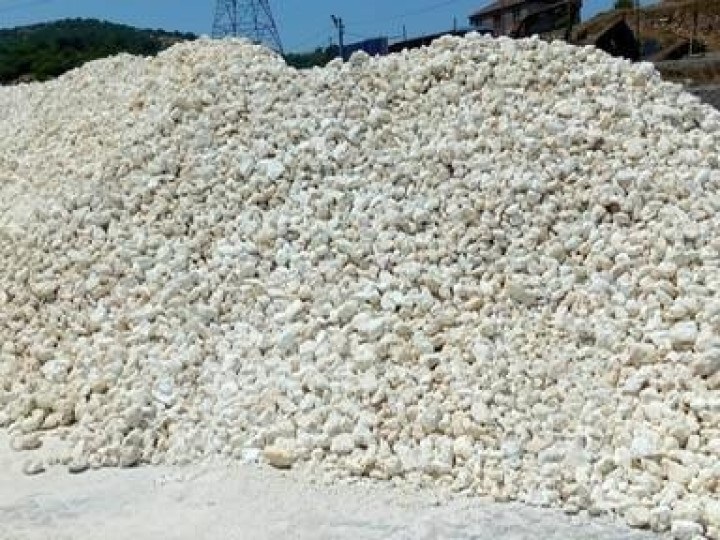
| Appearance | Light grey to white granules |
| Physical Structure | High density, low porosity, high hydration resistance |
SECTION 2: CHEMICAL COMPOSITION
| Grade | MgO (%) | SiO₂ (%) ≤ | CaO (%) ≤ | Fe₂O₃ (%) ≤ | LOI (%) ≤ |
|---|---|---|---|---|---|
| DBM 87 | ≥ 87.0 | 5.0 | 3.0 | - | 0.5 |
| DBM 90 | ≥ 90.0 | 4.5 | 1.8 | - | 0.3 |
| DBM 92 | ≥ 92.0 | 3.5 – 4.0 | 1.6 – 2.5 | - | 0.3 |
| DBM 95 | ≥ 94.5 – 95.0 | 2.0 – 2.5 | 2.0 | - | 0.3 |
| DBM 97 | ≥ 96.5 – 97.0 | 1.2 – 1.5 | 1.5 – 2.0 | - | 0.3 |
| DBM 98 | ≥ 97.5 – 98.0 | 0.6 | 1.0 | - | 0.3 |
SECTION 3: PHYSICAL PROPERTIES
| Property | Typical Value |
|---|---|
| Bulk Density | 3.00 – 3.30 g/cm³ |
| Apparent Porosity | 15 – 18% |
| Cold Crushing Strength (CCS) | 60 – 80 MPa |
| Refractoriness Under Load (RUL) @ 0.2 MPa | 1,540 – 1,700°C |
| Refractoriness | > 2,000°C |
| Thermal Conductivity | High (requires insulation in some applications) |
| Thermal Shock Resistance | Poor (requires temperature stability) |
| Hydration Resistance | High (stable in humid environments) |
SECTION 4: PRODUCTION PROCESS
| Stage | Description |
|---|---|
| 1. Mining | Extraction of cryptocrystalline natural magnesite ore |
| 2. Calcination | Raw magnesite (MgCO₃) is heated to decompose to MgO: MgCO₃ → MgO + CO₂ |
| 3. Grinding & Briquetting | Calcined magnesia is ground and formed into briquettes |
| 4. Sintering | High-temperature firing in rotary or shaft kilns at 1,800–2,200°C |
| 5. Cooling & Screening | Cooling and sizing to required particle sizes (0–15 mm or custom) |
Key Difference: Compared to caustic calcined magnesia (produced at 700-1,000°C), sintered magnesia is fired at much higher temperatures (>1,500°C), resulting in a dense, non-reactive, stable periclase structure .
SECTION 5: FUNCTIONAL PROPERTIES
| Property | Description |
|---|---|
| High Thermal Stability | Remains stable in extreme temperature environments; does not decompose at high temperatures |
| Low Slag Reactivity | Extends refractory service life in steel production; strong resistance to basic (alkaline) slag |
| High Hydration Resistance | Maintains stability in humid environments |
| Low Porosity | Provides mechanical strength and chemical resistance |
| High Bulk Density | Ensures durability and abrasion resistance |
| High Refractoriness | Refractoriness above 2,000°C |
| Dimensional Stability | Excellent volume stability at high temperatures |
Key Thermochemical Properties:
| Property | Value |
|---|---|
| Melting Point | ~2,852°C |
| Decomposition Temperature | Forms at >1,500°C from MgCO₃ |
| Highest Melting Point | Among all refractory oxides |
| Thermal Expansion | Volume stable at high temperatures |
SECTION 6: APPLICATIONS BY INDUSTRY
| Industry | Application |
|---|---|
| Refractory Industry | Brick and mortar production for steel, cement, and glass furnaces |
| Steel Production | Converter linings, electric arc furnace walls and bottoms, ladle linings, ferroalloy furnaces |
| Cement Kilns | Magnesite-alumina bricks in sintering zones |
| Glass Industry | Regenerator checker bricks in glass furnaces |
| Non-Ferrous Metallurgy | Copper, nickel, lead, zinc, tin smelting furnace linings |
| High-Temperature Kilns | Electrical resistance elements, lime kilns |
| Leather Industry | pH regulator in tanning baths |
| Insulation | Heating element insulation materials |
SECTION 7: GRADES AND STANDARDS
| Standard | Grade | MgO (%) | Typical Bulk Density (g/cm³) |
|---|---|---|---|
| ISO 10081-1 | MZ-87 | ≥ 87 | ≥ 2.90 |
| ISO 10081-1 | MZ-89 | ≥ 89 | ≥ 2.90 |
| ISO 10081-1 | MZ-91 | ≥ 91 | ≥ 2.90 |
| ISO 10081-1 | MZ-93 | ≥ 93 | ≥ 2.95 |
| ISO 10081-1 | MZ-95 | ≥ 95 | ≥ 2.95 |
| ISO 10081-1 | MZ-97 | ≥ 97 | ≥ 3.00 |
SECTION 8: OTHER NAMES AND SYNONYMS
| Name | Description / Context |
|---|---|
| Dead Burned Magnesia (DBM) | International technical name for sintered MgO form |
| DBM | Common abbreviation used in contracts and ERP systems |
| Refractory Magnesite | Widely used sector name in Turkey |
| Sintered Magnesia | Definition emphasizing the production process |
| Magnesia Clinker | Term used in refractory industry |
| Periclase | Mineralogical name for crystalline MgO |
| Magnesia | General commercial name; emphasizes high MgO content |
| Magnesite (incorrect usage) | Some sources confuse with raw MgCO₃ |
SECTION 9: NOTES AND CONFUSIONS
| Confusion | Clarification |
|---|---|
| Magnesite vs. Magnesia | Magnesite (MgCO₃ – carbonate) is often confused with Magnesia (MgO – oxide). Sintered magnesite is the oxide form, not the carbonate. |
| Visual Similarity | Sometimes confused with magnetite (Fe₃O₄) and howlite due to visual similarity |
| DBM Documentation | When "DBM" appears in commercial documents, MgO content and sintering temperature must always be specified |
SECTION 10: SAFETY, HANDLING AND REGULATORY INFORMATION
| Parameter | Information |
|---|---|
| REACH Registration | Mandatory for EU trade |
| GHS Classification | Not classified as toxic; however, dust control is recommended |
| Storage | Store in dry conditions; protect from moisture due to hydration risk |
| Incompatibilities | Contact with acid refractory materials should be avoided; basic refractory materials should not contact acid refractories at high temperatures |
| ERP Integration | MgO content, particle size, kiln temperature and hydration resistance must be clearly defined |
SECTION 11: SUMMARY AND CRITICAL NOTES
Product Summary
| Parameter | Value / Description |
|---|---|
| Product | Sintered Magnesite (Dead Burned Magnesia – DBM) |
| CAS Number | 1309-42-8 |
| Chemical Formula | MgO |
| Appearance | Light grey to white granules |
| MgO Content | 87 – 98% |
| Primary Function | Basic refractory raw material |
| Key Feature | High density, low porosity, high hydration resistance |
Critical Notes
-
Production Process: Sintered magnesite is produced by firing natural magnesite (MgCO₃) at high temperatures (1,800–2,200°C), resulting in dense, chemically stable, low-reactivity periclase .
-
Chemical Composition: MgO content typically ranges from 87% to 98%; different grades are available for different applications .
-
Primary Application: Approximately 70% of all magnesia production is used in the steel industry, with sintering constituting about 90% of global magnesia output .
-
Key Properties: High density, low porosity, high hydration resistance, and high refractoriness (>2,000°C) .
-
Hydration Resistance: Sintered magnesite is stable in humid environments—a critical property for storage and transport .
-
Refractory Value: MgO has the highest melting point among all refractory oxides and is the most suitable heat containment material for high-temperature processes .
-
Terminology Confusion: Magnesite (MgCO₃) and Magnesia (MgO) are frequently confused. Sintered magnesite is the oxide form .
-
Certification: Supplier verification of ore source, kiln parameters, and MgO analysis certificate should be requested.
IMPORTANT DECLARATION: This Technical Data Sheet (TDS) is for informational purposes only and has been prepared based on available technical data. The user is responsible for determining the product's suitability for their specific application and for complying with all local, national, and international regulations. For complete safety, storage, use, transport, waste, and regulatory compliance information, refer to the official Safety Data Sheet (SDS/MSDS) provided by the manufacturer/supplier.