We unleash your business potential by maximize the business innovation.
Send EmailCoconut Wax, Hydrogenated Coconut Oil Wax, Cocos Nucifera Wax, Coconut Candle Wax, 84836-98-6
COCONUT WAX (HYDROGENATED COCONUT OIL WAX)
Cocos Nucifera Wax - CAS: 84836-98-6
| Product Group | Vegetable Waxes - Hydrogenated Oils |
| CAS Number | 84836-98-6 |
ITEM 1: PRODUCT IDENTITY AND NOMENCLATURE
| Parameter | Description |
|---|---|
| Chemical Name | Hydrogenated Coconut Oil |
| INCI Name | Cocos Nucifera (Coconut) Oil Hydrogenated |
| Common Names | Coconut Wax, Hydrogenated Coconut Oil Wax, Cocos Nucifera Wax, Coconut Candle Wax |
| CAS Number | 84836-98-6 |
| EINECS / EC Number | 282-010-2 (Hydrogenated Coconut Oil) |
| REACH Registration Status | Registered and compliant |
| HS Code | 1516.20.00.00.00 |
Important Note: CAS 84836-98-6 is specifically for hydrogenated coconut oil (coconut wax). Do not confuse with CAS 8002-74-2 which belongs to paraffin wax. These are completely different products with distinct chemical structures and applications.
ITEM 2: CHEMICAL STRUCTURE AND COMPOSITION
| Parameter | Description |
|---|---|
| Chemical Family | Triglycerides (Hydrogenated Vegetable Oils) |
| Source | Coconut Oil (Cocos Nucifera) |
| Production Process | Hydrogenation of refined coconut oil |
| Hydrogenation Degree | Fully hydrogenated (iodine value < 1) |
| Ester Content | > 99% triglycerides |
| Free Fatty Acid Content | < 0.5% |
| Saponification Value | 245 – 265 mg KOH/g |
| Iodine Value | < 1 g I₂/100g |
| Unsaponifiable Matter | < 1.5% |
Description: Coconut wax is produced through the catalytic hydrogenation of refined coconut oil. This process converts unsaturated fatty acids into saturated fatty acids, resulting in a hard, stable wax with excellent oxidative stability and a high melting point compared to unhydrogenated coconut oil.
ITEM 3: FATTY ACID PROFILE
| Fatty Acid | Typical Composition (%) |
|---|---|
| Caprylic Acid (C8:0) | 5 – 10 |
| Capric Acid (C10:0) | 5 – 10 |
| Lauric Acid (C12:0) | 45 – 55 |
| Myristic Acid (C14:0) | 15 – 20 |
| Palmitic Acid (C16:0) | 7 – 10 |
| Stearic Acid (C18:0) | 2 – 5 |
| Oleic Acid (C18:1) | 5 – 10 |
| Linoleic Acid (C18:2) | < 2 |
Description: The high lauric acid content (45-55%) is the defining characteristic of coconut wax. This high level of medium-chain saturated fatty acids provides the wax with its unique hardness, high melting point, and excellent stability against oxidation.
ITEM 4: PHYSICAL APPEARANCE AND FORM
| Parameter | Specification | Test Method |
|---|---|---|
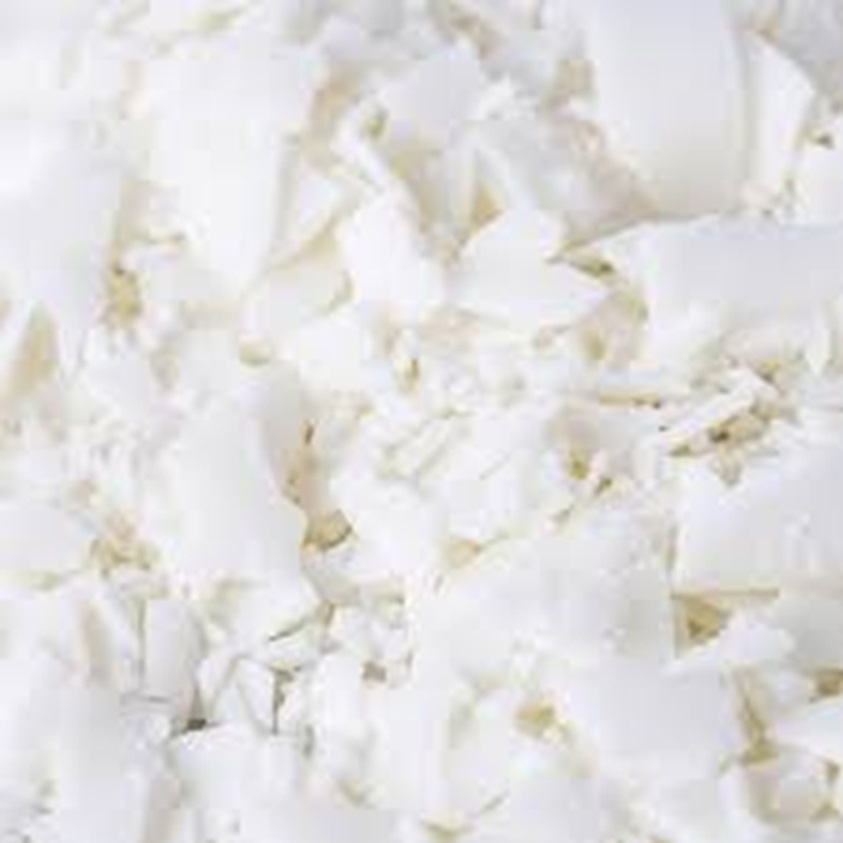
| Color | White to off-white | Visual Inspection |
| Form | Flakes, Granules or Blocks | Visual Inspection |
| Odor | Neutral to slight coconut scent | Organoleptic |
| Texture | Hard, waxy, non-greasy | Visual/Tactile |
| Impurities | None detectable | Visual Inspection |
| Heavy Metals | < 10 ppm | ICP-MS |
Description: The product is supplied as white to off-white solid wax in various physical forms to suit different processing requirements. Flakes and granules are preferred for melting and blending operations, while blocks are used for storage and transportation.
ITEM 5: PHYSICAL PROPERTIES - THERMAL
| Property | Specification | Typical Value | Test Method |
|---|---|---|---|
| Melting Point Range | 35 – 42 °C | 38 – 40 °C | ASTM D127 |
| Congealing Point | 35 – 40 °C | 37 °C | ASTM D938 |
| Boiling Point | ≥ 300 °C | > 300 °C | – |
| Flash Point | > 200 °C | 230 °C | ASTM D92 |
| Cloud Point | 32 – 38 °C | 35 °C | ASTM D2500 |
| Specific Heat Capacity | – | 2.1 J/g·K | DSC |
Description: The relatively low melting point (38-40°C) makes coconut wax ideal for candle applications where it melts just above room temperature, providing a clean, slow burn. The high flash point ensures safe processing and handling.
ITEM 6: PHYSICAL PROPERTIES - DENSITY
| Property | Specification | Typical Value | Test Method |
|---|---|---|---|
| Density at 25°C (Solid) | 0.95 – 0.98 g/cm³ | 0.96 g/cm³ | ASTM D792 |
| Density at 80°C (Liquid) | 0.85 – 0.90 g/cm³ | 0.88 g/cm³ | ASTM D792 |
| Specific Gravity (Solid) | 0.95 – 0.98 | 0.96 | ASTM D792 |
| Bulk Density (Flakes) | 450 – 550 kg/m³ | 500 kg/m³ | ASTM D1895 |
| Bulk Density (Granules) | 500 – 600 kg/m³ | 550 kg/m³ | ASTM D1895 |
Description: The density is slightly higher than water, meaning the solid wax sinks in water. The liquid density decreases significantly at elevated temperatures, which is important for volume calculations in melting and blending operations.
ITEM 7: HARDNESS AND TEXTURE PROPERTIES
| Property | Specification | Typical Value | Test Method |
|---|---|---|---|
| Penetration (25°C) | 10 – 20 dmm | 14 dmm | ASTM D1321 |
| Needle Penetration (25°C) | 10 – 20 1/10 mm | 14 1/10 mm | ASTM D5 |
| Drop Point | – | 40 – 42 °C | ASTM D127 |
| Break Point | – | 38 – 40 °C | – |
Description: Coconut wax has a medium hardness compared to other waxes. It is softer than carnauba wax but harder than soy wax. This balanced hardness provides good candle performance while being easy to handle and process.
ITEM 8: CHEMICAL AND SOLUBILITY PROPERTIES
| Property | Specification / Description |
|---|---|
| pH (at 25°C) | Neutral (7.0) |
| Solubility in Water | Insoluble |
| Solubility in Oils | Completely soluble (hot) |
| Solubility in Alcohols | Partially soluble (hot) |
| Solubility in Hydrocarbons | Completely soluble (hot) |
| Acid Value | < 0.5 mg KOH/g |
| Saponification Value | 245 – 265 mg KOH/g |
| Ester Value | 245 – 265 mg KOH/g |
| Peroxide Value | < 5 meq/kg |
Description: The product is highly hydrophobic and insoluble in water. It dissolves completely in hot oils, hydrocarbons, and organic solvents. The very low acid and peroxide values indicate high purity and excellent oxidative stability.
ITEM 9: THERMAL STABILITY AND DEGRADATION
| Property | Specification | Typical Value | Test Method |
|---|---|---|---|
| Onset Degradation (N₂) | ≥ 220 °C | 240 °C | TGA |
| Onset Degradation (Air) | ≥ 200 °C | 215 °C | TGA |
| Maximum Continuous Use Temp | – | 100 °C | – |
| Shelf Life (Unopened) | 24 months | 24 months | – |
| Oxidative Stability (Rancimat) | > 20 hours | 25 hours | AOCS Cd 12b-92 |
Description: Due to its fully hydrogenated structure (iodine value < 1), coconut wax exhibits exceptional oxidative stability. It resists rancidity and degradation significantly better than non-hydrogenated vegetable oils and waxes.
ITEM 10: ELECTRICAL PROPERTIES
| Property | Typical Value | Test Method |
|---|---|---|
| Dielectric Constant | 2.8 – 3.2 | ASTM D150 |
| Volume Resistivity | > 10¹⁴ Ω·cm | ASTM D257 |
| Dielectric Strength | 15 – 20 kV/mm | ASTM D149 |
Description: As a non-polar material, coconut wax provides good electrical insulation properties. This makes it suitable for certain electrical and electronic applications where wax-based insulation is required.
ITEM 11: CHEMICAL RESISTANCE PROFILE
| Chemical Type | Resistance Level |
|---|---|
| Water (All temperatures) | Excellent |
| Seawater | Excellent |
| Dilute Acids (pH 3-6) | Excellent |
| Dilute Bases (pH 8-11) | Excellent |
| Alcohols (Ethanol, Isopropanol) | Good (hot) |
| Glycols | Good |
| Vegetable Oils (Hot) | Complete solubility |
| Mineral Oils (Hot) | Complete solubility |
| Aromatic Solvents (Toluene, Xylene) | Complete solubility |
| Aliphatic Solvents (Hexane) | Complete solubility |
| Ketones (Acetone) | Complete solubility |
Description: The material is highly resistant to water and aqueous solutions. It is soluble in most organic solvents and oils at elevated temperatures. This solubility profile facilitates formulation development across multiple industries.
ITEM 12: REGULATORY AND SAFETY CLASSIFICATIONS
| Regulatory System | Status / Classification |
|---|---|
| TSCA (USA) | Listed and compliant |
| ECHA / REACH (EU) | Registered and compliant (84836-98-6) |
| WHMIS (Canada) | Not classified as hazardous |
| GHS / CLP | Not classified as hazardous |
| FDA 21 CFR | Approved for food contact (select grades) |
| Cosmetics Regulation (EU) | Approved - INCI listed |
| California Prop 65 | No warning required |
| DOT / IATA / IMDG | Not regulated for transport |
Description: Coconut wax is recognized as a safe substance across all major regulatory frameworks. It is not classified as hazardous under GHS/CLP and is approved for use in food, cosmetics, and personal care applications in most jurisdictions.
ITEM 13: HEALTH AND TOXICOLOGICAL PROFILE
| Parameter | Description |
|---|---|
| Acute Oral Toxicity | Low (LD50 > 5000 mg/kg) |
| Acute Dermal Toxicity | Low (LD50 > 2000 mg/kg) |
| Skin Irritation | Mild irritation possible |
| Eye Irritation | Mild irritation possible |
| Skin Sensitization | Not sensitizing |
| Carcinogenicity | Not classified |
| Mutagenicity | Not classified |
| Reproductive Toxicity | Not classified |
Description: Coconut wax has an excellent safety profile with very low toxicity. The main hazard is physical - dust particles may cause mechanical irritation to eyes and respiratory tract. In molten form, hot wax can cause thermal burns.
ITEM 14: ENVIRONMENTAL PROFILE
| Parameter | Description |
|---|---|
| Biodegradability | Readily biodegradable |
| Biodegradation Rate | > 60% within 28 days |
| Ecotoxicity (Aquatic) | Low toxicity (LC50 > 100 mg/L) |
| Persistence | Not persistent |
| Bioaccumulation Potential | Low (log Kow < 6) |
| VOC Content | < 100 ppm |
| Renewable Content | 100% plant-based |
Description: Coconut wax is an environmentally friendly, fully renewable material. It is readily biodegradable in aerobic conditions and has low toxicity to aquatic organisms. It does not contain volatile organic compounds (VOCs) in significant quantities.
ITEM 15: COSMETIC AND PERSONAL CARE APPLICATIONS
| Application | Function |
|---|---|
| Creams and Lotions | Emollient, skin-softening agent |
| Balms and Salves | Barrier protector, viscosity builder |
| Lipsticks and Lip Balms | Structuring agent, gloss enhancer |
| Body Butters | Texture modifier, occlusive agent |
| Hair Styling Products | Hold agent, shine enhancer |
| Massage Products | Slip agent, glide enhancer |
| Soaps | Hardness booster, superfatting agent |
| Sun Care Products | Water-resistance enhancer |
| Deodorants | Structure builder, stick formulator |
Description: In cosmetic applications, coconut wax functions as a natural, plant-based alternative to petroleum-derived waxes. It provides excellent skin feel, melts at body temperature, and forms a protective barrier without feeling greasy.
ITEM 16: CANDLE AND WAX APPLICATIONS
| Application | Function / Advantage |
|---|---|
| Container Candles | Base wax, excellent fragrance retention |
| Pillar Candles | Hardness enhancer, clean burn |
| Tealight Candles | Stable melt pool, slow burn rate |
| Votive Candles | Good surface finish, no wet spots |
| Aromatherapy Candles | Superior scent throw, neutral carrier |
| Wax Melts and Tarts | High fragrance load, long-lasting |
| Food Decorations | Edible wax coating (certified grade) |
| Cheese Coatings | Protective barrier (certified grade) |
| Fruit Coatings | Shine and protection (certified grade) |
Description: Coconut wax has become increasingly popular in candle manufacturing due to its clean burn, excellent fragrance retention, and natural origin. It burns slower and cleaner than paraffin wax, with no soot or harmful emissions.
ITEM 17: COATING AND TECHNICAL APPLICATIONS
| Application | Function |
|---|---|
| Plastics Processing | Internal lubricant, release agent |
| Rubber Industry | Processing aid, anti-tack agent |
| Polish Formulations | Structure builder, gloss enhancer |
| Paints and Coatings | Flow modifier, matting agent |
| Textile Finishing | Softening agent, lubrication |
| Paper Coating | Water resistance, surface slickness |
| Agricultural Formulations | Carrier for actives, binder |
| Explosives Manufacturing | Binder and plasticizer |
Description: In technical applications, coconut wax serves as a processing aid and functional additive. Its lubricating properties, low melt viscosity, and compatibility with various materials make it valuable across multiple industrial sectors.
ITEM 18: BLENDING AND COMPATIBILITY
| Material | Compatibility Level |
|---|---|
| Paraffin Wax | High compatibility |
| Soy Wax | High compatibility |
| Beeswax | High compatibility |
| Candelilla Wax | High compatibility |
| Carnauba Wax | Medium compatibility |
| Microcrystalline Wax | High compatibility |
| Stearic Acid | High compatibility |
| Vegetable Oils | Complete miscibility (hot) |
| Mineral Oils | Complete miscibility (hot) |
| Aliphatic Hydrocarbons | Complete miscibility |
| Aromatic Solvents | Complete miscibility |
Description: Coconut wax blends well with most natural and synthetic waxes. This makes it an excellent formulation component for creating customized wax blends with specific properties such as melting point, hardness, and appearance.
ITEM 19: RECOMMENDED PROCESSING PARAMETERS
| Parameter | Recommendation / Value |
|---|---|
| Melting Temperature | 45 – 60°C |
| Processing Temperature | 60 – 80°C |
| Maximum Safe Temperature | < 100°C (avoids discoloration) |
| Pouring Temperature | 55 – 65°C (for candles) |
| Cooling Rate | 1 – 2°C per minute (slow for crystal structure) |
| Storage Temperature | 10 – 30°C |
| Pre-melting Time | 60 – 90 minutes (at 60-70°C) |
| Re-melting Limit | < 3 times (quality degradation) |
Description: Proper temperature control is essential for achieving consistent results. Heating above 100°C can cause discoloration and thermal degradation. Slow cooling promotes better crystal structure and surface appearance in candles.
ITEM 20: PACKAGING, STORAGE AND SHELF LIFE
| Parameter | Description |
|---|---|
| Standard Packaging | 25 kg multi-layer kraft paper bags with PE liner |
| Bulk Packaging | 500 – 1000 kg big-bags |
| Liquid Bulk | 20 – 25 MT ISO containers (heated) |
| Storage Conditions | Cool, dry, well-ventilated area |
| Storage Temperature | 10 – 30°C |
| Avoid Contact With | Strong oxidizing agents, acids |
| Shelf Life (Unopened) | 24 months |
| Shelf Life (Opened) | 12 months (properly closed) |
| Signs of Degradation | Rancid odor, discoloration, stickiness |
Description: Store in original packaging in a cool, dry place away from direct sunlight and heat sources. Protect from moisture and strong oxidizing agents. When stored properly, the product maintains its quality for up to 24 months.
ITEM 21: HANDLING AND SAFETY PRECAUTIONS
| Parameter | Description |
|---|---|
| Dust Formation | Avoid creating dust clouds |
| Personal Protective Equipment | Safety glasses, dust mask, gloves |
| Ventilation | Adequate general ventilation recommended |
| Fire Extinguishing | CO₂, dry chemical powder, foam, water spray |
| Fire Class | Class B (flammable organic material) |
| Flash Point | > 200°C (safe to 180°C) |
| Avoid During Handling | Open flames, sparks, static electricity |
| Spill Cleanup | Scoop up solid; absorb liquid with inert material |
| Waste Disposal | Comply with local and international regulations |
Description: While coconut wax is considered safe, general industrial hygiene practices should be followed. Dust particles may form explosive mixtures with air. The product should not be handled near open flames or ignition sources.
ITEM 22: REGULATORY AND CERTIFICATION STATUS
| Certificate / Standard | Status |
|---|---|
| ISO 9001:2015 | Applicable manufacturing sites |
| ISO 14001:2015 | Applicable manufacturing sites |
| REACH (EC 1907/2006) | Full compliance |
| FDA 21 CFR 177.1770 | Approved (select grades) |
| Halal Certification | Available upon request |
| Kosher Certification | Available upon request |
| COSMOS / Ecocert | Available for select grades |
| Soil Association | Available for select grades |
| Organic Certification | Available for select grades |
Description: Coconut wax is available in various certification grades to meet specific market requirements. Halal, Kosher, and organic certifications can be provided depending on the manufacturing batch and production line.
ITEM 23: TRANSPORT INFORMATION
| Parameter | Classification |
|---|---|
| UN Number | Not regulated |
| DOT Classification | Not hazardous |
| IMDG Classification | Not hazardous |
| IATA Classification | Not hazardous |
| ADR/RID Classification | Not hazardous |
| Transport Temperature (Solid) | Ambient |
| Transport Temperature (Liquid) | > 45°C (heated tanks) |
| Packaging Group | Not applicable |
| Marine Pollutant | No |
Description: Coconut wax is not classified as dangerous goods for transport. Solid forms can be transported at ambient temperatures. Liquid forms require heated tankers or ISO containers maintained at 45-60°C.
ITEM 24: SPECIFICATION SUMMARY TABLE
| Property | Minimum | Maximum | Typical | Unit |
|---|---|---|---|---|
| Melting Point | 35 | 42 | 38-40 | °C |
| Density (Solid, 25°C) | 0.95 | 0.98 | 0.96 | g/cm³ |
| Acid Value | – | 0.5 | 0.2 | mg KOH/g |
| Saponification Value | 245 | 265 | 255 | mg KOH/g |
| Iodine Value | – | 1 | 0.5 | g I₂/100g |
| Peroxide Value | – | 5 | 2 | meq/kg |
| Penetration (25°C) | 10 | 20 | 14 | 1/10 mm |
| Flash Point | 200 | – | 230 | °C |
| Heavy Metals (Pb) | – | 10 | < 5 | ppm |
| Arsenic (As) | – | 3 | < 1 | ppm |
| Shelf Life | 24 | – | 24 | months |
ITEM 25: TURKISH MARKET ALIASES AND LOCAL TERMS
| Turkish Term | English Equivalent |
|---|---|
| Hindistan Cevizi Mumu | Coconut Wax |
| Hindistan Cevizi Yağı Bazlı Mum | Coconut Oil Based Wax |
| Katı Hindistan Cevizi Yağı | Solid Coconut Oil |
| Doğal Hindistan Cevizi Mumu | Natural Coconut Wax |
| Hindistan Cevizi Taban Mum | Coconut Base Wax |
| Hindistan Cevizi Karışım Mum | Coconut Blend Wax |
| Hindistan Cevizi Mum Granülü | Coconut Wax Granules |
| Hindistan Cevizi Mum Pul | Coconut Wax Flakes |
| Hindistan Cevizi Beyaz Mum | White Coconut Wax |
| Hindistan Cevizi Mum Esası | Coconut Wax Base |
| Hindistan Cevizi Balmumu | Coconut Wax (archaic) |
| Hindistan Cevizi Bitkisel Mum | Coconut Vegetable Wax |
| Hindistan Cevizi Krem Mum | Cream Coconut Wax |
Description: This list provides all local market equivalents and aliases for ERP system integration, procurement systems, and sales documentation in the Turkish market. CAS 84836-98-6 is the definitive identifier regardless of the local name used.
ITEM 26: INDUSTRY COMPATIBILITY MATRIX
| Industry | Suitability | Primary Functions |
|---|---|---|
| Candle Manufacturing | Excellent | Base wax, fragrance carrier, burn regulator |
| Cosmetics | Excellent | Emollient, structuring agent, barrier enhancer |
| Personal Care | Excellent | Skin-softening, viscosity builder, surface modifier |
| Food Industry | Good (select grades) | Coating agent, glazing agent (E907 alternative) |
| Pharmaceutical | Good | Ointment base, tablet coating, suppository base |
| Plastics / Plastisols | Moderate | Lubricant, release agent, density modifier |
| Textile | Moderate | Softener, lubricant, finishing agent |
| Polish & Coatings | Good | Structure builder, shine enhancer, leveling agent |
| Paper | Moderate | Coating additive, water repellent |
| Agricultural | Good | Carrier for active ingredients, binder |
Description: The compatibility matrix provides a quick reference for determining suitability across industries. "Excellent" indicates established industrial usage, "Good" indicates proven applications, and "Moderate" indicates potential applications requiring testing.
SECTOR COMPATIBILITY SUMMARY FOR ALL WAX TYPES (No Emojis)
| Product | CAS No | Food | Cosmetics | Candles | Packaging | Textile | Description |
|---|---|---|---|---|---|---|---|
| Carnauba Wax | 8015-86-9 | Suitable | Suitable | Limited | Limited | Suitable | E903 food additive; high gloss, high melting point |
| Fully Refined Paraffin | 8002-74-2 | Limited | Limited | Suitable | Suitable | Suitable | Low oil content; technical and packaging use |
| Coconut Wax | 84836-98-6 | Suitable | Suitable | Suitable | Not suitable | Not suitable | Soft structure; ideal for aromatherapy candles |
| Stearic Acid 1865 | 57-11-4 | Suitable | Suitable | Suitable | Limited | Limited | Hardener for waxes; widely used in soaps |
| Polyethylene Wax | 9002-88-4 | Not suitable | Not suitable | Limited | Suitable | Suitable | Rheology modifier; PVC and plastisol additive |
| Liquid Paraffin | 8042-47-5 | Suitable | Suitable | Not suitable | Limited | Suitable | BP/USP/IP compliant; pharmaceutical and cosmetic |
| Semi Refined Paraffin | 8002-74-2 | Not suitable | Limited | Suitable | Suitable | Suitable | Technical grade; packaging and textile use |
| Palm Wax | 68440-10-6 | Not suitable | Limited | Suitable | Suitable | Limited | Crystalline appearance; widely used in candles |
| Soy Wax | 8016-70-4 | Suitable | Suitable | Suitable | Not suitable | Not suitable | Clean burning; massage and natural candles |
| Rice Bran Wax | 8016-60-2 | Limited | Suitable | Suitable | Limited | Limited | Hardener in stick formulations |
| Beeswax | 8012-89-3 | Suitable | Suitable | Suitable | Limited | Limited | E901 food additive; emulsifying agent |
| Microcrystalline Wax | 63231-60-7 | Limited | Suitable | Suitable | Suitable | Limited | High viscosity; barrier and carrier |
| Slack Wax | 64742-61-6 | Not suitable | Not suitable | Suitable | Suitable | Suitable | Refinery by-product; low purity, technical grade |
| Candelilla Wax | 8006-44-8 | Suitable | Suitable | Limited | Limited | Limited | Vegan alternative; lipsticks and lip balms |
Legend: Suitable = Fully compatible and approved | Limited = Conditional use, requires testing | Not suitable = Not recommended for the application
QUALITY AND CERTIFICATION INFORMATION
| Certificate / Standard | Status |
|---|---|
| ISO 9001:2015 | Certified manufacturing sites |
| REACH (EC 1907/2006) | Full compliance (CAS 84836-98-6 registered) |
| FDA 21 CFR 177.1770 | Select grades approved for food contact |
| Halal Certification | Available upon request |
| Kosher Certification | Available upon request |
| GMP (Good Manufacturing Practices) | Applicable for cosmetic and food grades |