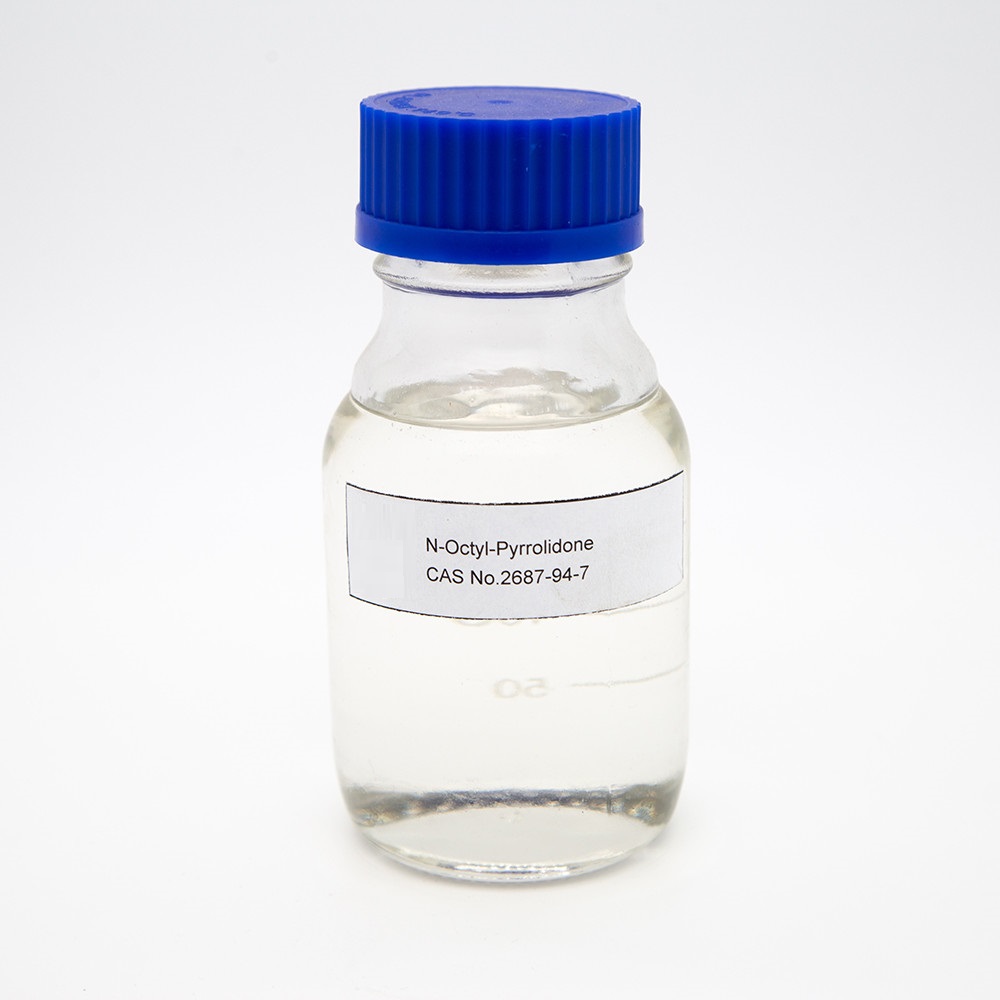
Octyl Pyrrolidone, N-Octyl-2-pyrrolidone, 1-Octyl-2-pyrrolidone, N-Octylpyrrolidone, N-Octylbutyrolactam, NOP, 2687-94-7
N-OCTYL-2-PYRROLIDONE (NOP)
CAS Number: 2687-94-7
EC Number (EINECS): 403-700-8
Molecular Formula: C₁₂H₂₃NO
Molecular Weight: 197.32 g/mol
UNSPSC Code: 12352100
GTIP Code: 2933.99.00
SECTION 1: PRODUCT IDENTIFICATION AND CHEMICAL IDENTITY
| Parameter |
Description |
| Chemical Name (IUPAC) |
1-Octylpyrrolidin-2-one |
| Other Names |
N-Octyl-2-pyrrolidone, N-Octylpyrrolidone, N-Octylbutyrolactam, NOP, Octyl Pyrrolidone, 1-Octyl-2-pyrrolidone |
| CAS Number |
2687-94-7 |
| EC Number (EINECS) |
403-700-8 |
| Molecular Formula |
C₁₂H₂₃NO |
| Molecular Weight |
197.32 g/mol |
| Chemical Class |
Lactam (pyrrolidone derivative) |
| Structure |
Five-membered lactam ring with octyl substituent at nitrogen position |
| Appearance |
Colorless to yellowish liquid |
| Odor |
Mild characteristic |
| UNSPSC Code |
12352100 |
| GTIP Code |
2933.99.00 |
SECTION 2: PHYSICAL AND CHEMICAL PROPERTIES
| Property |
Value / Range |
| Molecular Formula |
C₁₂H₂₃NO |
| Molecular Weight |
197.32 g/mol |
| Appearance |
Colorless to yellowish liquid |
| Odor |
Mild characteristic |
| Melting Point |
~ -25°C |
| Boiling Point |
170 - 172°C (at 15 mmHg) |
| Density (25°C) |
~0.92 g/cm³ |
| Refractive Index (n²⁰D) |
1.465 |
| Flash Point |
> 230°F (~110°C) |
| Vapor Pressure (20°C) |
0.03 - 0.08 Pa |
| Solubility in Water |
Limited (~1.2 g/L at 20°C) |
| Solubility in Organic Solvents |
Soluble in most organic solvents (alcohols, ketones, esters, hydrocarbons) |
| pH (1% aqueous) |
~7.0 (neutral) |
| Water Hazard Class (WGK Germany) |
WGK 2 (moderate hazard to water) |
| Viscosity (25°C) |
~15 cP |
SECTION 3: SOLUBILITY PROFILE
| Solvent |
Solubility |
Condition |
| Water |
Limited (~1.2 g/L) |
20°C |
| Methanol |
Completely miscible |
- |
| Ethanol |
Completely miscible |
- |
| Acetone |
Completely miscible |
- |
| Ethyl Acetate |
Completely miscible |
- |
| Toluene |
Completely miscible |
- |
| Xylene |
Completely miscible |
- |
| Mineral Oils |
Completely miscible |
- |
| Aliphatic Hydrocarbons |
Completely miscible |
- |
| Aromatic Hydrocarbons |
Completely miscible |
- |
Critical Note: NOP has limited water solubility (~1.2 g/L) but is completely miscible with most organic solvents. Its amphiphilic nature (polar lactam ring + hydrophobic octyl chain) provides excellent solvency for both polar and non-polar substances.
SECTION 4: CHEMICAL PROPERTIES AND REACTIONS
| Property |
Description |
| Chemical Class |
Lactam (pyrrolidone derivative) |
| Functional Group |
Amide (lactam ring) with octyl substituent |
| Reactivity |
Low under normal conditions |
| N-Alkylation |
Can be used for synthesis of pyrrolidone derivatives |
| Solvation |
High solvency for both polar and apolar substances |
| Surface Activity |
Low foaming profile; acts as dispersion enhancer |
| Thermal Decomposition |
> 300°C releases nitrogen oxides (NOₓ), carbon oxides |
| Oxidation |
Stable under normal conditions |
4.1. Key Reactions
| Reaction Type |
Description |
| N-Alkylation |
Used in synthesis of pyrrolidone derivatives |
| Hydrolysis |
Slow hydrolysis in strong acidic/basic conditions |
| Ring Opening |
Under extreme conditions, lactam ring may open |
4.2. Stability
| Parameter |
Information |
| Thermal Stability |
Stable up to ~250°C |
| Hydrolytic Stability |
Stable at neutral pH; slow hydrolysis in strong acids/bases |
| Oxidation Stability |
Good |
| Incompatibilities |
Strong oxidizers, strong acids (at elevated temperature), strong bases (at elevated temperature) |
| Decomposition Products |
Nitrogen oxides (NOₓ), CO, CO₂ |
SECTION 5: SPECTRAL DATA
| Parameter |
Value |
| FTIR (KBr, cm⁻¹) |
2950 (C-H aliphatic), 1680 (C=O amide), 1460 (C-H bend), 1280 (C-N), 1120 (C-C) |
| ¹H-NMR (CDCl₃, ppm) |
3.40 (t, 2H, N-CH₂), 3.30 (t, 2H, ring CH₂-N), 2.40 (t, 2H, ring CH₂-CO), 2.00 (m, 2H, ring CH₂), 1.60 (m, 2H, octyl CH₂), 1.30 (m, 10H, octyl CH₂), 0.90 (t, 3H, octyl CH₃) |
| ¹³C-NMR (CDCl₃, ppm) |
175.0 (C=O), 49.0 (N-CH₂), 42.0 (ring CH₂-N), 31.0 (ring CH₂-CO), 29.0 (ring CH₂), 28.0-22.0 (octyl CH₂), 14.0 (octyl CH₃) |
| Mass Spectrometry (EI-MS) |
197 [M]⁺, 126 [M-C₅H₁₁]⁺, 84 [C₄H₆NO]⁺ |
SECTION 6: PURITY AND QUALITY SPECIFICATIONS
| Parameter |
Standard Grade |
High Purity Grade |
| Purity (GC) |
≥ 98.0% |
≥ 99.0% |
| Appearance |
Colorless to yellowish liquid |
Colorless liquid |
| Color (APHA) |
≤ 100 |
≤ 50 |
| Density (25°C) |
0.918 - 0.924 g/cm³ |
0.920 - 0.922 g/cm³ |
| Refractive Index (n²⁰D) |
1.464 - 1.466 |
1.465 - 1.466 |
| Water Content (KF) |
≤ 0.5% |
≤ 0.2% |
| Acid Value |
≤ 0.5 mg KOH/g |
≤ 0.2 mg KOH/g |
| Ash Content |
≤ 0.1% |
≤ 0.05% |
| Color (Hazen) |
≤ 100 |
≤ 50 |
SECTION 7: MAJOR APPLICATIONS AND END-USES
7.1. Cleaning Products
| Application |
Function |
Suitability |
| Low-Foaming Surfactant |
Provides cleaning action with low foam profile |
High |
| Solvent |
Dissolves oils, greases, and other hydrophobic substances |
High |
| Hard Surface Cleaners |
Effective degreaser for industrial and household applications |
High |
| Metal Cleaning |
Surface-active solvent for metal degreasing |
High |
7.2. Agricultural Chemicals
| Application |
Function |
Suitability |
| Pesticide Formulations |
Co-solvent, improves active ingredient solubility |
High |
| Herbicide Adjuvants |
Enhances absorption and efficacy |
High |
| Fungicide Formulations |
Solubilizer and dispersant |
High |
| Insecticide Formulations |
Carrier solvent |
High |
7.3. Inks and Printing
| Application |
Function |
Suitability |
| Offset Printing Systems |
Wetting agent, improves ink flow |
High |
| Printing Inks |
Solvent and dispersant |
High |
| Flexographic Inks |
Carrier solvent |
High |
7.4. Rubber and Fillers
| Application |
Function |
Suitability |
| Silica Dispersion |
Wetting agent for silica and pigments |
High |
| Pigment Dispersion |
Dispersant for pigments in rubber compounds |
High |
| Filler Wetting |
Improves filler incorporation |
High |
7.5. Veterinary Pharmaceuticals
| Application |
Function |
Suitability |
| Injectable Formulations |
Co-solvent and solubilizer |
High |
| Topical Formulations |
Penetration enhancer |
High |
| Oral Formulations |
Solubilizer |
High |
7.6. Specialty Applications
| Application |
Function |
Suitability |
| Coatings |
Solvent and coalescent |
Moderate |
| Electronics Cleaning |
Cleaning solvent for electronic components |
Moderate |
| Paint Strippers |
Active solvent |
Moderate |
SECTION 8: INDUSTRY SUITABILITY MATRIX
| Industry |
Suitability |
Explanation |
| Cleaning Products |
High |
Low-foaming surfactant and solvent for hard surface cleaning |
| Agricultural Chemicals |
High |
Co-solvent for pesticide formulations |
| Inks & Printing |
High |
Wetting agent for offset printing systems |
| Rubber & Fillers |
High |
Wetting agent for silica and pigment dispersion |
| Veterinary Pharmaceuticals |
High |
Co-solvent for injectable formulations |
| Metal Cleaning |
High |
Surface-active solvent for degreasing |
| Electronics |
Moderate |
Cleaning solvent for electronic components |
| Coatings |
Moderate |
Solvent and coalescent |
| Cosmetics |
Limited |
Not widely used in personal care |
| Food |
Not suitable |
Not approved as food additive |
SECTION 9: TYPICAL USE LEVELS
| Application |
Typical Use Level |
| Cleaning Formulations |
1% - 10% |
| Pesticide Systems |
5% - 15% (co-solvent) |
| Ink & Printing Systems |
2% - 8% (wetting agent) |
| Rubber/Filler Systems |
1% - 5% (wetting/dispersant) |
| Veterinary Formulations |
1% - 10% (co-solvent) |
SECTION 10: OTHER NAMES AND IDENTIFIERS
| Type |
Name / Description |
| IUPAC Name |
1-Octylpyrrolidin-2-one |
| Commercial Names |
NOP, N-Octyl-2-pyrrolidone, Octyl Pyrrolidone |
| Synonyms |
N-Octylpyrrolidone, N-Octylbutyrolactam, 1-Octyl-2-pyrrolidone |
| Common Names |
Low-foaming pyrrolidone solvent, Agricultural additive, NOP solvent |
| CAS Number |
2687-94-7 |
| EC Number |
403-700-8 |
| UNSPSC Code |
12352100 |
| GTIP Code |
2933.99.00 |
SECTION 11: PRODUCTION METHOD
| Parameter |
Description |
| Method |
2-Pyrrolidone + 1-Bromooctane → N-Octyl-2-pyrrolidone |
| Catalyst |
Tetrabutylammonium bromide (phase transfer catalyst) |
| Temperature |
~90°C |
| Duration |
~10 hours |
| Purity |
≥ 98% (confirmed by GC) |
| Yield |
High (typical industrial process) |
SECTION 12: ALTERNATIVE PRODUCTS
| Alternative |
CAS Number |
Description |
| N-Methyl-2-pyrrolidone (NMP) |
872-50-4 |
More polar, more water-soluble |
| 1-Dodecyl-2-pyrrolidone |
2687-96-9 |
More hydrophobic, longer chain alternative |
| Propylene Carbonate |
108-32-7 |
More environmentally friendly aprotic solvent |
| 2-Pyrrolidone |
616-45-5 |
Precursor for NOP production |
| N-Ethyl-2-pyrrolidone (NEP) |
2687-91-4 |
Shorter chain analogue |
SECTION 13: COMPARISON OF PYRROLIDONE DERIVATIVES
| Property |
NOP (C₈) |
NMP (C₁) |
NEP (C₂) |
NDP (C₁₂) |
| Carbon Chain Length |
8 |
1 |
2 |
12 |
| Water Solubility |
Limited (1.2 g/L) |
Miscible |
Miscible |
Very low |
| Hydrophobicity |
Moderate |
Low |
Low |
High |
| Foam Profile |
Low |
Moderate |
Moderate |
Very low |
| Agricultural Use |
Yes |
Yes |
Yes |
Limited |
| Cleaning Use |
Yes |
Yes |
Yes |
Yes |
| Ink Use |
Yes |
Limited |
Limited |
Yes |
SECTION 14: TOXICOLOGY AND HEALTH EFFECTS
| Parameter |
Value / Description |
| GHS Classification |
Warning |
| Hazard Statements |
H315 (Causes skin irritation), H319 (Causes serious eye irritation), H335 (May cause respiratory irritation) |
| Precautionary Statements |
P261 (Avoid breathing dust/fume/gas/mist/vapors/spray), P280 (Wear protective gloves/protective clothing/eye protection/face protection), P302+P352 (IF ON SKIN: Wash with plenty of water), P305+P351+P338 (IF IN EYES: Rinse cautiously with water) |
| Oral LD50 (Rat) |
> 2,000 mg/kg |
| Dermal LD50 (Rabbit) |
> 2,000 mg/kg |
| Skin Irritation |
Mild irritant |
| Eye Irritation |
Mild irritant |
| Skin Sensitization |
Not sensitizing |
| Mutagenicity |
Negative (Ames test) |
| Carcinogenicity |
Not classified |
| Reproductive Toxicity |
Not classified |
| Target Organs |
Skin, eyes, respiratory system |
SECTION 15: ECOTOXICOLOGY AND ENVIRONMENTAL BEHAVIOR
| Parameter |
Value / Description |
| Fish Toxicity (LC50, 96 hours) |
> 100 mg/L |
| Daphnia Toxicity (EC50, 48 hours) |
> 100 mg/L |
| Algae Toxicity (EC50, 72 hours) |
> 100 mg/L |
| Biodegradability |
Readily biodegradable (OECD 301) |
| Bioaccumulation Factor (BCF) |
Low (LogP ~ 3.0) |
| Hydrolysis |
Not hydrolytically degradable (stable) |
| Soil Mobility |
Moderate |
| Bioaccumulation Potential |
Low to moderate |
| Persistence |
Low (readily biodegradable) |
| Water Hazard Class (WGK Germany) |
WGK 2 (moderate hazard to water) |
Ecotoxicological Summary: NOP is readily biodegradable (OECD 301) and has low to moderate bioaccumulation potential. It shows moderate aquatic toxicity (LC₅₀ > 100 mg/L). Classified as WGK 2 (moderate hazard to water).
SECTION 16: SAFETY MEASURES AND PERSONAL PROTECTIVE EQUIPMENT
| Parameter |
Information |
| Respiratory Protection |
Organic vapor cartridge (at elevated temperatures or mist formation) |
| Gloves |
Chemically resistant (nitrile, neoprene) |
| Eye Protection |
Chemical safety goggles |
| Body Protection |
Chemical-resistant apron |
| Ventilation |
Local exhaust ventilation and general ventilation |
| Engineering Controls |
Closed systems when possible |
SECTION 17: STORAGE INFORMATION
| Parameter |
Information |
| Storage Conditions |
Cool, dry, well-ventilated area |
| Temperature |
15 - 30°C |
| Container |
Tightly closed metal drums, IBC tanks |
| Materials to Avoid |
Fire, direct sunlight, strong oxidizers, strong acids, strong bases |
| Moisture Sensitivity |
Low |
| Shelf Life |
24 months (under recommended conditions) |
| Packaging |
200 kg drum, 1000 kg IBC |
SECTION 18: TRANSPORT INFORMATION
| Parameter |
Information |
| UN Number |
Not regulated (not classified as dangerous goods) |
| Hazard Class |
Not applicable |
| Packing Group |
Not applicable |
| Proper Shipping Name |
N-Octyl-2-pyrrolidone |
| ADR/RID |
Not regulated |
| IMDG Code |
Not regulated |
| IATA (Air) |
Not regulated |
| Marine Pollutant |
No |
| Transport Notes |
Keep away from heat; prevent leakage |
SECTION 19: FIRE-FIGHTING MEASURES
| Parameter |
Information |
| Fire Hazard |
Combustible (flash point > 110°C) |
| Extinguishing Media |
Water fog, foam, CO₂, dry chemical |
| Special Hazards |
When heated, releases nitrogen oxides (NOₓ), CO, CO₂ |
| Decomposition Products |
Nitrogen oxides (NOₓ), CO, CO₂ |
| Protective Equipment |
Self-contained breathing apparatus (SCBA), full protective clothing |
| Explosion Risk |
Vapor/air mixtures potentially explosive |
| Water Use |
Prevent fire-fighting water from entering the environment |
SECTION 20: SUMMARY AND CRITICAL WARNINGS
Product Summary
| Parameter |
Value |
| Product |
N-Octyl-2-pyrrolidone (NOP) |
| CAS |
2687-94-7 |
| Appearance |
Colorless to yellowish liquid |
| Density (25°C) |
~0.92 g/cm³ |
| Boiling Point |
170 - 172°C (at 15 mmHg) |
| Water Solubility |
Limited (~1.2 g/L) |
| Flash Point |
> 110°C |
| Key Industries |
Cleaning, agriculture, inks, rubber, veterinary |
CRITICAL WARNINGS
-
Amphiphilic Nature: NOP's structure (polar lactam ring + hydrophobic octyl chain) provides excellent solvency for both polar and non-polar substances, making it versatile for multiple applications.
-
Low-Foaming Profile: NOP is characterized by its low-foaming properties, making it particularly suitable for cleaning applications where foam suppression is required.
-
Agricultural Use: Widely used as a co-solvent in pesticide, herbicide, fungicide, and insecticide formulations at 5-15% concentration.
-
Biodegradability: Readily biodegradable (OECD 301) with low bioaccumulation potential, making it more environmentally friendly than some alternatives.
-
Not for Food Use: NOP is not approved as a food additive. Use only in technical and industrial applications.
-
Water Solubility: Limited water solubility (~1.2 g/L) should be considered when formulating aqueous systems.
-
Compatibility: Excellent compatibility with most organic solvents, resins, and polymers.
-
Storage: Store in cool, dry, well-ventilated areas. Keep away from strong oxidizers, acids, and bases.
-
Alternatives: NMP is more polar and water-soluble; dodecyl pyrrolidone is more hydrophobic. Choose based on specific application requirements.
-
REACH Registration: Registered under EU REACH. Registration required under Turkey KKDİK.
IMPORTANT DISCLAIMER: This Technical Data Sheet (TDS) is for informational purposes only and is based on available technical data. The user is solely responsible for determining the product's suitability for their specific application and for complying with all applicable local, national, and international regulations. For complete safety, storage, handling, transportation, disposal, and regulatory compliance information, always refer to the official Safety Data Sheet (SDS/MSDS) provided by the manufacturer/supplier. Users are responsible for testing the product in their own processes and applications. All local, national, and international regulations must be followed when working with N-Octyl-2-pyrrolidone.