We unleash your business potential by maximize the business innovation.
Send EmailCreatine Pyruvate, Pyruvate Creatine Complex, 208535-04-0
CREATINE PYRUVATE
1. CHEMICAL IDENTITY AND DEFINITION
| Parameter | Information |
|---|---|
| Product Name | Creatine Pyruvate |
| Chemical Name | 2-[carbamimidoyl(methyl)amino]acetic acid;2-oxopropanoic acid |
| CAS Number | 208535-04-0 |
| EC Number | 429-120-5 |
| UNII | DPM6MX7AJD |
| Chemical Formula | C₇H₁₃N₃O₅ |
| Molecular Weight | 219.20 g/mol |
| Stoichiometry | 1:1 (Creatine : Pyruvic Acid) |
| Creatine Content | ~60% (by weight) |
| Pyruvate Content | ~40% (by weight) |
| Chemical Class | Organic salt, sports nutrition ingredient |
Synonyms:
-
Creatine pyruvate
-
Pyruvate-creatine complex
-
N-(Aminoiminomethyl)-N-methylglycine mixture with 2-oxopropanoic acid
2. CAS NUMBER INFORMATION
| CAS Number | Compound | Status |
|---|---|---|
| 208535-04-0 | Creatine Pyruvate | Correct CAS |
| 55965-97-4 | MCI/MI Mixture (Kathon CG) | Incorrect – This CAS belongs to a preservative mixture |
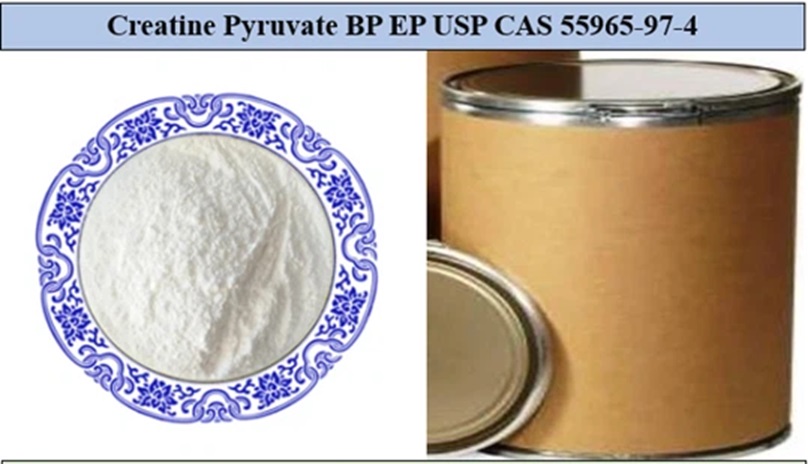
CAS Number Warning: The correct CAS number for Creatine Pyruvate is 208535-04-0. CAS 55965-97-4 belongs to MCI/MI (Kathon CG) preservative mixture and has no relation to this compound.
3. CHEMICAL STRUCTURE
Creatine Pyruvate is an organic salt formed by the ionic pairing of creatine (cation) with pyruvic acid (anion) in a 1:1 stoichiometric ratio.
    Creatine Portion:           Pyruvate Portion:
         NH₂                       O
         ||                        ||
    HN = C — N — CH₂ — COO⁻        CH₃ — C — COO⁻
         |
         CH₃

    [Creatine]⁺ [Pyruvate]⁻
IUPAC Name: 2-[carbamimidoyl(methyl)amino]acetic acid;2-oxopropanoic acid
SMILES: CC(=O)C(=O)O.CN(CC(=O)O)C(=N)N
InChIKey: DLNGCCQFGNSBOP-UHFFFAOYSA-N
4. PHYSICAL PROPERTIES
| Property | Value |
|---|---|
| Appearance | White to off-white crystalline powder |
| Odor | Slight characteristic |
| Taste | Improved flavor profile (better than creatine monohydrate) |
| Water Solubility (20°C) | 54 g/L – 3.9 times higher than creatine monohydrate |
| Creatine Monohydrate Solubility (20°C) | 14 g/L (for comparison) |
| Creatine Citrate Solubility (20°C) | 29 g/L (for comparison) |
| Net Creatine Solubility Advantage | ~2.6 times higher than monohydrate |
| Acid Stability | Stable at neutral pH |
| Hygroscopicity | Moderate |
| Storage | Cool, dry place (2-8°C recommended) |
5. PHARMACOKINETIC PROPERTIES
Pharmacokinetics examines the processes of absorption, distribution, metabolism, and excretion of a drug in the body. Creatine Pyruvate offers significant pharmacokinetic advantages compared to creatine monohydrate.
5.1. Absorption and Plasma Creatine Levels
In a randomized, cross-over human study comparing creatine pyruvate (CrPyr), creatine monohydrate (CrM), and tri-creatine citrate (CrC) at isomolar creatine doses (4.4 g):
| Parameter | Creatine Pyruvate | Creatine Monohydrate | Creatine Citrate | Difference |
|---|---|---|---|---|
| Peak Plasma Creatine (Cmax) | Highest | Lower | Lower | +17% vs CrM/CrC |
| Area Under Curve (AUC₀–₈ₕ) | Highest | Lower | Lower | +14% vs CrM/CrC |
| 1-Hour Plasma Creatine | 972.2 μmol/L | 761.9 μmol/L | 855.3 μmol/L | Significant (p=0.015) |
| Time to Peak (Tmax) | ~1.0 hour | ~2.0 hours | ~1.5 hours | Faster |
| Absorption Rate Constant (ka) | Similar | Similar | Similar | No difference |
| Elimination Rate Constant (kel) | Similar | Similar | Similar | No difference |
5.2. Bioavailability
Creatine monohydrate has approximately 100% bioavailability. Creatine Pyruvate's higher plasma concentrations are not due to higher bioavailability but rather to slightly different absorption kinetics.
5.3. Formulation Advantages
| Advantage | Description |
|---|---|
| Superior Water Solubility | 54 g/L (at 20°C) – 3.9 times higher than creatine monohydrate |
| Suitable for Clear Beverages | No sedimentation due to high solubility |
| Ideal for Effervescent Tablets | Rapid dissolution and dispersion |
| Acid Stability | Stable at neutral pH; creatine monohydrate degrades to creatinine at pH 3.5-5.5 |
| Improved Taste | Better flavor profile compared to bitter creatine monohydrate |
| GI Tolerance | Better gastrointestinal tolerance than creatine monohydrate |
6. PHARMACODYNAMICS
Pharmacodynamics describes the relationship between drug concentration and the resulting pharmacological effect.
6.1. Mechanism of Action
| Component | Mechanism | Effect |
|---|---|---|
| Creatine (~60%) | Phosphocreatine system substrate | ATP regeneration during high-intensity exercise |
| Pyruvate (~40%) | TCA cycle (Krebs cycle) intermediate | Aerobic energy production, antioxidant activity |
| Combination | Dual energy pathway support | Both anaerobic and aerobic systems supported |
6.2. Performance Effects
| Study | Design | Findings |
|---|---|---|
| Handgrip Exercise | 28 days, 5 g/day, 49 healthy young athletes | Creatine Pyruvate provided significant force maintenance across 10 maximal intervals (p < 0.001). Creatine citrate was only significant for the first 2 intervals |
| Canoeist Performance | 5 days, 7.5 g/day | Increased rowing speed, decreased lactate levels (improved aerobic metabolism) |
| Cycling Performance | 1 week, 7 g/day | No significant improvement in endurance or sprint performance in trained cyclists |
6.3. Metabolic Effects
| Effect | Description |
|---|---|
| Force Maintenance | Significant force maintenance across 10 maximal intervals |
| Relaxation Rate | Significant increase (p < 0.01) |
| Lipid Profile | Animal studies showed decreased hepatic triglycerides and serum total cholesterol (p < 0.01) |
7. RECOMMENDED DOSAGE
| User Type | Daily Dose | Timing | Duration |
|---|---|---|---|
| Recreational Athlete | 2,000 – 3,000 mg | Pre-workout | 4-8 weeks |
| Competitive Athlete | 3,000 – 5,000 mg | Pre-workout or split dose | 8-12 weeks |
| Strength Training | 3,000 – 5,000 mg | Pre-workout | 8-12 weeks |
| Endurance Training | 2,000 – 4,000 mg | Pre-workout | 4-8 weeks |
Loading Phase: Creatine Pyruvate typically does not require a loading phase due to improved absorption kinetics.
8. COMPARISON WITH CREATINE MONOHYDRATE
| Property | Creatine Pyruvate | Creatine Monohydrate |
|---|---|---|
| Creatine Content | ~60% | ~88% |
| Water Solubility (20°C) | 54 g/L (3.9 times higher) | 14 g/L |
| Acid Stability | High | Low (degrades to creatinine at pH 3.5-5.5) |
| Taste | Improved | Bitter |
| GI Tolerance | Better | Moderate |
| Plasma Creatine Cmax | +17% higher | Baseline |
| AUC | +14% higher | Baseline |
| Loading Phase | Not required | Required (20 g/day) |
| Additional Benefits | Pyruvate (energy + antioxidant) | None |
9. SAFETY AND TOXICOLOGY
| Parameter | Value |
|---|---|
| Acute Oral Toxicity (LD₅₀) | >2,000 mg/kg (estimated) |
| Skin Irritation | Mildly irritating |
| Eye Irritation | Mildly irritating |
| Carcinogenicity | Not classified as carcinogenic |
| Mutagenicity | Negative |
| GHS Classification | Eye Dam. 1 (Serious eye damage) |
Potential Side Effects (High Doses >5-10 g/day):
-
Mild gastrointestinal discomfort (bloating, nausea)
-
Diarrhea (osmotic effect)
10. STORAGE AND HANDLING
| Parameter | Requirement |
|---|---|
| Storage Temperature | Cool (15-25°C) or refrigerated (2-8°C) |
| Container | Tightly closed, dry |
| Humidity | Low humidity |
| Shelf Life | 12-24 months (with proper storage) |
11. SUMMARY
| Parameter | Value |
|---|---|
| Product | Creatine Pyruvate |
| CAS Number | 208535-04-0 |
| EC Number | 429-120-5 |
| Molecular Formula | C₇H₁₃N₃O₅ |
| Molecular Weight | 219.20 g/mol |
| Creatine Content | ~60% |
| Pyruvate Content | ~40% |
| Water Solubility (20°C) | 54 g/L |
| Plasma Creatine Cmax | +17% (vs creatine monohydrate) |
| AUC | +14% (vs creatine monohydrate) |
| Typical Dose | 2,000 – 5,000 mg/day |
| Primary Application | Sports nutrition, performance enhancement |
12. CRITICAL INFORMATION
1. CAS NUMBER WARNING: The correct CAS number for Creatine Pyruvate is 208535-04-0. 55965-97-4 is not for this compound; this CAS belongs to MCI/MI (Kathon CG) preservative mixture.
2. PHARMACOKINETIC ADVANTAGE: Creatine Pyruvate provides +17% higher plasma creatine concentration and +14% higher AUC compared to creatine monohydrate at isomolar doses.
3. SOLUBILITY ADVANTAGE: Creatine Pyruvate has 3.9 times higher water solubility (54 g/L) than creatine monohydrate (14 g/L).
4. FORMULATION ADVANTAGE: Superior solubility and acid stability make Creatine Pyruvate ideal for clear beverages, effervescent tablets, and liquid formulations.
5. FORCE MAINTENANCE: Creatine Pyruvate maintains significant force across 10 maximal intervals, while creatine citrate is only effective for the first 2 intervals.
6. LOADING PHASE NOT REQUIRED: Improved absorption kinetics typically eliminate the need for a loading phase.
7. STORAGE: The product is hygroscopic; store in a cool, dry place.
8. INTENDED USE: For sports nutrition and performance enhancement purposes. Consult a healthcare professional for any health conditions.
IMPORTANT DISCLAIMER: This Technical Data Sheet (TDS) is for informational purposes only and is prepared based on available technical data. For complete safety, storage, use, and regulatory compliance information, refer to the official documentation provided by the manufacturer/supplier.