We unleash your business potential by maximize the business innovation.
Send EmailPotassium Pyruvate, Potassium Oxopropanoate, Kalium Oxopropanoat, 4151-33-1
POTASSIUM PYRUVATE
CAS Number: 4151-33-1
EC Number (EINECS): 223-979-4
Molecular Formula: C₃H₃KO₃
Molecular Weight: 126.15 g/mol
Chemical Class: Organic acid salt (alpha-keto acid salt)
SECTION 1: PRODUCT IDENTIFICATION AND CHEMICAL IDENTITY
| Parameter | Description |
|---|---|
| Chemical Name (IUPAC) | Potassium 2-oxopropanoate |
| Other Names | Potassium Pyruvate, Pyruvic Acid Potassium Salt, Potassium Oxopropanoate, Kalium Oxopropanoat, 2-Oxopropanoic acid potassium salt, Propanoic acid, 2-oxo-, potassium salt |
| CAS Number | 4151-33-1 |
| EC Number (EINECS) | 223-979-4 |
| Molecular Formula | C₃H₃KO₃ |
| Molecular Weight | 126.15 g/mol |
| Chemical Class | Organic acid salt (alpha-keto acid salt) |
| Structure | CH₃COCOOK |
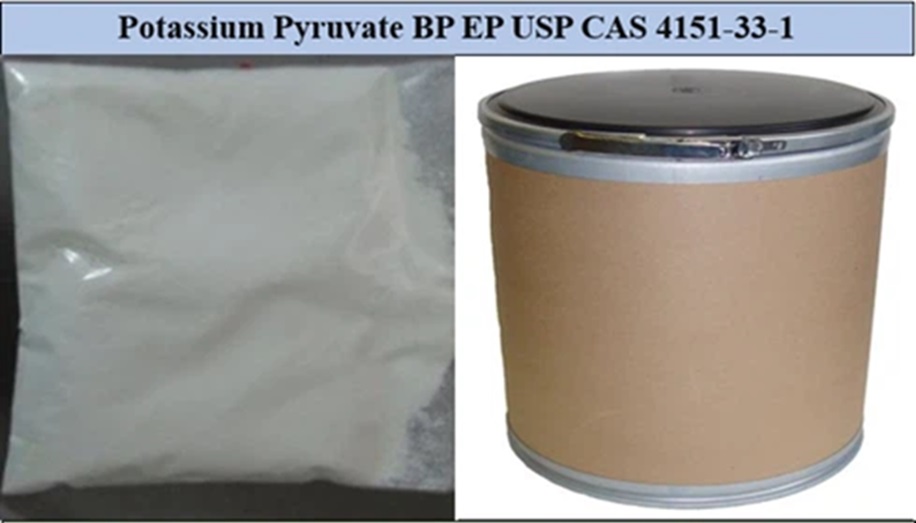
| Appearance | White to off-white crystalline powder |
| Physical State | Solid |
| Odor | Faint characteristic |
SECTION 2: PHYSICAL AND CHEMICAL PROPERTIES
| Property | Value / Range |
|---|---|
| Molecular Formula | C₃H₃KO₃ |
| Molecular Weight | 126.15 g/mol |
| Appearance | White to off-white crystalline powder |
| Odor | Faint characteristic |
| Melting Point | > 175°C (decomposes) |
| Solubility in Water | Slightly soluble |
| Solubility in Methanol | Very slightly soluble |
| LogP | ~ -1.24 (high polarity) |
| Hygroscopicity | Hygroscopic (absorbs moisture) |
| Stability | Hygroscopic; store under inert atmosphere |
| Storage | Room temperature, dry, inert atmosphere |
| pH (Aqueous solution) | ~7.0 (neutral) |
SECTION 3: SOLUBILITY PROFILE
| Solvent | Solubility | Condition |
|---|---|---|
| Water | Slightly soluble | Room temperature |
| Methanol | Very slightly soluble | - |
| Ethanol | Very slightly soluble | - |
| Acetone | Slightly soluble | - |
| DMSO | Soluble | - |
Critical Note: Potassium pyruvate is slightly soluble in water but soluble in DMSO. It is hygroscopic and should be stored under inert atmosphere to prevent moisture absorption.
SECTION 4: CHEMICAL PROPERTIES AND REACTIONS
| Property | Description |
|---|---|
| Chemical Class | Organic acid salt (alpha-keto acid salt) |
| Functional Groups | Ketone (C=O), carboxylate (-COO⁻) |
| Reactivity | Moderate; undergoes typical alpha-keto acid reactions |
| Acidification | Converts to pyruvic acid in acidic medium |
| Reduction | Can be reduced to lactic acid |
| Transamination | Participates in amino acid synthesis (e.g., alanine) |
| Oxidative Decarboxylation | Converts to acetyl-CoA, entering TCA cycle |
| UV Protection | Acts as free radical scavenger in cosmetic formulations |
| Thermal Decomposition | > 175°C decomposes; releases CO, CO₂ |
| Hygroscopicity | Absorbs moisture from air |
4.1. Key Reactions
| Reaction Type | Description |
|---|---|
| Acidification | Pyruvic acid formation in acidic medium |
| Reduction | Lactic acid formation |
| Transamination | Amino acid synthesis (alanine, etc.) |
| Oxidative Decarboxylation | Acetyl-CoA → TCA cycle |
| Free Radical Scavenging | UV protection, antioxidant effect |
SECTION 5: PRODUCTION METHOD
| Parameter | Description |
|---|---|
| Method 1 | Pyruvic acid + Potassium hydroxide → Potassium pyruvate + Water |
| Reaction | CH₃COCOOH + KOH → CH₃COCOOK + H₂O |
| Purification | Crystallization and drying under vacuum |
| Method 2 | Microbial fermentation (pyruvic acid from fermentation → potassium salt) |
SECTION 6: MAJOR APPLICATIONS AND END-USES
6.1. Cell Culture (Most Important Application)
| Application | Function | Suitability |
|---|---|---|
| Cell Culture Media | Energy source, enhances cell viability | High |
| Mammalian Cell Culture | Metabolic support | High |
| Hybridoma Culture | Cell viability and productivity enhancer | High |
6.2. Antioxidant
| Application | Function | Suitability |
|---|---|---|
| Free Radical Scavenger | Protects cells from oxidative stress | High |
| Antioxidant Formulations | Reduces oxidative damage | High |
6.3. Pharmaceutical
| Application | Function | Suitability |
|---|---|---|
| Neuroprotective Effects | Research and development | High |
| Metabolic Support | Metabolic disorder research | High |
| Drug Formulations | Active ingredient or excipient | High |
6.4. Cosmetics
| Application | Function | Suitability |
|---|---|---|
| UV Protection | Prevents UV-induced skin damage | High |
| Anti-Aging Formulations | Free radical scavenger | High |
| Skin Care Products | Protective and restorative effects | High |
6.5. Food and Supplements
| Application | Function | Suitability |
|---|---|---|
| Nutritional Supplements | Supports energy metabolism | High |
| Sports Nutrition | Energy and endurance support | High |
| Functional Foods | Metabolic enhancement | High |
6.6. Biochemistry
| Application | Function | Suitability |
|---|---|---|
| Glycolysis Studies | Substrate for metabolic pathway research | High |
| TCA Cycle Studies | Substrate for cellular respiration research | High |
| Enzyme Assays | Substrate for enzyme activity studies | High |
| Metabolic Research | Energy metabolism research | High |
SECTION 7: INDUSTRY SUITABILITY MATRIX
| Industry | Suitability | Explanation |
|---|---|---|
| Biotechnology / Cell Culture | High | Energy source, cell viability enhancer |
| Pharmaceuticals | High | Neuroprotective, metabolic support |
| Cosmetics | High | UV protection, anti-aging |
| Food Supplements | High | Energy metabolism support |
| Sports Nutrition | High | Energy and endurance support |
| Biochemistry | High | Glycolysis, TCA cycle studies |
| Nutraceuticals | High | Metabolic enhancement |
| Kosmetik | High | Free radical scavenger |
SECTION 8: OTHER NAMES AND IDENTIFIERS
| Type | Name / Description |
|---|---|
| IUPAC Name | Potassium 2-oxopropanoate |
| Commercial Names | Potassium Pyruvate, Kalium Oxopropanoat |
| Synonyms | Pyruvic Acid Potassium Salt, Potassium Oxopropanoate, 2-Oxopropanoic acid potassium salt, Propanoic acid, 2-oxo-, potassium salt |
| Common Names | Potassium Salt Pyruvate, Energy Salt (supplements), Muscle Support Salt (sports nutrition) |
| CAS Number | 4151-33-1 |
| EC Number | 223-979-4 |
| HS Code | 29183000 |
SECTION 9: COMPARISON WITH OTHER PYRUVATE SALTS
| Property | Potassium Pyruvate | Sodium Pyruvate | Calcium Pyruvate |
|---|---|---|---|
| Molecular Weight | 126.15 g/mol | 110.04 g/mol | 186.18 g/mol |
| Solubility | Slightly soluble | Highly soluble | Slightly soluble |
| Cation | K⁺ | Na⁺ | Ca²⁺ |
| Primary Use | Cell culture, cosmetics, supplements | Cell culture (most common) | Sports supplements |
| Advantage | Potassium supplementation | Most widely used | Calcium supplementation |
| Cost | Moderate | Lower | Higher |
SECTION 10: TOXICOLOGY AND HEALTH EFFECTS
| Parameter | Value / Description |
|---|---|
| GHS Classification | Not classified |
| Oral LD50 (Rat) | > 2,000 mg/kg |
| Skin Irritation | Not irritating |
| Eye Irritation | Mild irritant |
| Skin Sensitization | Not sensitizing |
| Mutagenicity | Negative |
| Carcinogenicity | Not classified |
| Target Organs | Eyes (mild irritant) |
| Metabolism | Natural intermediate in cellular metabolism |
SECTION 11: ECOTOXICOLOGY AND ENVIRONMENTAL BEHAVIOR
| Parameter | Value / Description |
|---|---|
| Biodegradability | Readily biodegradable |
| Aquatic Toxicity | Low |
| Bioaccumulation | Low |
| Water Hazard Class (WGK Germany) | WGK 1 (slight hazard to water) |
SECTION 12: SAFETY AND STORAGE
| Parameter | Information |
|---|---|
| Storage Conditions | Cool, dry, well-ventilated area |
| Temperature | Room temperature (15-30°C) |
| Container | Tightly closed, original packaging |
| Special Requirements | Hygroscopic; store under inert atmosphere (N₂) |
| Materials to Avoid | Moisture, strong oxidizers, strong acids |
| Shelf Life | 24 months (under recommended conditions) |
| Packaging | 25 kg drums, 500 kg big bags |
SECTION 13: TRANSPORT INFORMATION
| Parameter | Information |
|---|---|
| UN Number | Not regulated (not classified as dangerous goods) |
| Hazard Class | Not applicable |
| Packing Group | Not applicable |
| Proper Shipping Name | Potassium Pyruvate |
| ADR/RID | Not regulated |
| IMDG Code | Not regulated |
| IATA (Air) | Not regulated |
| Marine Pollutant | No |
SECTION 14: FIRE-FIGHTING MEASURES
| Parameter | Information |
|---|---|
| Fire Hazard | Combustible dust |
| Extinguishing Media | Water fog, CO₂, dry chemical, foam |
| Special Hazards | When heated, releases CO, CO₂ |
| Decomposition Products | CO, CO₂, potassium oxides |
| Protective Equipment | Self-contained breathing apparatus (SCBA), full protective clothing |
SECTION 15: ACCIDENTAL RELEASE AND CLEANUP
| Parameter | Information |
|---|---|
| Personal Protection | Gloves, safety goggles, dust mask |
| Ventilation | Increase ventilation |
| Cleanup Methods | Sweep while preventing dust formation; collect in sealed containers |
| Environmental Precautions | Prevent entry into drains |
| Waste Disposal | According to local regulations |
SECTION 16: FIRST AID MEASURES
| Exposure Route | Action |
|---|---|
| Inhalation | Move to fresh air. Seek medical attention if symptoms persist. |
| Skin Contact | Remove contaminated clothing. Wash with soap and plenty of water. |
| Eye Contact | Rinse with plenty of water for at least 15 minutes. Seek medical attention if irritation persists. |
| Ingestion | Do NOT induce vomiting. Drink plenty of water. Seek medical attention. |
SECTION 17: REGULATORY INFORMATION
| Region / Authority | Status |
|---|---|
| EU REACH | Registered |
| Turkey KKDİK | Registration required |
| USA TSCA | Listed |
| EINECS | 223-979-4 |
| WGK (Germany) | 1 (slight hazard to water) |
SECTION 18: SUMMARY AND CRITICAL WARNINGS
Product Summary
| Parameter | Value |
|---|---|
| Product | Potassium Pyruvate |
| CAS | 4151-33-1 |
| Appearance | White to off-white crystalline powder |
| Molecular Weight | 126.15 g/mol |
| Key Industries | Cell culture, cosmetics, pharmaceuticals, supplements |
CRITICAL WARNINGS
-
Energy Metabolism: Potassium pyruvate is a key intermediate in cellular energy metabolism. It serves as a substrate for glycolysis and the TCA cycle.
-
Cell Culture: Used as an energy source in cell culture media to enhance cell viability and productivity, particularly in mammalian and hybridoma cell cultures.
-
Antioxidant Properties: Acts as a free radical scavenger, protecting cells from oxidative stress. Used in cosmetic formulations for UV protection and anti-aging effects.
-
Hygroscopic: Potassium pyruvate is hygroscopic (absorbs moisture). Store under inert atmosphere (N₂) in tightly closed containers.
-
Solubility: Slightly soluble in water; soluble in DMSO. Formulation considerations required for aqueous systems.
-
Neuroprotective Potential: Research indicates neuroprotective and metabolic support effects in pharmaceutical applications.
-
Alternative Salts: Sodium pyruvate is more commonly used and more soluble; calcium pyruvate is used in sports supplements. Potassium pyruvate is preferred when potassium supplementation is desired.
-
Storage: Store in cool, dry, well-ventilated areas under inert atmosphere. Protect from moisture.
-
Metabolic Role: Participates in transamination reactions for amino acid synthesis and oxidative decarboxylation to acetyl-CoA.
-
Regulatory Status: Registered under REACH. Not classified as dangerous goods.
IMPORTANT DISCLAIMER: This Technical Data Sheet (TDS) is for informational purposes only and is based on available technical data. The user is solely responsible for determining the product's suitability for their specific application and for complying with all applicable local, national, and international regulations. Potassium pyruvate is hygroscopic and should be stored under inert atmosphere! For complete safety, storage, handling, transportation, disposal, and regulatory compliance information, always refer to the official Safety Data Sheet (SDS/MSDS) provided by the manufacturer/supplier. Users are responsible for testing the product in their own processes and applications. All local, national, and international regulations must be followed when working with Potassium Pyruvate.