We unleash your business potential by maximize the business innovation.
Send EmailTerephthalic Acid, Benzene Dicarboxylic Acid, Purified Terephthalic Acid, PTA, TPA, BDC, 100-21-0
TEREPHTHALIC ACID (PTA / TPA)
Terephthalic Acid / Purified Terephthalic Acid / 1,4-Benzenedicarboxylic Acid / p-Phthalic Acid / BDC
CAS Number: 100-21-0
EC Number: 202-830-0
SECTION 1: PRODUCT IDENTIFICATION AND CHEMICAL IDENTITY
| Parameter | Information |
|---|---|
| Product Name | Terephthalic Acid |
| Other Names | Purified Terephthalic Acid (PTA), TPA, 1,4-Benzenedicarboxylic Acid (BDC), p-Phthalic Acid |
| CAS Number | 100-21-0 |
| EC Number (EINECS) | 202-830-0 |
| Molecular Formula | C₈H₆O₄ (C₆H₄(COOH)₂) |
| Molecular Weight | 166.13 g/mol |
| Chemical Class | Aromatic dicarboxylic acid |
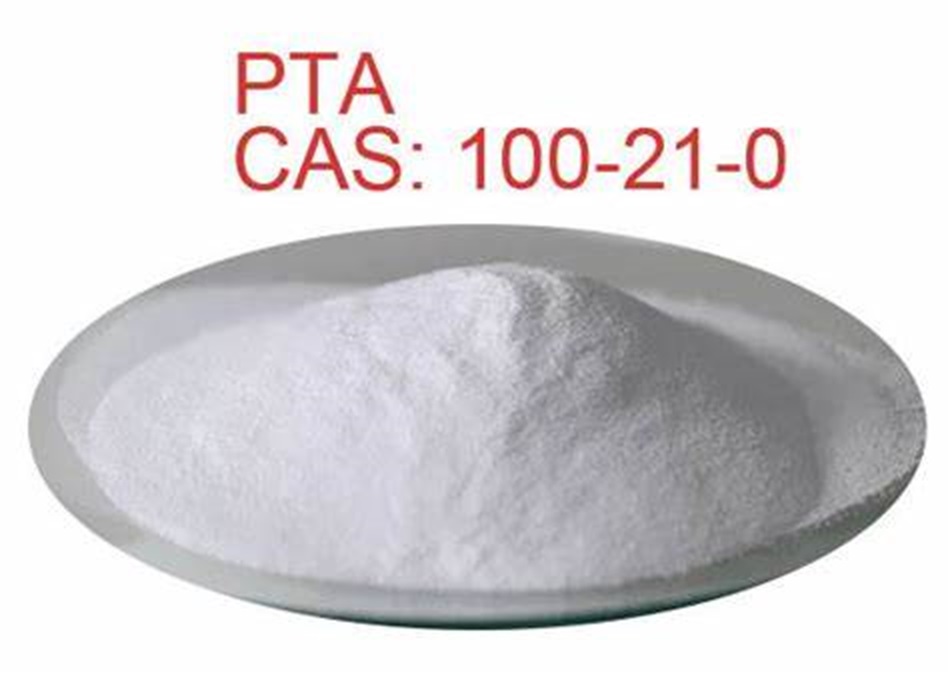
| Appearance | White crystalline powder |
| Odor | Odorless or very slight characteristic odor |
| Physical State (20°C) | Solid (crystalline powder) |
Terephthalic Acid is an aromatic dicarboxylic acid with two carboxyl groups attached to the benzene ring at the 1,4 (para) positions. It is one of the most important industrial chemicals, primarily used as a monomer in the production of polyethylene terephthalate (PET), polybutylene terephthalate (PBT), and various other polymers. Purified Terephthalic Acid (PTA) is the high-purity form required for polymer production.
SECTION 2: SYNONYMS AND OTHER NAMES
| Type | Name |
|---|---|
| Common Names | Terephthalic Acid, PTA, TPA, Purified Terephthalic Acid |
| Chemical Names | 1,4-Benzenedicarboxylic Acid, p-Phthalic Acid, Benzene-1,4-dicarboxylic Acid |
| CAS Number | 100-21-0 |
| EC Number | 202-830-0 |
| MDL Number | MFCD00002558 |
| PubChem CID | 7489 |
| RTECS | WZ0875000 |
| HS Code | 2917.36 |
SECTION 3: CHEMICAL STRUCTURE
3.1. Molecular Structure
Terephthalic acid consists of a benzene ring with two carboxyl groups (-COOH) attached at the 1 and 4 positions (para configuration). The molecule is highly symmetric.
Structural Formula:
        COOH
         |
         C
        / \
       /   \
      /     \
     /       \
    C         C
    |         |
    C - H     C - COOH
    |         |
    C         C
     \       /
      \     /
       \   /
        \ /
         C
          \
           COOH
Simplified Representation:
        COOH
         |
    C₆H₄ - COOH
    (1,4-configuration)
3.2. Molecular Formula
C₆H₄(COOH)₂ / C₈H₆O₄
3.3. Molecular Weight
166.13 g/mol
3.4. Key Structural Features
| Feature | Description |
|---|---|
| Core Structure | Benzene ring (C₆H₄) |
| Functional Groups | Two carboxyl groups (-COOH) |
| Substitution Pattern | 1,4 (para) configuration |
| Symmetry | Highly symmetric molecule |
| Acidity | Dicarboxylic acid (two acidic protons) |
| pKa₁ (25°C) | 3.51 |
| pKa₂ (25°C) | 4.82 |
SECTION 4: PHYSICAL AND CHEMICAL PROPERTIES
| Property | Value |
|---|---|
| Appearance | White to off-white crystalline powder |
| Odor | Odorless or very slight characteristic |
| Molecular Formula | C₈H₆O₄ |
| Molecular Weight | 166.13 g/mol |
| Density (20°C) | 1.522 g/cm³ |
| Bulk Density | 0.85 – 1.05 g/cm³ |
| Melting Point | 427°C (sealed tube) |
| Boiling Point | Thermal decomposition above 300°C |
| Flash Point | Not applicable (dust explosion risk) |
| Autoignition Temperature | 680°C |
| Vapor Pressure (20°C) | Negligible |
| Vapor Density (Air=1) | 5.73 |
| Water Solubility (20°C) | 0.0015 g/100 mL (very low) |
| Solubility in DMF | High |
| Solubility in DMSO | High |
| Solubility in NMP | High |
| Solubility in Acetic Acid | Low |
| pH (suspension) | 3 – 4 |
| pKa₁ (25°C) | 3.51 |
| pKa₂ (25°C) | 4.82 |
| Heat of Combustion | 3,250 kJ/mol |
SECTION 5: SOLUBILITY PROFILE
| Solvent | Solubility | Conditions |
|---|---|---|
| Water | Very low (0.0015 g/100 mL) | 20°C |
| Water | Slightly soluble | 100°C |
| Methanol | Very low | 25°C |
| Ethanol | Very low | 25°C |
| Acetone | Very low | 25°C |
| Dimethylformamide (DMF) | High | 25°C |
| Dimethyl Sulfoxide (DMSO) | High | 25°C |
| N-Methylpyrrolidone (NMP) | High | 25°C |
| Acetic Acid | Low | 25°C |
| Benzene | Insoluble | 25°C |
| Toluene | Insoluble | 25°C |
SECTION 6: CHEMICAL PROPERTIES AND REACTIVITY
| Property | Description |
|---|---|
| Chemical Character | Weakly acidic (dicarboxylic acid) |
| Stability | Stable under normal storage conditions |
| Hydrolysis | Very low reactivity; negligible hydrolysis |
| Esterification | Reacts with alcohols at high temperature to form esters (PET, PBT production) |
| Reaction with Amines | Forms terephthalamides |
| Reaction with Bases | Forms terephthalate salts (water-soluble) |
| Incompatible Materials | Strong oxidizers, strong bases (high temperature), strong reducing agents |
SECTION 7: REACTION EQUATIONS
7.1. Esterification (PET Production)
n C₆H₄(COOH)₂ + n HO-CH₂-CH₂-OH → [-OC-C₆H₄-CO-O-CH₂-CH₂-O-]n + 2n H₂O
7.2. Neutralization with Base
C₆H₄(COOH)₂ + 2 NaOH → C₆H₄(COONa)₂ + 2 H₂O (Disodium terephthalate)
7.3. p-Xylene Oxidation (Production)
C₆H₄(CH₃)₂ + 3 O₂ → C₆H₄(COOH)₂ + 2 H₂O
7.4. Esterification with Butanediol (PBT Production)
n C₆H₄(COOH)₂ + n HO-(CH₂)₄-OH → Polybutylene Terephthalate + 2n H₂O
SECTION 8: PRODUCTION PROCESS
| Method | Description |
|---|---|
| p-Xylene Liquid Phase Oxidation (Industrial Standard) | C₆H₄(CH₃)₂ + 3 O₂ → C₆H₄(COOH)₂ + 2 H₂O |
| Catalyst | Cobalt acetate + Manganese acetate + Bromide (HBr or NaBr) |
| Solvent | Acetic acid |
| Reaction Temperature | 150-200°C |
| Reaction Pressure | 10-20 bar |
| Oxidizing Agent | Air (O₂) |
| Purification | Crystallization, filtration, hydrogenation (4-CBA removal) |
| Yield | >95% |
Reaction Equation (p-Xylene Oxidation – Most Common):
C₆H₄(CH₃)₂ + 3 O₂ —[Co/Mn/Br]—> C₆H₄(COOH)₂ + 2 H₂O + Heat
SECTION 9: AVAILABLE FORMS
| Form | Description | Advantages | Applications |
|---|---|---|---|
| PTA Powder (Standard) | Fine white crystalline powder | High purity, fast reaction | PET, PBT, polyester resins |
| PTA Granules | Agglomerated particles | Low dust, free-flowing | Automatic dosing, large-scale production |
| Medium Purity (TPA) | Standard purity (≥99%) | Lower cost | Polyester paints, plasticizers |
| Crude Terephthalic Acid (CTA) | Lower purity | Intermediate | For purification process |
SECTION 10: QUALITY SPECIFICATIONS (PTA GRADE)
| Parameter | Specification | Test Method |
|---|---|---|
| Purity (C₈H₆O₄) | ≥ 99.9% (by weight) | HPLC |
| Appearance | White crystalline powder | Visual |
| Melting Point | 427°C (sealed tube) | DSC |
| Color (Melt, APHA) | ≤ 10 | Melt color |
| Ash Content | ≤ 0.05% (by weight) | ASTM D5631 |
| Moisture (Karl Fischer) | ≤ 0.2% | ASTM E203 |
| 4-CBA (4-Carboxybenzaldehyde) | ≤ 25 ppm | HPLC |
| p-Toluic Acid | ≤ 100 ppm | GC |
| Benzoic Acid | ≤ 50 ppm | GC |
| Total Metals (Co, Mn, Fe, Na) | ≤ 5 ppm | ICP-MS |
| Iron (Fe) | ≤ 2 ppm | ICP-OES |
| Cobalt (Co) | ≤ 5 ppm | ICP-OES |
| Manganese (Mn) | ≤ 5 ppm | ICP-OES |
| Particle Size (d50) | 120 – 200 µm | Sieve analysis / Laser diffraction |
| Bulk Density | 0.85 – 1.05 g/cm³ | ASTM D1895 |
| Acid Number | 674 – 676 mg KOH/g | Titration |
SECTION 11: APPLICATIONS AND INDUSTRIAL USES
11.1. Polyethylene Terephthalate (PET) – Largest Use (~75%)
| Application | Function |
|---|---|
| PET Bottle Production | Polycondensation with ethylene glycol → PET (blow molding) |
| Polyester Textile Fibers | Synthetic fibers (apparel, upholstery, industrial textiles) |
| Packaging Films | Food packaging (high barrier properties) |
| Thermoform Containers | Single-use food containers, trays |
| Strapping Bands | High-strength plastic straps |
11.2. Polybutylene Terephthalate (PBT) – Engineering Plastics (~10%)
| Application | Function |
|---|---|
| Automotive Parts | Injection molding (sensor housings, connectors, headlight reflectors) |
| Electrical/Electronics | Circuit breakers, sockets, relay housings |
| White Goods | High-temperature resistance parts |
| Industrial Parts | Gears, bearings, pump housings |
11.3. Plasticizers
| Application | Function |
|---|---|
| Di-Octyl Terephthalate (DOTP) | Non-phthalate plasticizer – PVC, cables, flooring |
| Di-Isononyl Terephthalate (DINT) | High-performance plasticizer |
| Di-Isodecyl Terephthalate (DIDT) | Low-temperature flexibility applications |
11.4. Paints and Coatings
| Application | Function |
|---|---|
| Polyester Coating Resins | Powder coatings, automotive topcoats |
| Industrial Coatings | Corrosion protection, metal coatings |
| Coil Coatings | Pre-painted metal (sheet) |
| Liquid Coatings | High-durability surfaces |
11.5. Polyamides and Other Polymers
| Application | Function |
|---|---|
| Polyphthalamide (PPA) | High-temperature engineering polymer |
| Liquid Crystal Polymers (LCP) | High-performance electronic components |
| Polyesteramides | Thermoplastic elastomers |
11.6. Pharmaceutical and Chemical Industry
| Application | Function |
|---|---|
| Pharmaceutical Intermediates | Synthesis of certain drug molecules |
| Terephthalate Salts | Additives in cosmetics and personal care products |
| Organic Synthesis | As an intermediate |
11.7. Military Applications
| Application | Function |
|---|---|
| M83 Smoke Grenade | Obscurant (liquid) |
| M90 Smoke Grenade | Military tactical smoke screen |
11.8. Other Applications
| Application | Function |
|---|---|
| Thermoset Polyester | Glass fiber-reinforced products |
| Polyester Polyol | For polyurethane production |
| Paint Binders | Dispersion in water-based paints |
| Epoxy Curing Agents | Special applications |
SECTION 12: POLYETHYLENE TEREPHTHALATE (PET) PRODUCTION
| Component | Function |
|---|---|
| Terephthalic Acid (PTA) | Dicarboxylic acid component |
| Ethylene Glycol (EG) | Diol component |
| Antimony Trioxide (Sb₂O₃) or Titanium | Polymerization catalyst |
| Phosphite Stabilizers | Prevents thermal degradation |
Typical PET Production Steps:
| Step | Temperature | Description |
|---|---|---|
| Esterification | 250-270°C | PTA + EG → Bis(2-hydroxyethyl) terephthalate (BHET) |
| Polycondensation | 270-290°C (vacuum) | BHET → PET + EG |
| Solid State Polymerization (SSP) | 200-230°C | Molecular weight increase |
Typical Formulation Ratios:
| Component | Ratio (by weight) |
|---|---|
| Terephthalic Acid (PTA) | 60-70% |
| Ethylene Glycol (EG) | 30-40% |
| Catalyst (Sb/Ti) | 200-300 ppm |
SECTION 13: TOXICOLOGICAL PROFILE
| Parameter | Value |
|---|---|
| Acute Oral Toxicity (LD50, Rat) | > 5,000 mg/kg (low toxicity) |
| Acute Dermal Toxicity (LD50, Rabbit) | > 2,000 mg/kg |
| Acute Inhalation (LC50, Rat, 4 h) | > 5 mg/L |
| Skin Irritation | Mild irritant |
| Eye Irritation | Mechanical irritant |
| Skin Sensitization | Not a sensitizer |
| Respiratory Sensitization | Not a sensitizer |
| Mutagenicity | Negative (Ames test) |
| Carcinogenicity | IARC: Not classified (Group 3) |
SECTION 14: GHS CLASSIFICATION
| Hazard Class | Category | H-Statement |
|---|---|---|
| Skin Irritation | Category 2 | H315 |
| Eye Irritation | Category 2 | H319 |
| Specific Target Organ Toxicity - SE | Category 3 | H335 |
| Acute Aquatic Toxicity | Category 3 | H402 |
Signal Word: WARNING
Hazard Pictograms: GHS07 (Exclamation Mark)
Hazard Statements (H-Codes):
| Code | Statement |
|---|---|
| H315 | Causes skin irritation. |
| H319 | Causes serious eye irritation. |
| H335 | May cause respiratory irritation. |
| H402 | Harmful to aquatic life. |
SECTION 15: PRECAUTIONARY STATEMENTS (P-CODES)
| Code | Statement |
|---|---|
| P261 | Avoid breathing dust. |
| P280 | Wear protective gloves/protective clothing/eye protection/face protection. |
| P302+P352 | IF ON SKIN: Wash with plenty of soap and water. |
| P305+P351+P338 | IF IN EYES: Rinse cautiously with water for several minutes. Remove contact lenses if present. |
| P312 | Call a POISON CENTER/doctor if you feel unwell. |
| P501 | Dispose of contents/container in accordance with local regulations. |
SECTION 16: FIRST AID MEASURES
| Route of Exposure | Action to Be Taken |
|---|---|
| Inhalation | Move to fresh air. If breathing difficulty occurs, administer oxygen. Seek medical attention. |
| Skin Contact | Remove contaminated clothing. Wash with plenty of water. |
| Eye Contact | Rinse thoroughly with plenty of water for at least 15 minutes. Seek medical attention. |
| Ingestion | Rinse mouth. Drink plenty of water. Do not induce vomiting. Seek medical attention. |
SECTION 17: FIRE-FIGHTING MEASURES
| Parameter | Information |
|---|---|
| Fire Hazard | Dust explosion potential (Kst = medium level) |
| Suitable Extinguishing Media | Water spray, CO₂, dry chemical powder, foam |
| Special Hazards | When heated, decomposes releasing toxic gases (CO, CO₂) |
| Protective Equipment | Self-contained breathing apparatus (SCBA), full protective clothing |
SECTION 18: ACCIDENTAL RELEASE MEASURES
| Parameter | Information |
|---|---|
| Personal Protection | Dust mask, protective goggles, gloves, coverall |
| Ventilation | Increase ventilation; use local exhaust in confined spaces |
| Containment | Cover spilled area to prevent dust dispersion |
| Cleaning Methods | Collect dry using vacuum or careful sweeping. Avoid washing with water. |
| Environmental Precautions | Prevent entry into drains, sewers, and water bodies |
| Waste Disposal | Dispose of in accordance with local regulations |
SECTION 19: STORAGE AND SHELF LIFE
| Parameter | Information |
|---|---|
| Storage Conditions | Cool (15-30°C), dry (below 50% RH), well-ventilated area |
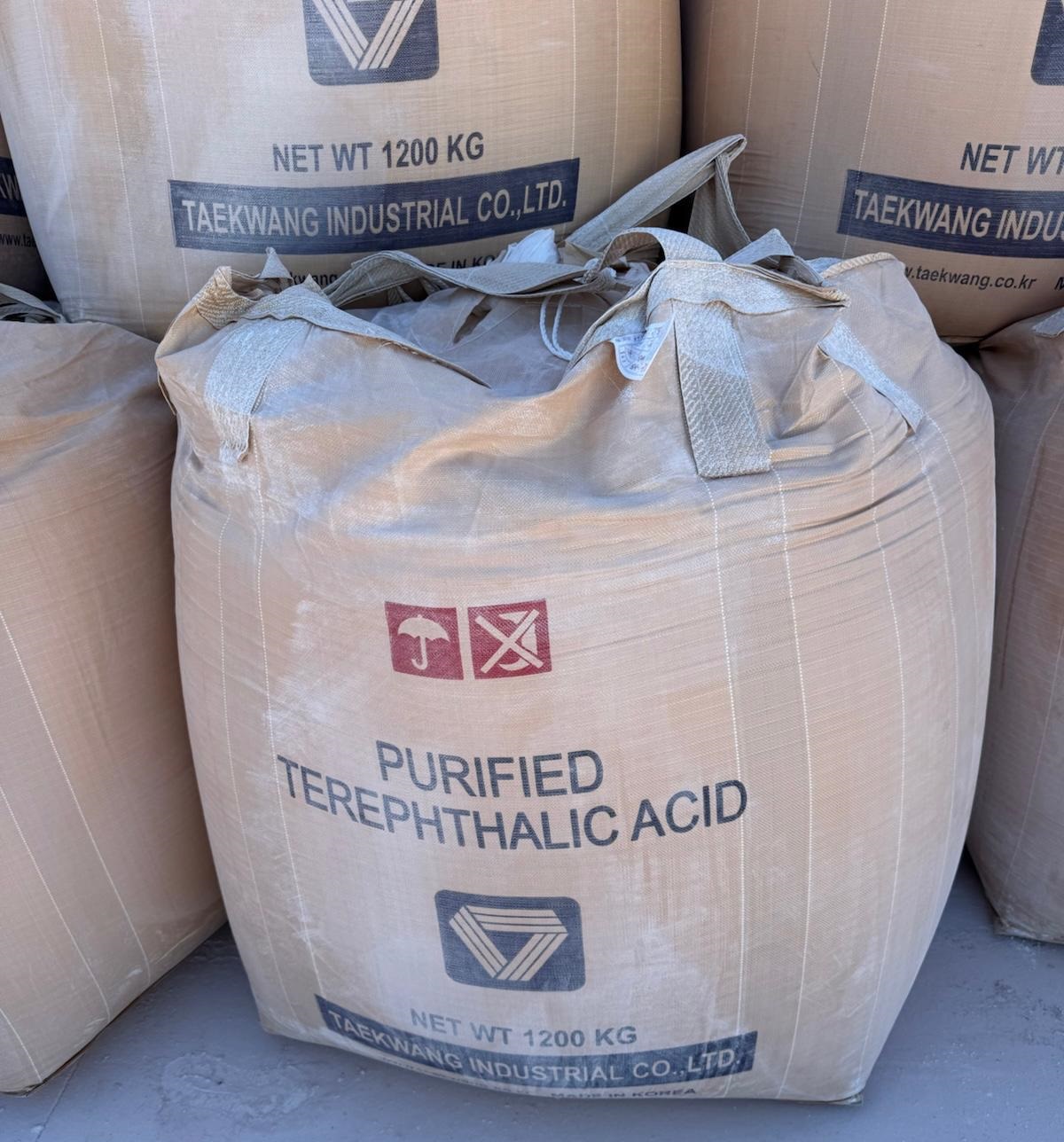
| Container Requirements | Moisture-proof containers (kraft bags, lined FIBCs) |
| Materials to Avoid | Strong oxidizers, strong bases (high temperature), strong reducing agents |
| Shelf Life | 24 months (unopened, in dry containers under proper storage) |
| Stability Note | Low hygroscopicity; protect from moisture to prevent caking |
| Packaging Options | 25 kg kraft bags, 500 kg/1000 kg FIBCs, 20-25 ton containers |
SECTION 20: PACKAGING OPTIONS
| Packaging Type | Quantity | Material |
|---|---|---|
| Kraft Bag | 25 kg | Kraft paper with PE liner |
| Big-Bag (FIBC) | 500 – 1000 kg | Polypropylene |
| Container | 20 – 25 tons | Lined container |
SECTION 21: TRANSPORT INFORMATION
| Parameter | Information |
|---|---|
| UN Number | Not applicable (not classified as dangerous goods) |
| Hazard Class | Not classified as hazardous |
| Packing Group | Not applicable |
| Proper Shipping Name | Terephthalic Acid |
| Marine Pollutant | No |
| ADR/RID Label | Not applicable |
SECTION 22: REGULATORY INFORMATION
| Region | Status |
|---|---|
| EU (REACH) | Registered; approved for industrial use |
| Turkey (KKDIK) | Mandatory compliance; registration required |
| USA (TSCA) | Listed |
| Canada (DSL) | Listed |
| Australia (AICS) | Listed |
| Japan (ENCS) | Listed |
| Korea (KECL) | Listed |
| China (IECSC) | Listed |
| FDA | 21 CFR 177.1630 (food contact for PET) |
| EU Food Contact | EU 10/2011 (food contact) |
SECTION 23: ENVIRONMENTAL INFORMATION
| Parameter | Information |
|---|---|
| Aquatic Toxicity | Harmful to aquatic life (H402) |
| Biodegradability | Slowly biodegradable |
| Bioaccumulation | Low potential (Log P = 1.89) |
| Mobility in Soil | Low (insoluble in water) |
| Waste Disposal | Dispose of according to local regulations. Controlled incineration preferred. |
SECTION 24: OTHER NAMES AND SYNONYMS
| Type | Name |
|---|---|
| Turkish Names | Tereftalik Asit, Saflaştırılmış Tereftalik Asit |
| English Names | Terephthalic Acid, Purified Terephthalic Acid (PTA), TPA, 1,4-Benzenedicarboxylic Acid (BDC), p-Phthalic Acid |
| CAS | 100-21-0 |
| EC | 202-830-0 |
| MDL | MFCD00002558 |
| PubChem CID | 7489 |
| RTECS | WZ0875000 |
| UN | Not applicable |
SECTION 25: QUICK REFERENCE TABLE
| Property | Value |
|---|---|
| CAS Number | 100-21-0 |
| EC Number | 202-830-0 |
| Molecular Formula | C₈H₆O₄ |
| Molecular Weight | 166.13 g/mol |
| Appearance | White crystalline powder |
| Odor | Odorless or slight |
| Density | 1.522 g/cm³ |
| Melting Point | 427°C (sealed tube) |
| Water Solubility (20°C) | 0.0015 g/100 mL |
| pKa₁ / pKa₂ | 3.51 / 4.82 |
| Primary Uses | PET, PBT, plasticizers, coatings |
| Shelf Life | 24 months |
| UN Number | Not applicable |
| GHS Signal Word | WARNING |
| Hazard Statements | H315, H319, H335, H402 |
SECTION 26: CRITICAL NOTICES AND BEST PRACTICES
CRITICAL NOTICES:
-
PET Production: Terephthalic acid reacts with ethylene glycol via polycondensation to form PET polymer. This is one of the most produced engineering polymers in the world.
-
PBT Production: Terephthalic acid reacts with 1,4-butanediol (BDO) to form PBT. PBT is widely used in automotive and electronics due to its high temperature and chemical resistance.
-
Non-Phthalate Plasticizers: Terephthalic acid-derived plasticizers (DOTP) are considered safe alternatives to traditional phthalate plasticizers.
-
Caking: Terephthalic acid tends to cake when stored in humid conditions. Store in dry conditions and use airtight containers.
-
Dust Explosion: When handling powder, prevent static electricity buildup. Use grounding and dust collection systems.
-
DOTP Plasticizer: Di-octyl terephthalate (DOTP) is produced by esterification of terephthalic acid with 2-ethylhexanol and is a non-phthalate plasticizer.
-
Food Contact Approval: PET produced from terephthalic acid is approved for food contact by FDA and EFSA.
-
Recycling: PET bottles and polyester fibers are widely recyclable (rPET).
BEST PRACTICE RECOMMENDATIONS:
-
Storage: Store in a cool, dry, and well-ventilated area. Use moisture-proof containers. Maintain temperature below 30°C and humidity below 50% RH.
-
Handling: Use protective gloves, goggles, and dust mask. Avoid dust formation. Use local exhaust ventilation.
-
Processing: Pre-dry PTA before use in esterification reactions. Maintain PTA:EG molar ratio of 1:1.05 – 1:1.20 for PET production.
-
Quality Control: Monitor purity, moisture content, and 4-CBA levels. Ensure product meets specifications.
-
Waste Management: Dispose of waste in accordance with local regulations. Incineration is recommended for contaminated materials.
LEGAL DISCLAIMER:
This Technical Data Sheet (TDS) is for informational purposes only and is prepared based on available technical data. The user is solely responsible for determining the suitability of the product for their specific application and for complying with all local, national, and international regulations. For complete safety, storage, handling, transport, waste, and regulatory compliance information, the official Safety Data Sheet (SDS/MSDS) provided by the manufacturer/supplier must be consulted. This document does not substitute professional advice.