We unleash your business potential by maximize the business innovation.
Send EmailNickel Hydroxide, Nickel Hydroxide Anhydrous, Nickel Hydroxide Monohydrate, 12054-48-7, 36897-37-7
NICKEL HYDROXIDE – NICKEL HYDROXIDE
1. CHEMICAL IDENTITY AND DEFINITION
| Parameter | Information |
|---|---|
| Chemical Name (IUPAC) | Nickel(II) Hydroxide |
| Other Names | Nickel Hydroxide, Theophrastite, Nickel Hydroxide Anhydrous, Nickel Hydroxide Monohydrate |
| Chemical Formula | Ni(OH)₂ |
| Molecular Weight | 92.72 g/mol (anhydrous) |
| CAS Number (Anhydrous) | 12054-48-7 |
| CAS Number (Monohydrate) | 36897-37-7 |
| EC Number (EINECS) | 235-008-5 |
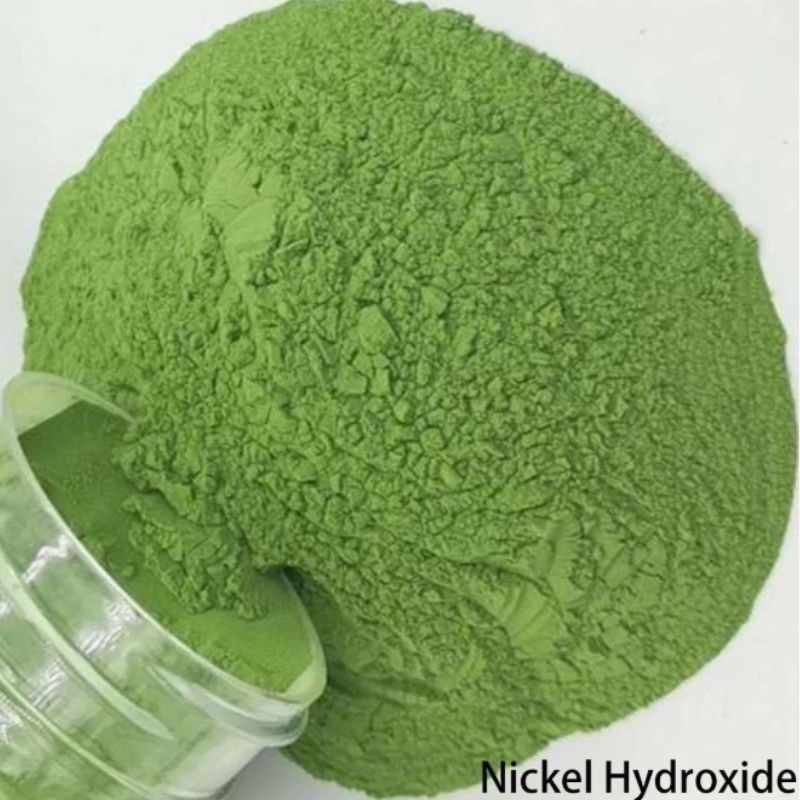
| Appearance | Green crystalline powder |
| Odor | Odorless |
| Physical State (20°C) | Solid (powder) |
| Chemical Class | Inorganic salt (metal hydroxide) |
2. WHAT IS NICKEL HYDROXIDE?
Nickel hydroxide (Ni(OH)₂) is a green, crystalline inorganic compound. It is insoluble in water but soluble in dilute acids. Its most common application is as the active material in the positive electrodes of nickel-cadmium (Ni-Cd) and nickel-metal hydride (Ni-MH) batteries. It also plays an important role in catalysis, electroplating, and environmental applications.
3. PHYSICAL PROPERTIES
| Property | Anhydrous | Monohydrate |
|---|---|---|
| Chemical Formula | Ni(OH)₂ | Ni(OH)₂·H₂O |
| Molecular Weight | 92.72 g/mol | 110.74 g/mol |
| CAS Number | 12054-48-7 | 36897-37-7 |
| Appearance | Green crystalline powder | Green crystalline powder |
| Density | 4.10 g/cm³ | ~3.5 – 4.0 g/cm³ |
| Melting Point | 230 °C (decomposes) | ~200 °C (decomposes) |
| Solubility in Water (20°C) | Insoluble | Insoluble |
| Solubility in Acids | Soluble (dilute acids) | Soluble (dilute acids) |
| Crystal Structure | Hexagonal (brucite type) | Hexagonal |
| Color | Light green | Light green |
| Odor | Odorless | Odorless |
4. CHEMICAL PROPERTIES
| Property | Information |
|---|---|
| Chemical Formula | Ni(OH)₂ |
| Molecular Weight | 92.72 g/mol |
| Nickel Content | ~63.3% (anhydrous) |
| Hydroxide Content | ~36.7% |
| pH (Suspension) | ~8.5 – 10.0 (alkaline) |
| Thermal Decomposition | Ni(OH)₂ → NiO + H₂O (> 230°C) |
| Reactivity | Reacts with acids to form nickel salts |
| Stability | Stable under normal conditions |
| Hygroscopicity | Low |
5. CHEMICAL STRUCTURE
            OH⁻
              |
    Ni²⁺ — OH⁻
              |
            OH⁻
Nickel Hydroxide Structure:
-
Crystal System: Hexagonal
-
Space Group: P-3m1
-
Unit Cell: Brucite-type layered structure
-
Coordination: Octahedral (Ni surrounded by six OH groups)
Chemical Formula: Ni(OH)₂
Nickel Hydroxide Monohydrate: Ni(OH)₂·H₂O
6. THERMAL DECOMPOSITION
| Temperature | Reaction | Description |
|---|---|---|
| > 230 °C | Ni(OH)₂ → NiO + H₂O | Thermal decomposition to nickel oxide |
| > 400 °C | NiO → NiO (stable) | Stable nickel(II) oxide formed |
Reaction Equation:
Ni(OH)₂ → NiO + H₂O (at > 230°C)
7. APPLICATIONS
7.1. Batteries and Energy Storage
| Application | Description |
|---|---|
| Ni-Cd Batteries | Positive electrode active material |
| Ni-MH Batteries | Positive electrode active material |
| Ni-Zn Batteries | Positive electrode material |
| Ni-H₂ Batteries | Space applications |
| Lithium-Ion Batteries | Additive (research) |
7.2. Catalyst
| Application | Description |
|---|---|
| Hydrogenation Catalyst | Organic hydrogenation reactions |
| Oxidation Catalyst | Selective oxidation reactions |
| Electrocatalysis | Oxygen evolution reaction (OER) in water electrolysis |
| Petrochemicals | Refinery catalysts |
7.3. Electroplating
| Application | Description |
|---|---|
| Nickel Plating | Nickel source in electroplating baths |
| Surface Treatments | Metal surface coating |
| Passivation | Corrosion resistance enhancement |
7.4. Environmental Applications
| Application | Description |
|---|---|
| Wastewater Treatment | Heavy metal ion removal |
| Adsorption | Contaminant adsorption |
| Phosphate Removal | Phosphate removal from aquatic environments |
7.5. Other Applications
| Application | Description |
|---|---|
| Ceramics | Coloring pigment |
| Glass | Green colorant |
| Pigments | Nickel-based pigment production |
| Powder Metallurgy | Precursor for nickel powder production |
8. PRODUCTION METHODS
8.1. Chemical Precipitation Methods
| Method | Reaction | Description |
|---|---|---|
| Sulfate Method | NiSO₄ + 2NaOH → Ni(OH)₂↓ + Na₂SO₄ | Most common method |
| Nitrate Method | Ni(NO₃)₂ + 2KOH → Ni(OH)₂↓ + 2KNO₃ | High-purity product |
| Chloride Method | NiCl₂ + 2NaOH → Ni(OH)₂↓ + 2NaCl | Alternative method |
8.2. Electrolytic Method
| Parameter | Description |
|---|---|
| Anode | Metallic nickel |
| Electrolyte | Nickel nitrate solution |
| Process | Precipitation via electrolysis |
| Advantage | High purity |
8.3. Hydrothermal Method
| Parameter | Description |
|---|---|
| Temperature | 100-200°C |
| Pressure | High pressure |
| Result | Crystalline Ni(OH)₂ production |
9. ADVANTAGES OF NICKEL HYDROXIDE
| Advantage | Description |
|---|---|
| High Capacity | High specific capacity in battery electrodes |
| Stability | Stable during electrochemical cycling |
| Long Life | Provides long life in Ni-Cd and Ni-MH batteries |
| Low Cost | Relatively economical production |
| Environmentally Friendlier | More environmentally friendly than cadmium-based batteries |
| Recyclability | Nickel recycling is possible |
10. COMPARISON TABLE – NICKEL HYDROXIDE FORMS
| Property | Anhydrous | Monohydrate |
|---|---|---|
| Formula | Ni(OH)₂ | Ni(OH)₂·H₂O |
| CAS | 12054-48-7 | 36897-37-7 |
| Molecular Weight | 92.72 g/mol | 110.74 g/mol |
| Nickel Content | ~63.3% | ~53.0% |
| Appearance | Light green powder | Light green powder |
| Thermal Decomposition | > 230°C | > 200°C |
| Applications | Battery electrodes, catalyst | Specialty catalyst applications |
11. SAFETY AND HEALTH INFORMATION
| Parameter | Information |
|---|---|
| Toxicity | High (nickel compounds) |
| Oral LD50 (Rat) | ~1,000 – 2,000 mg/kg |
| Carcinogenicity | Category 1A (IARC Group 1) – Lung cancer |
| Mutagenicity | Positive |
| Reproductive Toxicity | Positive |
| Skin Sensitization | May cause allergic reactions |
| Inhalation | Dust inhalation may cause lung damage |
| Aquatic Toxicity | Very toxic to aquatic organisms |
11.1. GHS CLASSIFICATION
| Hazard Category | Description |
|---|---|
| Carcinogenicity | Category 1A (H350i) |
| Reproductive Toxicity | Category 1B (H360D) |
| Skin Sensitization | Category 1 (H317) |
| Specific Target Organ Toxicity | Category 1 (H372) |
| Aquatic Toxicity | Category 1 (H400/H410) |
11.2. FIRST AID MEASURES
| Route of Exposure | Action |
|---|---|
| Inhalation | Remove to fresh air. If breathing difficulty, seek medical attention. |
| Skin Contact | Wash with plenty of soap and water. Remove contaminated clothing. |
| Eye Contact | Rinse thoroughly with water for at least 15 minutes. Seek medical attention. |
| Ingestion | Rinse mouth. Do NOT induce vomiting. Seek medical attention. |
12. STORAGE AND HANDLING
| Parameter | Information |
|---|---|
| Storage Conditions | Cool, dry, well-ventilated area |
| Container Requirements | Tightly closed, original packaging |
| Protect From | Moisture, acids, strong oxidizing agents |
| Shelf Life | 12-24 months (with proper storage) |
| Dust Precautions | Prevent dust formation; use respiratory protection |
13. TRANSPORT INFORMATION
| Parameter | Information |
|---|---|
| UN Number | 3288 |
| Hazard Class | 6.1 (Toxic) |
| Packing Group | III |
| ADR/RID | 6.1 |
| IMDG Code | 6.1 |
| IATA (Air) | 6.1 |
| Marine Pollutant | Yes |
14. PACKAGING OPTIONS
| Packaging Type | Quantity | Material |
|---|---|---|
| Plastic Bucket | 5-25 kg | HDPE |
| Plastic Drum | 25-50 kg | HDPE |
| Plastic Bag | 1-5 kg | PE |
| Fiber Drum | 25-50 kg | Fiberboard |
15. REGULATORY STATUS
| Region / Authority | Status |
|---|---|
| European Union (REACH) | Substance of Very High Concern (SVHC) |
| USA (EPA) | Toxic Substance |
| USA (OSHA) | Nickel regulation |
| RoHS | Restricted substance (certain applications) |
| Turkey | Hazardous substance |
16. OTHER NAMES AND SYNONYMS
| Type | Name |
|---|---|
| Turkish Names | Nikel Hidroksit, Nikel(II) Hidroksit, Nikel Hidroksit Anhidrat, Nikel Hidroksit Monohidrat |
| English Names | Nickel Hydroxide, Nickel(II) Hydroxide, Nickel Hydroxide Anhydrous, Nickel Hydroxide Monohydrate |
| Mineral Name | Theophrastite |
| CAS Numbers | 12054-48-7 (Anhydrous), 36897-37-7 (Monohydrate) |
17. SUMMARY AND CRITICAL WARNINGS
Product Summary
| Parameter | Anhydrous | Monohydrate |
|---|---|---|
| Product | Nickel Hydroxide | Nickel Hydroxide Monohydrate |
| CAS Number | 12054-48-7 | 36897-37-7 |
| Formula | Ni(OH)₂ | Ni(OH)₂·H₂O |
| Molecular Weight | 92.72 g/mol | 110.74 g/mol |
| Appearance | Light green powder | Light green powder |
| Nickel Content | ~63.3% | ~53.0% |
| Primary Applications | Batteries, catalyst, plating | Catalyst, specialty applications |
CRITICAL WARNINGS
1. HIGH TOXICITY: Nickel hydroxide is classified as a Category 1A carcinogen. Inhalation exposure may cause lung cancer. Avoid prolonged exposure.
2. SKIN SENSITIZATION: Skin contact may cause allergic reactions (nickel eczema). Protective gloves must be worn.
3. CARCINOGENICITY: IARC Group 1 (carcinogenic to humans). Respiratory protection is mandatory.
4. ENVIRONMENT: Very toxic to aquatic organisms. Avoid release to the environment.
5. BATTERY APPLICATIONS: Used as positive electrode material in Ni-Cd and Ni-MH batteries. Provides high capacity and long life.
6. THERMAL DECOMPOSITION: When heated above 230°C, it loses water to form nickel oxide (NiO). This property is used in catalyst production.
7. PPE: Full protective equipment (gloves, goggles, apron, respirator) is required when handling.
8. STORAGE: Store in a cool, dry, well-ventilated area. Keep away from acids and oxidizing agents.
9. WASTE: Nickel-containing waste must be sent to licensed disposal facilities. Release into the environment causes serious ecological damage.
10. ANHYDROUS vs MONOHYDRATE: Anhydrous form (Ni(OH)₂) is preferred for battery applications, while monohydrate form (Ni(OH)₂·H₂O) is used for specialty catalyst applications. Select the correct form based on application requirements.
11. REGULATORY RESTRICTIONS: Restricted in many countries. Subject to REACH SVHC and RoHS regulations.
IMPORTANT DISCLAIMER: This Technical Data Sheet (TDS) is for informational purposes only and is prepared based on available technical data. The user is responsible for determining the suitability of the product for their specific application and for complying with all local, national, and international regulations. For complete safety, storage, use, handling, disposal, and regulatory compliance information, refer to the official Safety Data Sheet (SDS/MSDS) provided by the manufacturer/supplier. This document is not a substitute for professional or medical advice.