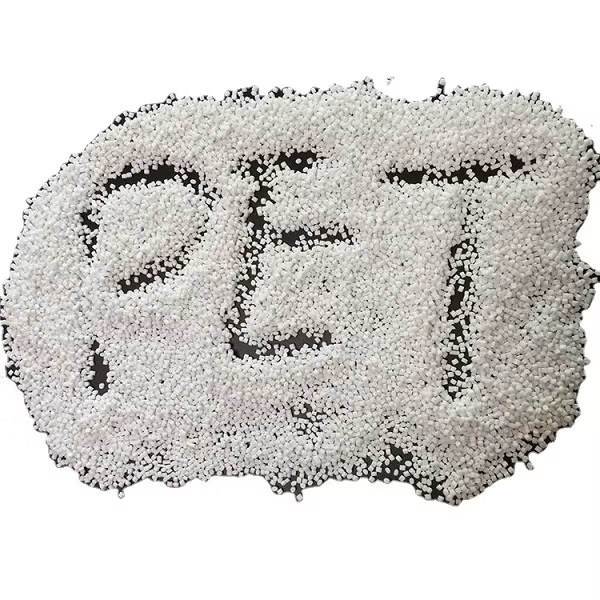
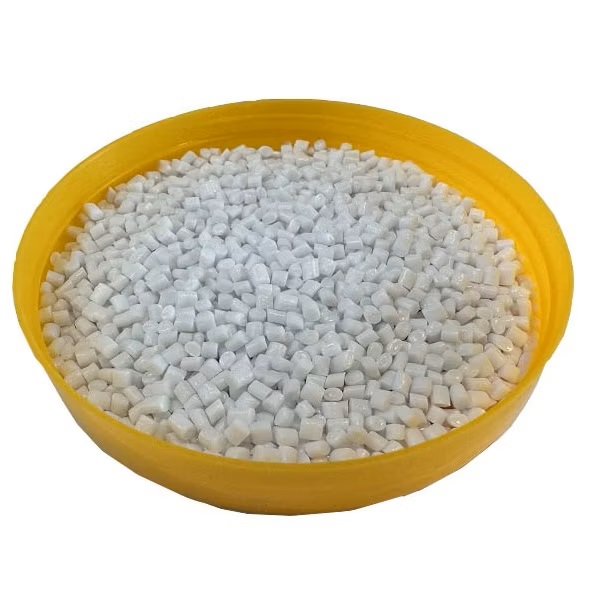
Polyethylene Terephthalate, PET Resin, Polyester Resin, PET Flakes, PET, PETE, 25038-59-9
PET RESIN (POLYETHYLENE TEREPHTHALATE)
CHEMICAL FORMULA AND STRUCTURE
Molecular Formula
(C₁₀H₈O₄)ₙ
Repeating Unit Structure
O O || || ──O──C───○───C──O──CH₂──CH₂──n
Structural Representations
| Representation Type |
Formula |
| Repeating Unit |
C₁₀H₈O₄ |
| Monomer Name |
Ethylene Terephthalate |
| CAS Number |
25038-59-9 |
| EC Number (EINECS) |
618-360-7 |
| IUPAC Name |
Poly(ethylene terephthalate) |
| Abbreviations |
PET, PETE |
Monomer Components
| Component |
Chemical Name |
Formula |
| Diacid |
Terephthalic Acid (PTA) |
C₆H₄(COOH)₂ |
| Diol |
Ethylene Glycol (EG) |
HOCH₂CH₂OH |
Polymerization Reaction
n C₆H₄(COOH)₂ + n HOCH₂CH₂OH → [-OC-C₆H₄-COO-CH₂CH₂-O-]ₙ + 2n H₂O
     (PTA)           (EG)              (PET Repeating Unit)
SECTION 1: PRODUCT IDENTIFICATION
| Parameter |
Information |
| Product Name |
PET Resin (Polyethylene Terephthalate) |
| Chemical Name |
Poly(ethylene terephthalate) |
| Synonyms |
PET, PETE, Polyester Resin, PET Flakes |
| CAS Number |
25038-59-9 |
| EC Number (EINECS) |
618-360-7 |
| Molecular Formula |
(C₁₀H₈O₄)ₙ |
| Molecular Weight |
Variable (typically 20,000 - 50,000 g/mol) |
| Chemical Class |
Thermoplastic Polyester |
| Polymer Type |
Linear, Semi-Crystalline |
| Degree of Crystallinity |
0-60% (depending on processing) |
SECTION 2: PHYSICAL AND CHEMICAL PROPERTIES
General Physical Properties
| Property |
Value |
Test Method |
| Appearance |
Transparent to opaque (depending on crystallinity) |
Visual |
| Color |
Colorless to pale yellow/blue tint |
Visual |
| Odor |
Odorless |
Olfactometric |
| Density (Amorphous) |
1.33 g/cm³ |
ASTM D792 |
| Density (Semi-Crystalline) |
1.38 g/cm³ |
ASTM D792 |
| Density (100% Crystalline) |
1.455 g/cm³ |
ASTM D792 |
| Melting Point (Tm) |
250-260°C |
DSC |
| Glass Transition Temp (Tg) |
75-80°C |
DSC |
| Crystallization Temp (Tc) |
150-160°C |
DSC |
| Decomposition Temperature |
Above 350°C |
TGA |
| Intrinsic Viscosity (IV) |
0.55 - 1.0 dL/g (varies by grade) |
ASTM D4603 |
Mechanical Properties (Typical Values)
| Property |
Value |
Test Method |
| Tensile Strength (Yield) |
50-70 MPa |
ASTM D638 |
| Tensile Strength (Break) |
45-55 MPa |
ASTM D638 |
| Elongation at Yield |
4-6% |
ASTM D638 |
| Elongation at Break |
30-300% |
ASTM D638 |
| Tensile Modulus |
2.0-3.5 GPa |
ASTM D638 |
| Flexural Strength |
90-120 MPa |
ASTM D790 |
| Flexural Modulus |
2.5-3.5 GPa |
ASTM D790 |
| Impact Strength (Izod) |
30-50 J/m |
ASTM D256 |
| Hardness (Rockwell) |
R 110-120 |
ASTM D785 |
Thermal Properties
| Property |
Value |
Test Method |
| Melting Point (Tm) |
250-260°C |
DSC |
| Glass Transition Temp (Tg) |
75-80°C |
DSC |
| Heat Deflection Temp (1.82 MPa) |
70-75°C |
ASTM D648 |
| Heat Deflection Temp (0.455 MPa) |
75-85°C |
ASTM D648 |
| Coefficient of Thermal Expansion |
6-8 x 10⁻⁵ /°C |
ASTM D696 |
| Thermal Conductivity |
0.15-0.20 W/mK |
ASTM C177 |
| Specific Heat Capacity |
1.0-1.2 J/g°C |
DSC |
| Vicat Softening Point |
80-85°C |
ASTM D1525 |
Chemical Resistance
| Substance/Medium |
Resistance |
Comments |
| Water (Room Temp) |
Excellent |
Very low absorption |
| Water (Hot, Above 80°C) |
Moderate |
Hydrolysis may occur |
| Dilute Acids (pH Below 4) |
Good |
Moderate resistance |
| Strong Acids (H₂SO₄, HNO₃) |
Poor |
Degrades |
| Dilute Bases (pH Above 9) |
Poor |
Hydrolysis/Depolymerization |
| Strong Bases (NaOH, KOH) |
Very Poor |
Rapid degradation |
| Organic Solvents (Aliphatic) |
Excellent |
Resistant |
| Organic Solvents (Aromatic) |
Moderate |
Swelling possible |
| Alcohols |
Excellent |
Resistant |
| Oils and Greases |
Excellent |
Resistant |
| UV Radiation |
Moderate |
Yellowing over time |
| Chlorinated Solvents |
Poor |
Dissolves/Swells |
Electrical Properties
| Property |
Value |
Test Method |
| Dielectric Constant (1 MHz) |
2.9-3.2 |
ASTM D150 |
| Dielectric Strength |
15-20 kV/mm |
ASTM D149 |
| Dissipation Factor (1 MHz) |
0.005-0.020 |
ASTM D150 |
| Volume Resistivity |
10¹⁵-10¹⁶ Ω·cm |
ASTM D257 |
| Surface Resistivity |
10¹⁴-10¹⁵ Ω |
ASTM D257 |
| Arc Resistance |
100-150 seconds |
ASTM D495 |
SECTION 3: MANUFACTURING PROCESS
Production Methods
| Method |
Process |
Description |
| 1. Esterification |
PTA + EG |
Terephthalic Acid + Ethylene Glycol → Oligomers + Water |
| 2. Polycondensation |
Oligomer Polymerization |
Chain growth under vacuum to produce high molecular weight PET |
| 3. Solid State Polymerization (SSP) |
Solid State |
Increases intrinsic viscosity for high-performance applications |
Production Process Flow
| Stage |
Process |
Conditions |
| 1 |
Slurry Preparation |
PTA and EG mixed with catalyst |
| 2 |
Esterification |
240-260°C, 0.3-0.5 MPa |
| 3 |
Pre-polymerization |
270-280°C, vacuum (10-20 mbar) |
| 4 |
Final Polymerization |
280-285°C, high vacuum (below 1 mbar) |
| 5 |
Extrusion |
Melt extruded into pellets |
| 6 |
Crystallization/Drying |
120-160°C for 4-6 hours |
| 7 |
Solid State Polymerization (Optional) |
200-220°C, inert atmosphere |
Common Catalysts Used
| Catalyst Type |
Examples |
Function |
| Antimony Compounds |
Sb₂O₃ |
Main polymerization catalyst |
| Titanium Compounds |
Ti(OBu)₄ |
Condensation catalyst |
| Germanium Compounds |
GeO₂ |
High-clarity PET production |
| Aluminum Compounds |
Al(OH)₃ |
Polymerization catalyst |
SECTION 4: PET GRADES AND TYPES
| Grade/Type |
Description |
Intrinsic Viscosity (IV) |
Applications |
| Bottle Grade |
High clarity, food contact approved |
0.70-0.85 dL/g |
Water bottles, beverage containers |
| Fiber Grade |
High tensile strength |
0.55-0.65 dL/g |
Polyester fibers, textiles |
| Film Grade |
Excellent optical properties |
0.60-0.70 dL/g |
Packaging films, photographic films |
| Engineering Grade |
High heat resistance |
0.80-1.00 dL/g |
Automotive parts, electrical components |
| Recycled PET (rPET) |
Post-consumer recycled |
Variable |
Bottles, fibers, strapping |
| High IV PET |
For industrial applications |
Above 1.0 dL/g |
Tire cord, industrial yarns |
| Low IV PET |
For molding applications |
0.55-0.60 dL/g |
Injection molding, small parts |
SECTION 5: PROCESSING METHODS
| Processing Method |
Temperature Range |
Applications |
| Injection Molding |
260-280°C |
Bottle preforms, closures, housings |
| Extrusion |
270-290°C |
Films, sheets, profiles |
| Blow Molding |
260-280°C |
Bottles, containers |
| Thermoforming |
160-220°C |
Trays, containers |
| Spinning (Fiber) |
280-300°C |
Polyester filaments, staple fibers |
| 3D Printing (Filament) |
220-250°C |
Additive manufacturing |
Processing Parameters (Injection Molding)
| Parameter |
Typical Value |
| Melt Temperature |
260-280°C |
| Mold Temperature |
10-60°C |
| Injection Pressure |
60-100 MPa |
| Holding Pressure |
40-80 MPa |
| Injection Speed |
Medium-High |
| Drying Temperature |
120-140°C |
| Drying Time |
4-6 hours |
| Moisture Content (Max) |
Less than 0.02% |
SECTION 6: APPLICATION AREAS
1. Packaging Industry
| Application |
Description |
PET Grade Used |
| Beverage Bottles |
Water, soft drinks, juices |
Bottle Grade |
| Food Containers |
Clamshells, trays, jars |
Bottle/Film Grade |
| Transparent Films |
Shrink films, blister packaging |
Film Grade |
| Thermoformed Packaging |
Blister packs, clamshells |
Sheet Grade |
| Cosmetic Packaging |
Cream jars, lotion bottles |
Bottle Grade |
| Pharmaceutical Packaging |
Tablet strips, medical bottles |
High-clarity Grade |
2. Textile Industry
| Application |
Description |
PET Grade Used |
| Polyester Fibers |
Clothing, sportswear, lingerie |
Fiber Grade |
| Carpets and Rugs |
Floor coverings |
Fiber Grade |
| Upholstery Fabrics |
Furniture textiles |
Fiber Grade |
| Industrial Yarns |
Ropes, belts, cords |
High IV Grade |
| Non-woven Fabrics |
Geotextiles, filtration |
Fiber Grade |
3. Automotive Industry
| Application |
Description |
PET Grade Used |
| Interior Components |
Dashboard, door panels |
Engineering Grade |
| Engine Cover Parts |
Heat resistant components |
High IV Grade |
| Seat Belt Fabrics |
Safety systems |
Fiber Grade |
| Airbag Fabrics |
Vehicle safety |
High Tenacity Grade |
| Electrical Components |
Connectors, housings |
Engineering Grade |
4. Electrical & Electronics
| Application |
Description |
PET Grade Used |
| Insulation Films |
Motor insulation, cable wrapping |
Film Grade |
| Printed Circuit Boards |
Base materials |
Film Grade |
| Capacitor Films |
Electrical storage devices |
High Purity Film Grade |
| Electrical Housings |
Switch boxes, plugs |
Engineering Grade |
| Connectors |
Various electrical connectors |
Engineering Grade |
5. Medical & Healthcare
| Application |
Description |
PET Grade Used |
| Sterile Packaging |
Medical device packaging |
High-clarity Grade |
| Disposable Medical Devices |
Syringes, test tubes |
Medical Grade |
| Pharmaceutical Blisters |
Tablet packaging |
Medical Grade |
| Surgical Textiles |
Sutures, meshes |
Fiber Grade |
6. Construction & Building
| Application |
Description |
PET Grade Used |
| Roofing Sheets |
Corrugated sheets |
Sheet Grade |
| Insulation Materials |
Thermal/acoustic insulation |
Fiber Grade |
| Reinforcement Composites |
Structural components |
High IV Grade |
| Profiles & Trims |
Window frames, moldings |
Engineering Grade |
7. 3D Printing
| Application |
Description |
PET Grade Used |
| PETG Filaments |
3D printing filament |
Modified PET |
| Functional Prototypes |
Engineering models |
PETG Grade |
| End-use Parts |
Functional components |
PETG Grade |
SECTION 7: ADVANTAGES AND DISADVANTAGES
Advantages
| Advantage |
Description |
| Lightweight |
Low density compared to glass and metals |
| High Strength |
Excellent tensile and impact properties |
| Chemical Resistance |
Resistant to most acids, oils, and organic solvents |
| Transparency |
Excellent optical clarity for packaging |
| Good Thermal Resistance |
Suitable for hot-fill applications (up to 85°C) |
| Low Moisture Absorption |
Dimensional stability |
| Fully Recyclable |
100% recyclable with established recycling systems |
| Processable |
Easily processed by various methods |
| Cost Effective |
Low raw material cost |
| Barrier Properties |
Good gas (CO₂, O₂) barrier |
Disadvantages
| Disadvantage |
Description |
| High Temperature Sensitivity |
Degrades at high temperatures (above 300°C) |
| Hydrolysis Sensitivity |
Degrades in hot water/alkaline conditions |
| Poor Alkali Resistance |
Strong bases attack and depolymerize PET |
| UV Degradation |
Yellowing and property loss under prolonged UV exposure |
| Slow Crystallization |
Requires careful processing for crystallinity |
| Recycling Challenges |
Requires proper sorting and cleaning systems |
| Moisture Sensitivity |
Must be thoroughly dried before processing |
SECTION 8: RECYCLING AND SUSTAINABILITY
Recycling Methods
| Method |
Description |
Applications |
| Mechanical Recycling |
Grinding, washing, re-pelletizing |
Bottles, fibers, strapping |
| Chemical Recycling |
Depolymerization to monomers |
Pure monomers for virgin production |
| Feedstock Recycling |
Thermal decomposition |
Energy recovery, fuel |
| Closed-loop Recycling |
Bottle to bottle recycling |
High-quality rPET bottles |
rPET Properties
| Property |
Virgin PET |
rPET (Post-consumer) |
| Intrinsic Viscosity |
0.70-0.85 dL/g |
0.70-0.80 dL/g |
| Color |
Colorless |
Slightly yellow |
| Molecular Weight |
High |
Slightly lower |
| Contaminants |
None |
Low levels (requires processing) |
| Food Contact |
Approved |
Approved (after proper processing) |
Recycling Codes
| Code |
Symbol |
Description |
| 1 |
PETE |
Polyethylene Terephthalate |
| SPI Code |
1 |
PET Recycling Code |
SECTION 9: QUALITY SPECIFICATIONS (BOTTLE GRADE)
| Parameter |
Specification |
Test Method |
| Appearance |
Colorless, transparent pellets |
Visual |
| Intrinsic Viscosity (IV) |
0.72-0.84 dL/g |
ASTM D4603 |
| Acetaldehyde Content |
Less than or equal to 1.0 ppm |
GC |
| Carboxyl End Groups |
Less than or equal to 35 eq/ton |
Titration |
| Diethylene Glycol (DEG) |
Less than or equal to 1.5% |
GC |
| Melting Point (Tm) |
250-255°C |
DSC |
| Glass Transition (Tg) |
75-80°C |
DSC |
| Color (L*) |
Greater than or equal to 80 |
CIE Colorimetry |
| Color (b*) |
Less than or equal to 2.0 |
CIE Colorimetry |
| Moisture Content |
Less than or equal to 0.02% |
Karl Fischer |
| Ash Content |
Less than or equal to 0.1% |
Gravimetric |
| Heavy Metals (Pb, Cd) |
Less than or equal to 100 ppm |
ICP-OES |
| Crystallinity |
35-45% |
DSC/XRD |
SECTION 10: HAZARD CLASSIFICATION AND SAFETY
GHS Classification (Not Classified as Hazardous)
| Parameter |
Information |
| GHS Classification |
Not classified as hazardous |
| Toxicity |
Non-toxic under normal conditions |
| Dust Explosion |
Potential dust explosion hazard (if fine particles) |
| Flammability |
Combustible plastic; burns with smoky flame |
| Decomposition Products |
CO, CO₂, acetaldehyde, aromatic compounds |
| Eye Contact |
Mechanical irritation from dust possible |
| Skin Contact |
Generally non-irritating |
| Inhalation |
Dust may cause respiratory irritation |
SECTION 11: STORAGE AND SHELF LIFE
| Parameter |
Information |
| Storage Conditions |
Cool, dry, well-ventilated area |
| Storage Temperature |
15-25°C |
| Moisture Protection |
Critical – keep below 0.02% moisture |
| UV Protection |
Avoid prolonged sunlight exposure |
| Shelf Life (Proper Storage) |
12-24 months |
| Drying Required Before Processing |
Yes (4-6 hours at 120-140°C) |
SECTION 12: COMPARISON WITH OTHER PLASTICS
| Property |
PET |
PP |
PS |
PVC |
PLA (Bioplastic) |
| Density (g/cm³) |
1.38 |
0.90 |
1.05 |
1.40 |
1.24 |
| Melting Point (°C) |
250 |
160 |
240 |
170 |
150 |
| Tg (°C) |
75 |
-10 |
100 |
80 |
60 |
| Tensile Strength (MPa) |
60 |
35 |
45 |
50 |
50 |
| Transparency |
Excellent |
Good |
Excellent |
Good |
Good |
| Chemical Resistance |
Excellent |
Good |
Good |
Moderate |
Moderate |
| Recyclability |
High |
Medium-High |
Medium |
Medium |
High |
| Cost |
Moderate |
Low |
Moderate |
Low |
High |
| Food Contact |
Approved |
Approved |
Approved |
Approved |
Approved |
| Sustainability |
Good |
Moderate |
Moderate |
Poor |
Excellent |
SECTION 13: STANDARDS AND COMPLIANCE
| Standard |
Description |
| ISO 1183 |
Density determination |
| ISO 1133 |
Melt flow rate measurement |
| ISO 527 |
Tensile properties |
| ISO 179 |
Impact properties |
| FDA 21 CFR |
Food contact approval (USA) |
| EU 10/2011 |
Food contact approval (EU) |
| REACH |
Registration, Evaluation, Authorization |
| RoHS |
Restriction of Hazardous Substances |
SECTION 14: SUMMARY TABLE
| Parameter |
Value |
| Product |
PET Resin (Polyethylene Terephthalate) |
| CAS Number |
25038-59-9 |
| Molecular Formula |
(C₁₀H₈O₄)ₙ |
| Density |
1.38 g/cm³ |
| Melting Point |
250-260°C |
| Glass Transition Temp |
75-80°C |
| Tensile Strength |
50-70 MPa |
| Water Absorption |
Less than 0.5% |
| Recycling Code |
1 PETE |
| Biodegradability |
Not biodegradable |
| Food Contact Approved |
Yes |
| Primary Applications |
Bottles, Textiles, Packaging |
| Key Advantage |
Fully recyclable, excellent barrier properties |
SECTION 15: CRITICAL WARNINGS AND BEST PRACTICES
CRITICAL WARNINGS:
Moisture Sensitivity: PET must be dried thoroughly before processing. Moisture causes hydrolysis and degradation, resulting in poor mechanical properties and visible defects.
Thermal Degradation: Avoid processing above 300°C to prevent degradation and formation of acetaldehyde and other decomposition products.
Alkali Sensitivity: Avoid contact with strong bases (NaOH, KOH) as they depolymerize PET.
UV Degradation: Prolonged UV exposure causes yellowing and property loss.
Flammability: PET burns with a smoky flame and produces hazardous decomposition products.
BEST PRACTICE RECOMMENDATIONS:
Drying: Pre-dry PET to less than or equal to 0.02% moisture (4-6 hours at 120-140°C).
Processing: Use appropriate processing temperatures (260-280°C) and avoid long residence times.
Recycling: Design products for recyclability; use appropriate SPI 1 code.
Handling: Avoid contamination with other polymers; use dedusting equipment.
Storage: Store in sealed containers with desiccant; protect from moisture and UV.
Quality Control: Regularly monitor IV and acetaldehyde content to maintain quality.
LEGAL DISCLAIMER:
The information provided in this document is based on our current knowledge and experience and is presented in good faith; however, as all conditions of use are beyond our control, it does not constitute a binding specification or warranty. This Technical Data Sheet is for informational purposes only. Users are responsible for testing the suitability for their own applications. For complete safety, storage, use, handling, disposal, and regulatory compliance information, please refer to the official Safety Data Sheet (SDS/MSDS) provided by the manufacturer/supplier.