Kojic Acid Palmitate, Kojic Dipalmitate, Dipalmitoyl Kojic Acid, KAD, 79725-98-7
KOJIC ACID PALMITATE (KAD)
CAS Number: 79725-98-7
EC Number (EINECS): Not listed (polymer/derivative)
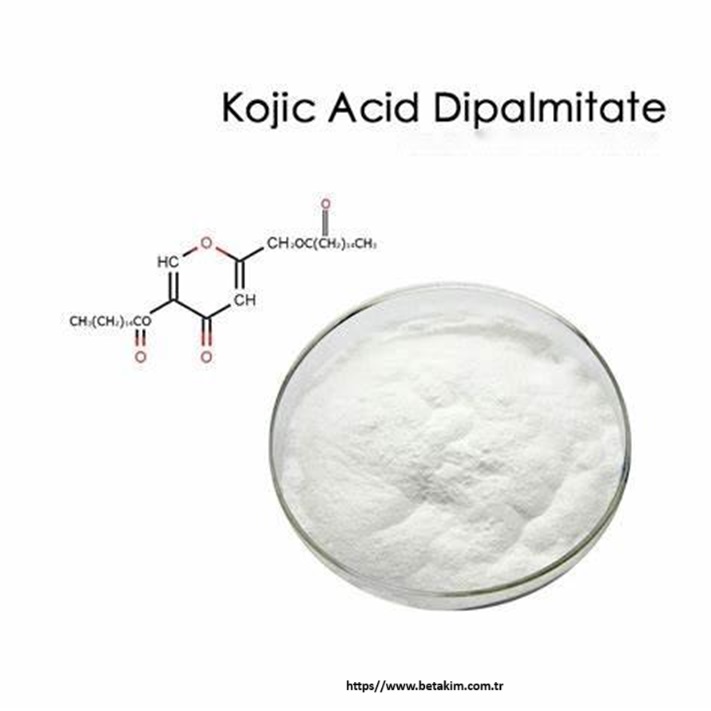
Molecular Formula: C₃₇H₆₄O₆
Molecular Weight: 604.90 g/mol
Chemical Class: Fatty acid ester (kojic acid derivative)
INCI Name: Kojic Dipalmitate
SECTION 1: PRODUCT IDENTIFICATION AND CHEMICAL IDENTITY
| Parameter |
Description |
| Chemical Name (IUPAC) |
(5-Hexadecanoyloxy-4-oxopyran-2-yl) hexadecanoate |
| Other Names |
Kojic Acid Palmitate, Kojic Dipalmitate, KAD, Kojic Acid Ester, Dipalmitoyl Kojic Acid |
| CAS Number |
79725-98-7 |
| EC Number (EINECS) |
Not listed (polymer/derivative) |
| INCI Name |
Kojic Dipalmitate |
| Molecular Formula |
C₃₇H₆₄O₆ |
| Molecular Weight |
604.90 g/mol |
| Chemical Class |
Fatty acid ester (kojic acid derivative) |
| Appearance |
White crystalline powder |
| Odor |
Faint characteristic |
| Solubility |
Insoluble in water; soluble in oils and organic solvents |
SECTION 2: PHYSICAL AND CHEMICAL PROPERTIES
| Property |
Value / Range |
| Molecular Formula |
C₃₇H₆₄O₆ |
| Molecular Weight |
604.90 g/mol |
| Appearance |
White crystalline powder |
| Odor |
Faint characteristic |
| Melting Point |
92 - 95°C |
| Solubility in Water |
Insoluble |
| Solubility in Oils |
Soluble |
| Solubility in Organic Solvents |
Soluble in alcohols, esters, hydrocarbons |
| Stability |
Stable; resistant to oxidation |
| LogP |
High (lipophilic) |
SECTION 3: SOLUBILITY PROFILE
| Solvent |
Solubility |
Condition |
| Water |
Insoluble |
- |
| Mineral Oil |
Soluble |
- |
| Isopropyl Myristate |
Soluble |
- |
| Ethanol |
Soluble |
- |
| Propylene Glycol |
Slightly soluble |
- |
| Glycerin |
Insoluble |
- |
Critical Note: Kojic acid palmitate is a lipophilic derivative of kojic acid. It is insoluble in water but soluble in oils and organic solvents, making it suitable for oil-based cosmetic formulations.
SECTION 4: CHEMICAL PROPERTIES AND REACTIONS
| Property |
Description |
| Chemical Class |
Fatty acid ester (kojic acid derivative) |
| Functional Groups |
Ester, ketone, pyranone ring |
| Reactivity |
Low under normal conditions |
| Hydrolysis |
Hydrolyzes to kojic acid and palmitic acid |
| Oxidation |
Resistant to oxidation (more stable than kojic acid) |
| Thermal Decomposition |
> 200°C releases CO, CO₂ |
| Stability |
More stable than kojic acid; does not discolor easily |
4.1. Key Reactions
| Reaction Type |
Description |
| Hydrolysis |
Kojic acid palmitate + Water → Kojic acid + Palmitic acid |
| Transesterification |
Reacts with alcohols to form other esters |
| Enzymatic Cleavage |
Hydrolyzed by esterases to release kojic acid |
SECTION 5: MAJOR APPLICATIONS AND END-USES
5.1. Cosmetics and Personal Care (Most Important Application)
| Application |
Function |
Suitability |
| Skin Whitening Creams |
Melanin inhibitor, reduces hyperpigmentation |
High |
| Anti-Aging Creams |
Improves skin texture, reduces aging signs |
High |
| Dark Spot Correctors |
Reduces dark spots and freckles |
High |
| Sunscreens |
Skin lightening and UV protection |
High |
| Serums and Lotions |
Brightening and anti-aging |
High |
| Foundation and BB Creams |
Skin brightening additive |
High |
| Eye Creams |
Reduces dark circles |
High |
| Body Lotions |
Brightening and even skin tone |
High |
5.2. Pharmaceutical
| Application |
Function |
Suitability |
| Topical Formulations |
Skin depigmentation |
Moderate |
| Dermatological Products |
Treatment of hyperpigmentation disorders |
Moderate |
SECTION 6: INDUSTRY SUITABILITY MATRIX
| Industry |
Suitability |
Explanation |
| Cosmetics |
High |
Skin whitening, anti-aging, brightening |
| Personal Care |
High |
Creams, lotions, serums, sunscreens |
| Dermatology |
Moderate |
Hyperpigmentation treatments |
| Pharmaceuticals |
Moderate |
Topical formulations |
| Food |
Not suitable |
Not used as food additive |
| Industrial |
Not suitable |
No industrial applications |
SECTION 7: MECHANISM OF ACTION
7.1. Skin Lightening Mechanism
Kojic acid palmitate acts as a skin lightening agent through the following mechanisms:
| Mechanism |
Description |
| Tyrosinase Inhibition |
Inhibits tyrosinase, the key enzyme in melanin production |
| Melanin Reduction |
Reduces melanin synthesis in melanocytes |
| Copper Chelation |
Chelates copper ions required for tyrosinase activity |
| Antioxidant Activity |
Scavenges free radicals that stimulate melanin production |
7.2. Anti-Aging Mechanism
| Mechanism |
Description |
| Collagen Synthesis |
May stimulate collagen production |
| Free Radical Scavenging |
Protects skin from oxidative stress |
| Skin Texture Improvement |
Improves overall skin appearance |
SECTION 8: COMPARISON WITH KOJIC ACID
| Property |
Kojic Acid Palmitate |
Kojic Acid |
| Solubility |
Oil-soluble (lipophilic) |
Water-soluble |
| Stability |
Highly stable, oxidation-resistant |
Less stable, easily oxidized |
| Skin Penetration |
Better skin penetration |
Limited skin penetration |
| Discoloration |
Does not discolor |
May cause discoloration |
| Formulation |
Suitable for oil-based formulations |
Suitable for water-based formulations |
| Irritation |
Lower irritation potential |
Higher irritation potential |
| Activity |
Slower but longer-lasting |
Faster but shorter-lasting |
| Cost |
Higher |
Lower |
SECTION 9: OTHER NAMES AND IDENTIFIERS
| Type |
Name / Description |
| INCI Name |
Kojic Dipalmitate |
| IUPAC Name |
(5-Hexadecanoyloxy-4-oxopyran-2-yl) hexadecanoate |
| Commercial Names |
KAD, Kojic Acid Palmitate, Kojic Acid Ester |
| Synonyms |
Kojic Dipalmitate, Dipalmitoyl Kojic Acid |
| CAS Number |
79725-98-7 |
| EINECS |
Not listed |
| HS Code |
29329900 |
SECTION 10: TOXICOLOGY AND SAFETY
| Parameter |
Value / Description |
| GHS Classification |
Not classified (low toxicity) |
| Oral LD50 (Rat) |
> 2,000 mg/kg |
| Dermal LD50 (Rabbit) |
> 2,000 mg/kg |
| Skin Irritation |
Non-irritating |
| Eye Irritation |
Mild irritant |
| Skin Sensitization |
Not sensitizing |
| Mutagenicity |
Negative |
| Carcinogenicity |
Not classified |
| Target Organs |
Skin, eyes |
| Safety in Cosmetics |
Approved for cosmetic use (EU, USA, Japan) |
SECTION 11: TYPICAL DOSAGE IN COSMETIC FORMULATIONS
| Product Type |
Typical Concentration |
| Skin Whitening Creams |
0.5 - 2.0% |
| Anti-Aging Creams |
0.5 - 1.5% |
| Serums |
0.5 - 1.0% |
| Dark Spot Correctors |
1.0 - 2.0% |
| Sunscreens |
0.5 - 1.0% |
| Body Lotions |
0.3 - 1.0% |
| Eye Creams |
0.3 - 0.8% |
SECTION 12: FORMULATION GUIDELINES
| Parameter |
Recommendation |
| Solubilization |
Dissolve in oil phase at 70-80°C |
| pH Range |
Stable at pH 4.0 - 7.0 |
| Compatibility |
Compatible with most cosmetic ingredients |
| Storage |
Store in cool, dry place; protect from light |
| Shelf Life |
24 months (under recommended conditions) |
| Synergistic Combinations |
Works well with Vitamin C, Vitamin E, Arbutin, Niacinamide |
SECTION 13: ECOTOXICOLOGY AND ENVIRONMENTAL BEHAVIOR
| Parameter |
Value / Description |
| Biodegradability |
Moderate |
| Aquatic Toxicity |
Low |
| Bioaccumulation |
Moderate (lipophilic) |
| Water Hazard Class (WGK Germany) |
WGK 1 (slight hazard to water) |
SECTION 14: SAFETY AND STORAGE
| Parameter |
Information |
| Storage Conditions |
Cool, dry, well-ventilated area |
| Temperature |
Room temperature (15-30°C) |
| Container |
Tightly closed, original packaging |
| Light Protection |
Protect from direct sunlight |
| Shelf Life |
24 months (under recommended conditions) |
| Packaging |
1 kg, 5 kg, 25 kg drums |
SECTION 15: TRANSPORT INFORMATION
| Parameter |
Information |
| UN Number |
Not regulated (not classified as dangerous goods) |
| Hazard Class |
Not applicable |
| Packing Group |
Not applicable |
| Proper Shipping Name |
Kojic Acid Palmitate |
| ADR/RID |
Not regulated |
| IMDG Code |
Not regulated |
| IATA (Air) |
Not regulated |
| Marine Pollutant |
No |
SECTION 16: FIRE-FIGHTING MEASURES
| Parameter |
Information |
| Fire Hazard |
Combustible solid |
| Extinguishing Media |
Water fog, CO₂, dry chemical, foam |
| Special Hazards |
When heated, releases CO, CO₂ |
| Decomposition Products |
CO, CO₂ |
| Protective Equipment |
Self-contained breathing apparatus (SCBA), full protective clothing |
SECTION 17: ACCIDENTAL RELEASE AND CLEANUP
| Parameter |
Information |
| Personal Protection |
Gloves, safety goggles, dust mask |
| Ventilation |
Increase ventilation |
| Cleanup Methods |
Sweep while preventing dust formation; collect in sealed containers |
| Environmental Precautions |
Prevent entry into drains |
| Waste Disposal |
According to local regulations |
SECTION 18: FIRST AID MEASURES
| Exposure Route |
Action |
| Inhalation |
Move to fresh air. Seek medical attention if symptoms persist. |
| Skin Contact |
Remove contaminated clothing. Wash with soap and plenty of water. |
| Eye Contact |
Rinse with plenty of water for at least 15 minutes. Seek medical attention if irritation persists. |
| Ingestion |
Do NOT induce vomiting. Drink plenty of water. Seek medical attention. |
SECTION 19: REGULATORY INFORMATION
| Region / Authority |
Status |
| EU REACH |
Registered (as derivative) |
| Turkey KKDİK |
Registration required |
| USA TSCA |
Listed |
| EU Cosmetics Regulation |
Approved for cosmetic use |
| Japan (ENCS) |
Listed |
| Korea (KECL) |
Listed |
| FDA |
Not approved for food use |
| WGK (Germany) |
1 (slight hazard to water) |
SECTION 20: SUMMARY AND CRITICAL WARNINGS
Product Summary
| Parameter |
Value |
| Product |
Kojic Acid Palmitate (KAD) |
| CAS |
79725-98-7 |
| Appearance |
White crystalline powder |
| Melting Point |
92-95°C |
| Water Solubility |
Insoluble |
| Key Industries |
Cosmetics, personal care |
CRITICAL WARNINGS
-
Lipophilic Derivative: Kojic acid palmitate is a lipophilic derivative of kojic acid, making it suitable for oil-based cosmetic formulations. It is insoluble in water but soluble in oils and organic solvents.
-
Superior Stability: More stable than kojic acid; resistant to oxidation and does not discolor easily. This makes it ideal for long-term cosmetic formulations.
-
Better Skin Penetration: The lipophilic nature provides better skin penetration compared to kojic acid, resulting in enhanced efficacy.
-
Tyrosinase Inhibition: Inhibits tyrosinase, the key enzyme in melanin production, reducing hyperpigmentation, dark spots, and freckles.
-
Anti-Aging Properties: Improves skin texture and reduces signs of aging through antioxidant and collagen-stimulating effects.
-
Antimicrobial Properties: Provides protection against bacterial and fungal infections.
-
Cosmetic Applications: Used in skin whitening creams, anti-aging creams, serums, sunscreens, and dark spot correctors at concentrations of 0.3-2.0%.
-
Safety Profile: Low toxicity, non-irritating, and not sensitizing. Approved for cosmetic use in EU, USA, and Japan.
-
Synergistic Combinations: Works well with Vitamin C, Vitamin E, Arbutin, and Niacinamide for enhanced skin brightening effects.
-
Hydrolysis: Hydrolyzes to kojic acid and palmitic acid, releasing the active kojic acid gradually for sustained efficacy.
IMPORTANT DISCLAIMER: This Technical Data Sheet (TDS) is for informational purposes only and is based on available technical data. The user is solely responsible for determining the product's suitability for their specific application and for complying with all applicable local, national, and international regulations. For complete safety, storage, handling, transportation, disposal, and regulatory compliance information, always refer to the official Safety Data Sheet (SDS/MSDS) provided by the manufacturer/supplier. Users are responsible for testing the product in their own processes and applications. All local, national, and international regulations must be followed when working with Kojic Acid Palmitate.