We unleash your business potential by maximize the business innovation.
Send EmailCanola Oil Powder, Encapsulated Canola Oil, Rapeseed Oil Powder, Canola Protein Powder, Micronized Canola Oil, Canola Extract Powder, 120962-03-0
Canola Oil Powder – Technical Information
Production Technology
-
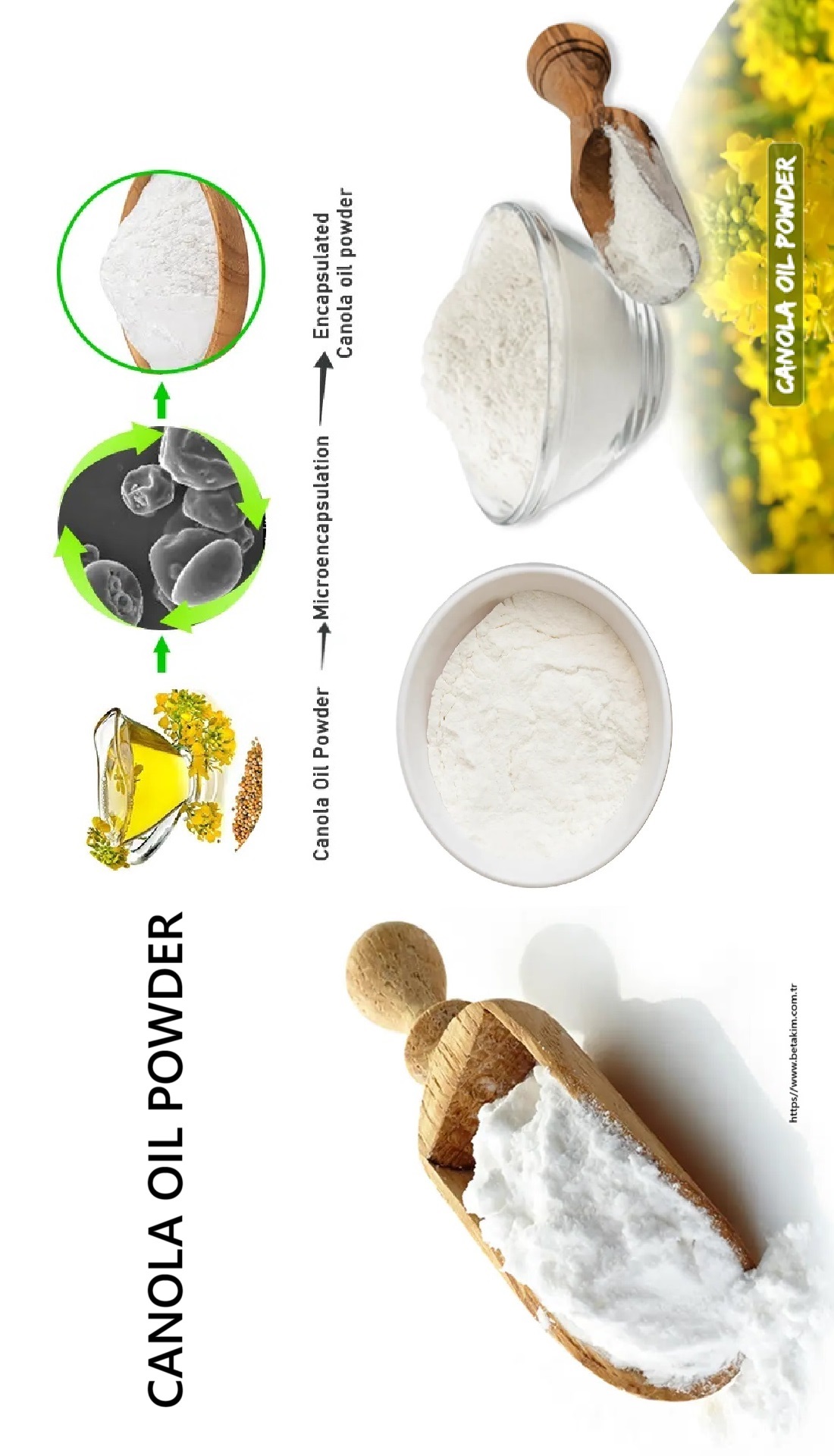
Microencapsulation: Canola oil is encapsulated with carriers such as maltodextrin, milk proteins, or gum arabic to protect it from oxidation.
-
Spray Drying: The oil-in-water emulsion is atomized and dried with hot air, resulting in a free-flowing powder.
-
Carrier Materials: Common carriers include maltodextrin, sodium caseinate, modified starch, which stabilize the oil and improve shelf life.
Physical & Chemical Properties
-
Moisture Content: Typically 3–5%, ensuring stability and extended shelf life.
-
Oil Load: Depending on formulation, 40–70% oil content is achievable.
-
Flowability: Anti-caking agents (e.g., silicon dioxide) may be added to improve handling.
-
Oxidative Stability: Encapsulation reduces peroxide value and free fatty acid formation.
Functional Characteristics
-
Dispersibility: Easily disperses in dry mixes and reconstitutes in liquid formulations.
-
Thermal Stability: Maintains integrity during baking or infant formula processing.
-
Nutritional Profile: Naturally low in saturated fat (~7%), high in oleic acid (~60%), and contains omega-3 (alpha-linolenic acid).
Applications
-
Infant Formula: Provides essential fatty acids and energy in a stable, safe form.
-
Functional Foods: Sports nutrition powders, coffee creamers, soups, sauces.
-
Pharmaceuticals & Supplements: Used as a lipid source in capsules or tablets.
-
Cosmetics: As a stable lipid ingredient in powdered formulations.
For your infant formula sourcing goal, the critical aspects are:
-
Oxidative stability for safety and shelf life.
-
Regulatory compliance with EFSA and Turkish Food Codex.
-
Carrier system documentation (maltodextrin + milk protein is the most common).
Detailed breakdown of Canola Oil Powder usage areas, organized point by point:
1. Infant Nutrition & Baby Formula
-
Essential Fatty Acids: Provides oleic acid and alpha-linolenic acid (omega-3), crucial for infant brain and eye development.
-
Energy Source: Stable lipid supply in powdered form, easy to blend into formula.
-
Oxidative Stability: Encapsulation protects sensitive fatty acids from rancidity, ensuring safety.
-
Regulatory Compliance: Widely accepted in EFSA and Codex Alimentarius standards when properly documented.
2. Functional Foods & Nutraceuticals
-
Sports Nutrition Powders: Used in protein shakes and recovery blends as a clean fat source.
-
Meal Replacements: Adds caloric density and healthy fats to balanced powders.
-
Coffee Creamers & Instant Drinks: Provides creamy mouthfeel without liquid oil separation.
-
Fortified Foods: Can be enriched with vitamins (A, D, E, K) for synergistic delivery.
3. Bakery & Confectionery
-
Baked Goods: Improves texture and moisture retention in cakes, cookies, bread.
-
Chocolate & Coatings: Acts as a fat source in powdered mixes, ensuring smooth melting.
-
Instant Desserts: Facilitates dry mix formulations (custards, puddings) with stable fat inclusion.
4. Culinary & Convenience Foods
-
Instant Soups & Sauces: Provides lipid phase without liquid oil handling.
-
Seasoning Mixes: Enhances flavor release and mouthfeel in spice blends.
-
Snack Powders: Used in savory coatings for chips, crackers, extruded snacks.
5. Pharmaceutical & Dietary Supplements
-
Capsules & Tablets: Serves as a lipid excipient in solid dosage forms.
-
Medical Nutrition: Incorporated into powders for patients requiring controlled fat intake.
-
Controlled Release Systems: Encapsulation allows gradual lipid release in formulations.
6. Animal Nutrition & Feed Industry
-
Pet Food Powders: Adds energy and palatability to dry kibble.
-
Livestock Feed: Provides stable fat source in powdered premixes.
-
Aquaculture: Used in fish feed formulations for omega-3 enrichment.
7. Cosmetics & Personal Care
-
Powdered Cosmetics: Stable lipid inclusion in face powders, masks, and dry formulations.
-
Skin Care: Acts as a carrier for fat-soluble actives in powdered delivery systems.
-
Hair Care: Incorporated into dry shampoos or powdered conditioners.
8. Industrial & Technical Applications
-
Encapsulation Studies: Model system for testing spray-drying and encapsulation efficiency.
-
Powdered Lubricants: Limited use in specialized technical formulations.
-
Biodegradable Materials: Potential role in bio-based composites as lipid filler.
Comparative Table – Usage Areas & Sectoral Suitability
| Feature / Sector | Canola Oil Powder | Palm Oil Powder | Coconut Oil Powder | Sunflower Oil Powder |
|---|---|---|---|---|
| Infant Formula | ✔️ Low saturated fat, high oleic & omega-3; regulatory compliant | ⚠️ High saturated fat; limited use | ⚠️ Very high saturated fat; generally avoided | ✔️ Rich in linoleic acid (omega-6); used in balanced formulations |
| Functional Foods | ✔️ Sports nutrition, coffee creamers, meal replacements | ✔️ High energy density, cost-effective | ✔️ Flavor/aroma enhancer in tropical products | ✔️ Balanced fatty acid profile; widely used in functional blends |
| Bakery & Confectionery | ✔️ Improves texture & moisture retention | ✔️ Provides stability & structure | ✔️ Adds flavor, especially in sweets | ✔️ Neutral taste; suitable for cakes, biscuits, chocolate |
| Convenience Foods | ✔️ Soups, sauces, seasoning mixes | ✔️ Economical, widely used | ✔️ Limited due to strong flavor | ✔️ Neutral profile; ideal for soups & sauces |
| Pharmaceuticals & Supplements | ✔️ Lipid excipient in capsules/tablets | ✔️ Energy source in formulations | ✔️ Limited role beyond flavor | ✔️ Omega-6 source; used in medical nutrition |
| Animal Nutrition | ✔️ Omega-3 enrichment, aquaculture feed | ✔️ High energy, common in livestock feed | ⚠️ Limited due to saturated fat | ✔️ Balanced profile; used in premixes |
| Cosmetics & Personal Care | ✔️ Stable lipid in powdered cosmetics | ✔️ Moisturizing, common in soap | ✔️ Exotic aroma, niche cosmetics | ✔️ Light, neutral oil; suitable for skincare |
| Industrial Applications | ✔️ Model for encapsulation studies | ✔️ Bio-based filler in composites | ✔️ Specialty tropical formulations | ✔️ Stable lipid source for technical uses |
Summary
-
Canola Oil Powder: Best suited for infant formula and functional foods; strong regulatory compliance due to low saturated fat and omega-3 content.
-
Palm Oil Powder: Cost-effective, energy-dense; widely used in bakery and convenience foods, but limited in infant formula.
-
Coconut Oil Powder: Flavor and aroma advantage; ideal for confectionery and tropical products, but nutritionally less suitable for infant formula.
-
Sunflower Oil Powder: Rich in linoleic acid (omega-6); complements canola in infant formula to achieve fatty acid balance, versatile in functional foods and bakery.
👉 For infant formula applications, the most effective combination is Canola (omega-3, oleic acid) + Sunflower (omega-6, linoleic acid). This pairing ensures a balanced fatty acid profile aligned with EFSA and Codex Alimentarius guidelines.