We unleash your business potential by maximize the business innovation.
Send EmailAnthocyanins, Cyanidin, Delphinidin, Malvidin, Pelargonidin, Peonidin, Petunidin, Grape Skin Extract, Anthocyanin Mixture, Blackcurrant Extract, E163, 11029-12-2
Anthocyanins (E163) – Natural Red, Blue, Purple Food Dyes
| Property | Detail |
|---|---|
| Common Names | Anthocyanins, Anthocyanines |
| Food Code | E163 |
| CAS Number | 11029-12-2 |
| EC/List Number | 600-954-3 |
| Source | Natural (fruits, flowers, berries, vegetables) |
| Color Range | Red, purple, blue, pink, orange (pH dependent) |
| Chemical Class | Flavonoids (anthocyanidins + sugars) |
What are Anthocyanins (E163)?
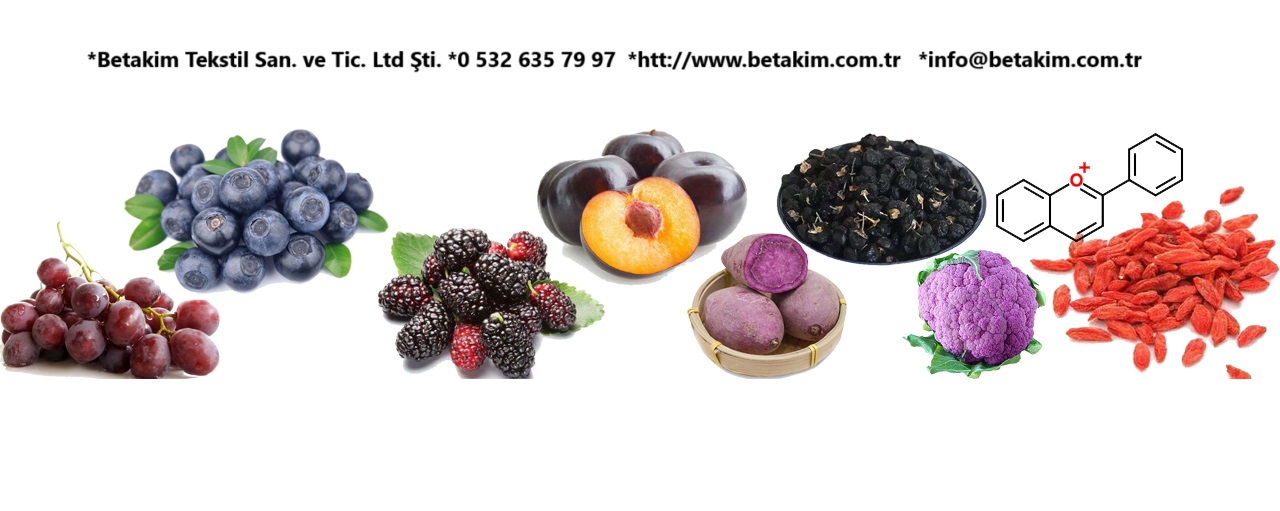
Anthocyanins (E163) are a broad group of natural colorants found in fruits, flowers, berries, and vegetables. They are responsible for the red, purple, blue, and pink colors in many plants. Anthocyanins always contain a carbohydrate molecule (sugar) , while anthocyanidins are the sugar-free form (present in smaller amounts).
Note: Anthocyanins are pH-sensitive pigments. Their color changes depending on the acidity or alkalinity of the environment.
Individual Components and Their Colors
| Code | Component | Color |
|---|---|---|
| E163a | Cyanidin | Red |
| E163b | Delphinidin | Blue |
| E163c | Malvidin | Pink |
| E163d | Pelargonidin | Orange |
| E163e | Peonidin | Red-brown |
| E163f | Petunidin | Dark red |
Types of E163 (Mixtures)
| Code | Name | Source |
|---|---|---|
| E163(i) | Grape Skin Extract | Grape skins |
| E163(ii) | Anthocyanin Mixture | Mixed sources |
| E163(iii) | Blackcurrant Extract | Blackcurrants |
Note: Individual components (E163a-f) are extracted from different plant species and are typically used as part of mixtures rather than in pure form.
Source
| Source Type | Details |
|---|---|
| Natural Sources | Fruits (grapes, berries, cherries, plums), flowers (hibiscus, roses), vegetables (red cabbage, eggplant, purple corn) |
| Commercial Sources | Grape skins, blackcurrants, elderberries, red cabbage, purple sweet potatoes, black carrots |
| Extraction Method | Acidified water or alcohol extraction from plant material |
Natural Sources by Component:
| Component | Common Natural Sources |
|---|---|
| Cyanidin (E163a) | Blackberries, cherries, red grapes, red cabbage, apples |
| Delphinidin (E163b) | Blueberries, eggplants, pomegranates |
| Malvidin (E163c) | Grapes (red wine), blueberries, bilberries |
| Pelargonidin (E163d) | Strawberries, radishes, red geraniums |
| Peonidin (E163e) | Red grapes, plums, purple corn |
| Petunidin (E163f) | Bilberries, blackcurrants |
Functions and Properties
| Property | Description |
|---|---|
| Color Range | pH dependent: Red → Purple → Blue |
| Solubility | Water-soluble |
| Stability | Low (sensitive to pH, temperature, light) |
| Antioxidant Activity | High (natural polyphenols) |
| Natural Status | Natural (plant-derived) |
pH Color Change Chart:
| pH Level | Color |
|---|---|
| pH < 3 (Acidic) | Red to Red-orange |
| pH 3-5 | Pink to Red |
| pH 5-7 | Purple to Violet |
| pH 7-8 | Blue |
| pH > 8 | Blue-green to Greenish (unstable) |
Important: Anthocyanins are rarely stable. Temperature, light, and pH significantly affect the color. This is both a limitation and a unique characteristic (used as natural pH indicators).
Applications and Usage Areas
Anthocyanins (E163) are used across multiple industries, but with limitations due to stability issues:
1. Food Industry
| Product Category | Examples | Notes |
|---|---|---|
| Beverages | Fruit juices, soft drinks, energy drinks, wine | Color depends on product pH |
| Confectionery | Candies, gummies, jellies | May fade over time |
| Dairy Products | Yogurt, ice cream, fruit preparations | Stability improved with certain additives |
| Jams & Preserves | Fruit jams, fruit fillings | Natural fruit color |
| Bakery | Cakes, pastries, icings | Sensitive to baking temperatures |
| Sauces | Fruit sauces, berry compotes | |
| Cereals | Breakfast cereals, snack bars |
2. Pharmaceutical Industry
| Application | Examples |
|---|---|
| Dietary Supplements | Antioxidant supplements, bilberry extract |
| Natural Health Products | Eye health supplements, circulation support |
| Syrups | Natural-colored medicinal syrups |
3. Cosmetic Industry
| Product Category | Examples |
|---|---|
| Skin Care | Natural-colored creams, lotions, serums |
| Hair Care | Natural-colored shampoos, conditioners |
| Makeup | Lip balms, blushes, eyeshadows |
4. Other Applications
| Application | Examples |
|---|---|
| Research | Natural pH indicators (science education) |
| Textiles (limited) | Natural dyeing (historical) |
Safety and Regulatory Status
| Question | Answer |
|---|---|
| Is it safe? | Yes, anthocyanins are natural pigments with no known side effects. |
| ADI (Acceptable Daily Intake) | Not specified for most components. E163(ii) (anthocyanin mixture): 2.5 mg/kg body weight/day |
| Side Effects | No known side effects at concentrations used in foods. |
| Toxicity | Very low toxicity; considered safe for all populations. |
| Natural Status | Natural (plant-derived) |
Regulatory Status:
| Region | Status | Notes |
|---|---|---|
| European Union | Permitted | Safe for use |
| Turkey | Permitted | Compliant with EU regulations |
| United States (FDA) | Permitted (grape extract, other sources) | Many sources are GRAS (Generally Recognized as Safe) |
| Japan | Permitted | |
| Worldwide | Permitted | Accepted globally as natural colorants |
Anthocyanins vs. Synthetic Colorants
| Feature | E163 (Anthocyanins) | Synthetic Dyes (E124, E129, etc.) |
|---|---|---|
| Source | Natural (plant-derived) | Synthetic (chemical) |
| Color Range | pH dependent (red → purple → blue) | Fixed (consistent) |
| Stability | Low (sensitive to pH, heat, light) | High |
| Health Benefits | Yes (antioxidants) | No |
| Warning Label | No | Yes (in EU) |
| Cost | Higher | Lower |
| Natural Claim | Yes | No |
Comparison of Individual Components (E163a-f)
| Component | Code | Primary Color | Natural Sources |
|---|---|---|---|
| Cyanidin | E163a | Red | Blackberries, cherries, red cabbage |
| Delphinidin | E163b | Blue | Blueberries, eggplants, pomegranates |
| Malvidin | E163c | Pink | Red wine, blueberries |
| Pelargonidin | E163d | Orange | Strawberries, radishes |
| Peonidin | E163e | Red-brown | Red grapes, plums |
| Petunidin | E163f | Dark red | Bilberries, blackcurrants |
Stability Challenges and Solutions
| Challenge | Effect | Solution |
|---|---|---|
| pH Sensitivity | Color changes with acidity | Use in products with controlled pH (3-5 for red) |
| Temperature Sensitivity | Color loss or degradation | Avoid high-temperature processing |
| Light Sensitivity | Fading over time | Use opaque packaging; protect from light |
| Interaction with Metal Ions | Unwanted color changes (blue/purple) | Avoid metal containers; use plastic or glass |
Natural Alternatives to Anthocyanins (for specific colors)
| Desired Color | Alternative Natural Colorant |
|---|---|
| Red | Beetroot red (E162), Carmine (E120) |
| Purple | Purple carrot extract, Purple sweet potato |
| Blue | Spirulina (blue-green algae), Butterfly pea flower |
| Pink | Beetroot red (E162), Carmine (E120) |
Compatibility with Dietary Restrictions
| Group | Status | Explanation |
|---|---|---|
| Halal | ✅ Permitted | Plant-derived (fruits, vegetables, berries) |
| Kosher | ✅ Permitted | Kosher-certified versions available |
| Vegan | ✅ Permitted | Plant-derived, not animal-derived |
| Vegetarian | ✅ Permitted | Suitable for all vegetarians |
| Allergens | ✅ No common allergens | Does not contain common allergens |
Note: All E163 components and mixtures (E163(i)-(iii)) are suitable for all religious groups, vegetarians (lacto-ovo and vegans).
Health Benefits (As Natural Compounds)
| Benefit | Description |
|---|---|
| Antioxidant | Neutralizes free radicals; reduces oxidative stress |
| Cardiovascular Health | May support heart health and blood vessel function |
| Eye Health | May improve night vision and reduce eye fatigue |
| Anti-inflammatory | May reduce inflammation in the body |
| Cognitive Function | May support brain health and memory |
Note: These health benefits apply to anthocyanins as natural compounds. As a food additive (E163), they are used for coloring purposes, but may provide incidental health benefits.
Storage and Handling
| Requirement | Recommendation |
|---|---|
| pH Control | Maintain acidic to neutral pH (3-5 for red/purple) |
| Light Protection | Use opaque containers; protect from light |
| Temperature | Avoid high heat; store in cool conditions |
| Container | Glass or plastic (avoid metal containers) |
| Shelf Life | Typically 12-24 months when stored properly |
| Stabilizers | May require addition of stabilizers (chelating agents) |
Summary
| Question | Answer |
|---|---|
| What is E163? | Anthocyanins, a group of natural red, purple, and blue pigments from plants. |
| What colors do they produce? | pH dependent: red → purple → blue. |
| What are the components? | Cyanidin (red), Delphinidin (blue), Malvidin (pink), Pelargonidin (orange), Peonidin (red-brown), Petunidin (dark red). |
| What are the main types? | E163(i) grape skin extract, E163(ii) anthocyanin mixture, E163(iii) blackcurrant extract. |
| Are they stable? | No – rarely stable; sensitive to pH, temperature, and light. |
| Is it safe? | Yes, no known side effects. ADI not specified (except E163(ii): 2.5 mg/kg). |
| What products contain it? | Beverages, jams, ice cream, candies, supplements. |
| Is it halal/vegan? | Yes (plant-derived). |
Key Takeaway
Anthocyanins (E163) are natural red, purple, and blue pigments found in fruits, flowers, and vegetables. They are a broad group of colorants including cyanidin (red), delphinidin (blue), malvidin (pink), pelargonidin (orange), peonidin (red-brown), and petunidin (dark red). Common sources include grape skins (E163(i)), blackcurrants (E163(iii)), and mixed sources (E163(ii)).
Advantages:
-
Natural (plant-derived)
-
No known side effects
-
Antioxidant health benefits
-
Suitable for all dietary groups
Disadvantages:
-
Rarely stable – sensitive to pH, temperature, and light
-
Color changes with acidity (pH dependent)
-
Higher cost than synthetic dyes
-
Limited stability limits widespread use
Best Used For: Products with controlled pH (acidic to neutral, 3-5 for red/purple) that are not subjected to high heat or prolonged light exposure. Often used in beverages, jams, ice cream, and confectionery with careful formulation to maximize stability.