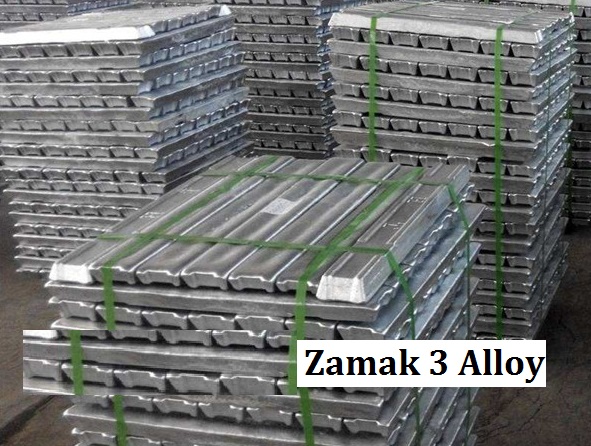
Zamak 3, Alloy 3, AG40A, White Metal, Casting Metal, Zinc Alloy, 7440-66-6, 7429-90-5, 7439-95-4, 7440-50-8
ZAMAK 3 – ZAMAK 3
1. CHEMICAL IDENTITY AND DEFINITION
| Parameter |
Information |
| Alloy Name |
Zamak 3 |
| Other Names |
Alloy 3, ZL0400, ZnAl4, AG40A, White Metal, Casting Metal, Zinc Alloy |
| Alloy Type |
Zinc-based casting alloy |
| Standards |
ASTM B240, EN 1774, ISO 301 |
| Appearance |
Silver-white, bright metallic |
| Odor |
Metallic (characteristic) |
| Physical State (20°C) |
Solid (metal) |
2. CHEMICAL COMPOSITION
| Element |
Symbol |
Percentage (%) |
CAS Number |
| Zinc (Base Metal) |
Zn |
~96% (balance) |
7440-66-6 |
| Aluminum |
Al |
3.8 – 4.2 |
7429-90-5 |
| Magnesium |
Mg |
0.035 – 0.06 |
7439-95-4 |
| Copper |
Cu |
≤ 0.03 |
7440-50-8 |
| Iron |
Fe |
≤ 0.02 |
7439-89-6 |
| Lead |
Pb |
≤ 0.003 |
7439-92-1 |
| Tin |
Sn |
≤ 0.001 |
7440-31-5 |
| Cadmium |
Cd |
≤ 0.001 |
7440-43-9 |
3. PHYSICAL PROPERTIES
| Property |
Value |
| Appearance |
Silver-white, bright metallic |
| Density (20°C) |
6.6 g/cm³ |
| Melting Point (Range) |
381 – 387 °C |
| Melting Point (Average) |
~385 °C |
| Thermal Conductivity |
113 W/mK |
| Electrical Resistivity |
6.37 μΩ-cm |
| Coefficient of Thermal Expansion |
27.4 μm/m°C |
| Specific Heat (20°C) |
~419 J/kg·K |
| Thermal Diffusivity |
~41.7 mm²/s |
4. MECHANICAL PROPERTIES
| Property |
Value |
| Tensile Strength |
~250 – 280 MPa |
| Yield Strength |
~208 – 220 MPa |
| Hardness (Brinell) |
~82 – 91 HB |
| Elongation (%) |
~10 – 15% |
| Impact Resistance (Charpy) |
~58 J |
| Modulus of Elasticity |
~96 GPa |
| Shear Modulus |
~36 GPa |
| Poisson's Ratio |
~0.25 |
5. THERMAL PROPERTIES
| Property |
Value |
| Melting Temperature Range |
381 – 387 °C |
| Casting Temperature |
410 – 440 °C |
| Thermal Conductivity |
113 W/mK |
| Coefficient of Thermal Expansion |
27.4 μm/m°C |
| Specific Heat Capacity |
~419 J/kg·K |
| Latent Heat of Fusion |
~113 kJ/kg |
6. ELECTRICAL PROPERTIES
| Property |
Value |
| Electrical Resistivity |
6.37 μΩ-cm |
| Electrical Conductivity |
~27% IACS |
| Temperature Coefficient |
~0.0038 /°C |
7. ZAMAK 3 STRUCTURE AND COMPONENTS
| Component |
Role |
Description |
| Zinc (Zn) |
Base metal |
Main component of the alloy, forms matrix |
| Aluminum (Al) |
Alloying element |
Increases strength, improves castability |
| Magnesium (Mg) |
Alloying element |
Improves corrosion resistance, refines grain structure |
| Copper (Cu) |
Additive element |
Increases strength and hardness |
8. ADVANTAGES OF ZAMAK 3
| Advantage |
Description |
| Excellent Castability |
Enables production of complex and detailed shapes |
| Dimensional Stability |
Provides long-term stability and precise tolerances |
| Plating Performance |
High performance in plating, painting, and chromating processes |
| Economic Efficiency |
Energy savings due to low melting point |
| Recyclability |
100% recyclable, environmentally friendly |
| Excellent Surface Quality |
Smooth surface, requires minimal finishing |
| High Strength |
High strength compared to other zinc alloys |
| Corrosion Resistance |
Good corrosion resistance |
9. APPLICATIONS
9.1. Automotive Industry
| Application |
Description |
| Brackets |
Mounting brackets and fastening elements |
| Housings |
Electronic control unit housings |
| Fasteners |
Screws, nuts, and other fastening parts |
| Door Locks |
Automotive door lock mechanisms |
| Seat Belt Components |
Seat belt system components |
9.2. Electronics and Electrical
| Application |
Description |
| Device Housings |
Electronic device enclosures |
| Connectors |
Electrical and electronic connectors |
| Protective Components |
Protective covers and housings |
| Socket and Switch Bodies |
Electrical socket and switch bodies |
| Coil Bobbins |
Electrical coil bobbins |
9.3. Consumer Products
| Application |
Description |
| Lock Systems |
Door locks, padlocks |
| Small Appliances |
Food processors, coffee machines |
| Hand Tools |
Screwdrivers, pliers body parts |
| Sports Equipment |
Sports equipment accessories |
9.4. Furniture and Decoration
| Application |
Description |
| Door Handles |
Interior and exterior door handles |
| Frames |
Picture and photo frames |
| Decorative Accessories |
Lamps, vases, and ornamental items |
| Furniture Accessories |
Hinges, knobs, and connecting parts |
9.5. Industrial Applications
| Application |
Description |
| Mechanical Parts |
Gears, bearings, shafts |
| Pump Bodies |
Small pump and valve bodies |
| Machine Accessories |
Industrial machine parts |
10. CASTING METHODS
| Method |
Description |
| Die Casting (Most Common) |
High-pressure injection, ideal for mass production |
| Centrifugal Casting |
Casting using rotating molds |
| Permanent Mold Casting |
Gravity casting in metal molds |
| Sand Casting |
Casting in sand molds (less common) |
11. SURFACE FINISHING PROCESSES
| Process |
Description |
| Plating |
Nickel, chromium, copper plating |
| Electroplating |
Electrochemical plating processes |
| Painting |
Powder coating, liquid painting applications |
| Chromating |
Yellow, green, black chromate coating |
| Phosphating |
Corrosion resistance enhancement |
| Polishing |
Achieving bright surface finish |
12. COMPARISON WITH OTHER ZAMAK ALLOYS
| Property |
Zamak 2 |
Zamak 3 |
Zamak 5 |
Zamak 7 |
| Zn (%) |
~94 |
~96 |
~95 |
~96 |
| Al (%) |
~3.9 |
~4.0 |
~4.0 |
~4.0 |
| Cu (%) |
~2.8 |
<0.03 |
~0.8 |
<0.03 |
| Mg (%) |
~0.05 |
~0.05 |
~0.05 |
~0.01 |
| Tensile Strength |
High |
Medium |
High |
Medium |
| Hardness |
High |
Medium |
High |
Medium |
| Dimensional Stability |
Low |
High |
Medium |
Very High |
| Application |
Demanding applications |
General purpose |
High strength |
Thin-walled casting |
13. ADVANTAGES AND DISADVANTAGES
Advantages
| Advantage |
Description |
| Excellent Castability |
Superior performance in complex geometries |
| Dimensional Stability |
Resistant to aging, long-term stability |
| High Plating Efficiency |
Compatible with all plating processes |
| Economic |
Low energy cost, high production speed |
| Recyclable |
100% recyclable |
Disadvantages
| Disadvantage |
Description |
| Moisture Sensitivity |
Dimensional changes in humid environments |
| Low Heat Resistance |
Not suitable for applications above 100°C |
| Aging Effect |
Microscopic dimensional changes over long term |
| Corrosion |
Better than pure zinc, but not as good as aluminum |
14. SAFETY AND HEALTH INFORMATION
| Parameter |
Information |
| Hazard |
Not hazardous in solid metal form |
| Dust and Fumes |
Inhalation may be harmful (ZnO fumes) |
| Molten State |
Causes severe burns |
| During Casting |
Proper ventilation required |
| Carcinogenicity |
Not classified as carcinogenic |
15. STORAGE AND HANDLING
| Parameter |
Information |
| Storage Conditions |
Dry, clean, well-ventilated area |
| Protect From |
Moisture, acids, alkalis, saline environments |
| Shelf Life |
Unlimited (with proper storage) |
| Molten State |
Used at 410-440°C casting temperature |
16. RECYCLING INFORMATION
| Parameter |
Information |
| Recyclability |
100% recyclable |
| Scrap Value |
High commercial value |
| Energy Savings |
70% energy savings compared to primary production |
| Environmental Impact |
Low environmental footprint |
17. STANDARDS AND SPECIFICATIONS
| Standard |
Description |
| ASTM B240 |
Zinc alloy casting ingot specification |
| EN 1774 |
Zinc and zinc alloys - Alloys for casting |
| ISO 301 |
Zinc alloy ingot specification |
| DIN 1743 |
Zinc casting alloys |
18. OTHER NAMES AND SYNONYMS
| Type |
Name |
| Technical Names |
Zamak 3, Alloy 3, ZL0400, ZnAl4, AG40A |
| Trade Names |
White Metal, Casting Metal, Durable Metal |
| Common Names |
Zinc Alloy, White Alloy |
| ASTM Grade |
AG40A |
| DIN |
ZnAl4 |
19. SUMMARY AND CRITICAL WARNINGS
Product Summary
| Parameter |
Value |
| Alloy |
Zamak 3 (Alloy 3) |
| Base Metal |
Zinc (~96%) |
| Alloying Elements |
Al (3.8-4.2%), Mg (0.035-0.06%), Cu (≤0.03%) |
| Melting Point |
381-387°C |
| Density |
6.6 g/cm³ |
| Primary Application |
Die casting parts |
CRITICAL WARNINGS
1. Chemical Composition: Zamak 3 contains approximately 96% zinc, 3.8-4.2% aluminum, 0.035-0.06% magnesium, and a maximum of 0.03% copper. These ratios are specified by standards.
2. Melting Point: With a melting range of 381-387°C, it provides low energy costs. Casting temperature is between 410-440°C.
3. Dimensional Stability: Zamak 3 exhibits good resistance to aging. The aging effect is at a microscopic level.
4. Corrosion Resistance: Better corrosion resistance than pure zinc, but not as good as aluminum. Protection can be enhanced with surface treatments.
5. Plating Suitability: Suitable for all coating processes (plating, painting, chromating).
6. Recycling: 100% recyclable, energy-efficient, and environmentally friendly.
7. Operating Temperature: Not suitable for long-term applications above 100°C.
8. Casting Method: The most common method is die casting. Ideal for complex and thin-walled parts.
9. Automotive and Electronics: The most common application areas are automotive and electronics industries.
10. Standards: Complies with ASTM B240, EN 1774, and ISO 301 standards.
IMPORTANT DISCLAIMER: This Technical Data Sheet (TDS) is for informational purposes only and is prepared based on available technical data. The user is responsible for determining the suitability of the product for their specific application and for complying with all local, national, and international regulations. For complete safety, storage, use, handling, disposal, and regulatory compliance information, refer to the official Safety Data Sheet (SDS/MSDS) provided by the manufacturer/supplier. This document is not a substitute for professional or medical advice.