We unleash your business potential by maximize the business innovation.
Send EmailVanilline, Vanillaldehyde, Vanillin NAT, Metyhl Vaniline, 121-33-5
Vanillin – Full Product Profile
1. Chemical Identity
-
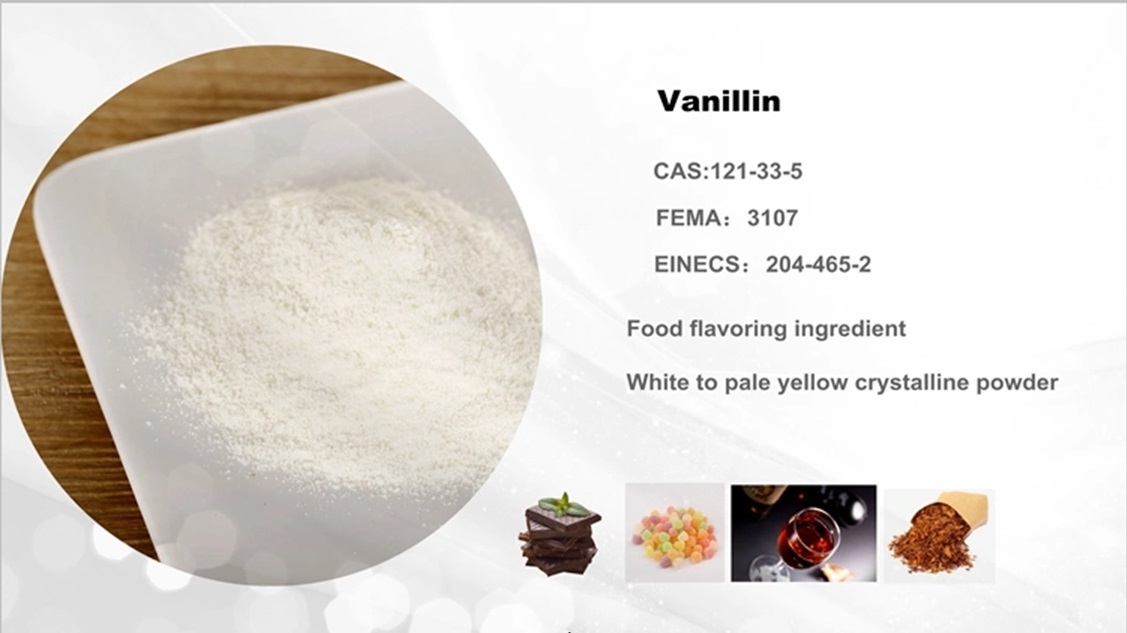
CAS Number: 121-33-5
-
Molecular Formula: C8H8O3
-
Molar Mass: 152.15 g/mol
-
IUPAC Name: 4-Hydroxy-3-methoxybenzaldehyde
-
Synonyms: Vanillaldehyde, Protocatechualdehyde methyl-, Vanillin NAT, Vanilline, etc.
-
FEMA Number: 3107
-
HS Code: 29124100
2. Physical & Chemical Properties
-
Appearance: White to pale yellow needle-like crystals, aromatic vanilla odor
-
Melting Point: 81–83 °C
-
Boiling Point: 170 °C (15 mmHg)
-
Density: 1.06 g/cm³
-
Solubility:
-
Water: 10 g/L at 25 °C
-
Soluble in ethanol, ether, chloroform, hot oils
-
-
pKa: 7.39 (phenolic OH group)
-
pH (10 g/L solution): 4.3
-
Stability: Sensitive to air, light, and moisture; oxidizes to vanillic acid; discolors in alkaline solution
-
Storage Conditions: 2–8 °C, protected from light and humidity
3. Industrial Production Methods
-
Lignin Route: Derived from sulfite pulp waste (Canada, USA)
-
Guaiacol–Formaldehyde Route (Nitroso Method): Used in Soviet Union and China
-
Guaiacol–Glyoxylic Acid Route: Developed by Rhone-Poulenc (France); currently the most efficient and environmentally friendly method
4. Applications
-
Food Industry:
-
Chocolate: up to 970 mg/kg
-
Chewing gum: 270 mg/kg
-
Cakes & biscuits: 220 mg/kg
-
Candy: 200 mg/kg
-
Cold drinks: 95 mg/kg
-
-
Cosmetics: Fixative, aroma coordinator, fragrance stabilizer
-
Pharmaceuticals: Intermediate for L-Dopa, Methyldopa
-
Other Uses: Tobacco flavoring, electroplating brightener, plant growth promoter
5. Toxicology & Safety
-
LD50 (oral, rat): ~1580 mg/kg
-
Hazard Classification: Irritant (Xi)
-
Risk Codes: R22 (harmful if swallowed), R36/37/38 (irritant to eyes, respiratory system, skin)
-
WGK (Germany): 1 – low water hazard
6. Market & Industry
-
Global Demand (2012): ~17,500 tons, with strong growth in developing countries
-
China: Largest producer (10,000 tons methyl vanillin, 2,000 tons ethyl vanillin annually)
-
Major International Producers: Rhodia (France), BOLI (Norway), Yubu (Japan)
-
Turkey: Primarily import-dependent, widely used in food and cosmetics
7. Regulatory Status
-
JECFA Number: 889
-
IFRA: No restrictions, but discoloration risk in white formulations
-
GB 2760 (China): Approved food additive, dosage limits defined
-
FAO/WHO: Max allowable in baby food/cereal: 70 mg/kg
8. Strategic Notes (for ERP/Product Card)
-
Critical Parameters: CAS, FEMA, HS Code, dosage limits, production method
-
Risk Management: Packaging and storage must prevent oxidation/discoloration
-
Supplier Benchmark:
-
China: High capacity, cost-effective
-
Europe/Japan: Higher quality, premium pricing
-
-
Application Share: Food 55%, Pharma 30%, Feed 10%, Cosmetics 5%
Vanillin – Sectoral Suitability & Usage Ratios
| Sector | Suitability | Typical Usage / Dosage |
|---|---|---|
| Food Industry | Widely used as a flavoring agent in baked goods, confectionery, beverages, dairy | Chocolate: 970 mg/kg; Chewing gum: 270 mg/kg; Cakes/Biscuits: 220 mg/kg; Candy: 200 mg/kg; Cold drinks: 95 mg/kg |
| Cosmetics | Fixative, fragrance stabilizer, aroma coordinator | Incorporated in perfumes, soaps, toothpaste; dosage varies depending on formulation |
| Pharmaceuticals | Intermediate in synthesis of L-Dopa, Methyldopa, catechol derivatives | Used as raw material; dosage not consumer-facing, depends on synthesis route |
| Feed Industry | Flavor additive for animal feed | Limited use; typically <0.1% depending on formulation |
| Tobacco | Flavoring agent for cigarettes and tobacco blends | Incorporated in flavoring mixtures; dosage varies by blend |
| Electroplating | Brightener in nickel/chromium plating | Technical additive; concentration depends on bath composition |
| Other Chemicals | Plant growth promoter, fungicide, lubricant defoaming agent | Application-specific; not standardized |
Vanillin Other names:
| Turkish | English |
|---|---|
| Vanilin | Vanillin |
| Vanillin Tozu | Vanillin Powder |
| Vanilline | Vanilline |
| Vanillin NAT | Vanillin NAT |
| Vanillaldehit | Vanillaldehyde |
| Doğal Vanillin | Vanillin natural |
| 2-Metoksi-4-formilfenol | 2-Methoxy-4-formylphenol |
| 4-Formil-2-metoksi-fenol | 4-Formyl-2-methoxyphenol |
| Protocatechualdehyde, metil- | Protocatechualdehyde, methyl- |
| 3-Metoksi-4-hidroksibenzaldehit | 3-Methoxy-4-hydroxybenzaldehyde |
| 4-Hidroksi-3-metoksibenzaldehit | 4-Hydroxy-3-methoxybenzaldehyde |
| 4-Hidroksi-3-metoksi-benzaldehit | 4-Hydroxy-3-methoxy-benzaldehyde |
| Vanillin (kimyasal tanım) | 3-Methoxy-4-hydroxybenzaldehyde (vanillin) |