We unleash your business potential by maximize the business innovation.
Send EmailVanillin, Vanilline, Methyl Vanillin, Vanillaldehyde, Vanillin NAT, 121-33-5
VANILLIN
PRODUCT IDENTIFIER INFORMATION
| Parameter | Information |
|---|---|
| Product Name | Vanillin |
| Chemical Name (IUPAC) | 4-Hydroxy-3-methoxybenzaldehyde |
| CAS Number | 121-33-5 |
| EC Number (EINECS) | 204-465-2 |
| FEMA Number | 3107 |
| JECFA Number | 889 |
| Molecular Formula | C8H8O3 |
| Molecular Weight | 152.15 g/mol |
SECTION 1: CHEMICAL IDENTITY AND DESCRIPTION
| Parameter | Information |
|---|---|
| Chemical Name (IUPAC) | 4-Hydroxy-3-methoxybenzaldehyde |
| Systematic Name | 3-Methoxy-4-hydroxybenzaldehyde |
| Synonyms | Vanillin, Vanillaldehyde, Methyl Vanillin, Vanillin NAT, Vanilline, 2-Methoxy-4-formylphenol, Protocatechualdehyde Methyl-, 4-Formyl-2-methoxyphenol |
| CAS Number | 121-33-5 |
| EC Number (EINECS) | 204-465-2 |
| FEMA Number | 3107 |
| JECFA Number | 889 |
| HS Code | 29124100 |
| Molecular Formula | C8H8O3 |
| Molecular Weight | 152.15 g/mol |
| Chemical Class | Phenolic aldehyde (vanilloid) |
| Functional Groups | Hydroxy (-OH), methoxy (-OCH3), formyl (-CHO) |
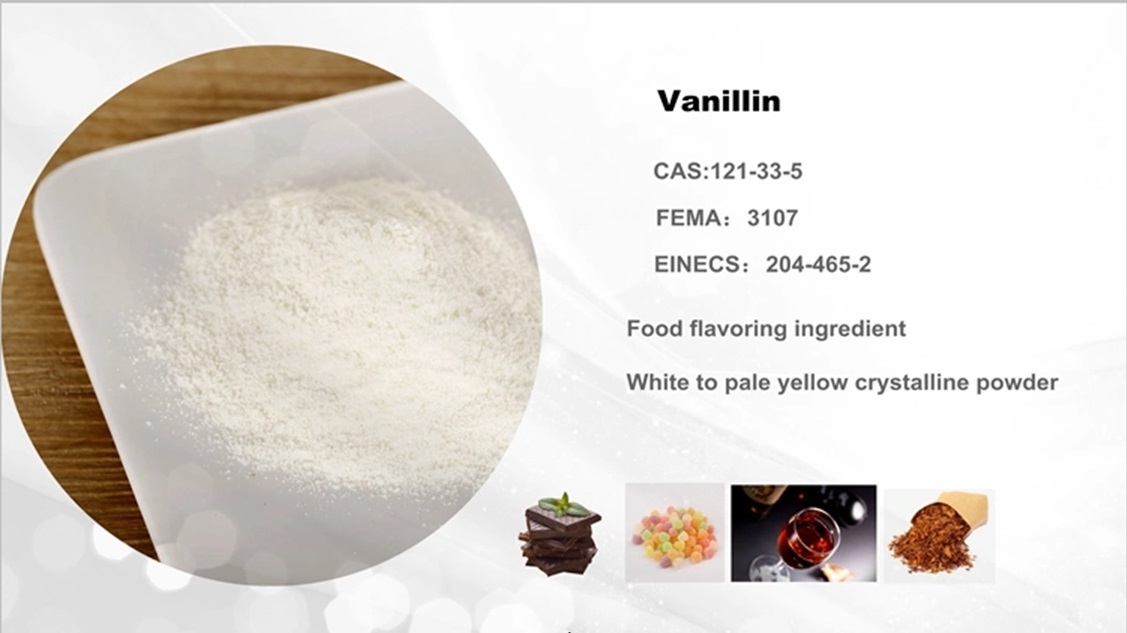
| Physical State (20°C) | Solid (white to yellowish needle crystals) |
| Odor | Characteristic intense vanilla |
| Taste | Sweet, vanilla-like |
SECTION 2: PHYSICAL AND CHEMICAL PROPERTIES
| Property | Value | Test Method |
|---|---|---|
| Appearance | White to yellowish needle crystals | Visual |
| Odor | Characteristic intense vanilla | Olfactometric |
| Taste | Sweet, vanilla-like | Sensory |
| Molecular Weight | 152.15 g/mol | Calculated |
| Melting Point | 81 – 83°C | DSC |
| Boiling Point | 170°C (15 mmHg) | ASTM D86 |
| Density (20°C) | 1.06 g/cm3 | ASTM D4052 |
| pKa (Phenolic OH) | 7.39 | Potentiometric |
| pH (10 g/L solution, 25°C) | ~4.3 | pH Meter |
| Solubility in Water (25°C) | ~10 g/L (moderately soluble) | Gravimetric |
| Solubility in Ethanol | Highly soluble | General Method |
| Solubility in Ether | Highly soluble | General Method |
| Solubility in Chloroform | Highly soluble | General Method |
| Solubility in Hot Oils | Highly soluble | General Method |
| Stability | Prone to oxidation in light and air; discolors in alkaline environment | |
| Flash Point | >100°C | ASTM D93 |
SECTION 3: CHEMICAL PROPERTIES AND REACTIVITY
| Parameter | Information |
|---|---|
| Chemical Character | Phenolic aldehyde; aromatic ring with -OH, -OCH3, and -CHO groups |
| Stability | Stable under normal conditions; prone to oxidation in light and air |
| Alkaline Environment | Discolors; oxidation accelerates |
| Decomposition Products (Heating) | CO, CO2, phenolic compounds |
| Incompatible Materials | Strong oxidizing agents, strong bases |
| Hazardous Polymerization | Does not occur |
SECTION 4: PRODUCTION METHODS
| Method | Source | Advantage | Disadvantage |
|---|---|---|---|
| Lignin Route | Paper industry sulfite waste liquor (lignosulfonates) | Waste utilization, low cost | Low yield, environmental burden |
| Guaiacol-Formaldehyde (Nitroso Method) | Guaiacol + formaldehyde + p-nitrosodimethylaniline | Widely used (Soviets/China) | Multi-step, high by-products |
| Guaiacol-Glyoxylic Acid Route | Guaiacol + glyoxylic acid | Fewer steps, low cost, environmentally friendly | Currently applied by Rhone-Poulenc |
SECTION 5: VANILLIN DERIVATIVES COMPARISON
| Property | Vanillin | Ethyl Vanillin | Methyl Vanillin |
|---|---|---|---|
| CAS Number | 121-33-5 | 121-32-4 | 120-14-9 |
| Molecular Formula | C8H8O3 | C9H10O3 | C9H10O3 |
| Molecular Weight | 152.15 | 166.17 | 166.17 |
| Melting Point | 81-83°C | 76-78°C | 42-43°C |
| Aroma Strength (Vanillin=1) | 1 | 3-4 | 1-2 |
| Odor Profile | Classic vanilla | Intense, elegant vanilla | Sweet, creamy vanilla |
| FEMA Number | 3107 | 2464 | - |
| Primary Use | Food, flavor, cosmetics | Confectionery, beverages, cosmetics | Perfumery |
SECTION 6: FUNCTIONAL PROPERTIES AND MECHANISM OF ACTION
| Property | Description |
|---|---|
| Flavoring Agent | Provides characteristic vanilla aroma and taste; widely used in food, cosmetics, and pharmaceuticals |
| Fixative / Fragrance Stabilizer | Increases longevity of fragrances in perfumes and cosmetics |
| Antioxidant | Exhibits antioxidant properties due to its phenolic structure |
| Pharmaceutical Intermediate | Used in synthesis of L-Dopa and Methyldopa |
| Electroplating Brightener | Brightness enhancer in nickel/chromium plating |
| Plant Growth Regulator | Plant growth promoter in certain applications |
SECTION 7: PRIMARY APPLICATION AREAS
| Sector / Application | Use | Typical Dosage / Concentration |
|---|---|---|
| Food - Chocolate | Flavoring agent | 970 mg/kg |
| Food - Chewing Gum | Flavoring agent | 270 mg/kg |
| Food - Cakes/Biscuits | Flavoring agent | 220 mg/kg |
| Food - Confectionery | Flavoring agent | 200 mg/kg |
| Food - Cold Beverages | Flavoring agent | 95 mg/kg |
| Cosmetic - Perfume, Soap | Fixative, fragrance coordinator | 0.1 – 2.0% |
| Cosmetic - Toothpaste, Cream | Flavoring agent | 0.05 – 0.5% |
| Pharmaceutical - L-Dopa Synthesis | Pharmaceutical intermediate | Process dependent |
| Feed Additives | Flavoring agent in animal feed | <0.1% |
| Tobacco | Flavor additive | Formulation dependent |
| Electroplating | Nickel/chromium brightener | Bath composition dependent |
SECTION 8: QUALITY SPECIFICATIONS (FOOD/FLAVOR GRADE)
| Parameter | Specification | Test Method |
|---|---|---|
| Appearance | White to yellowish needle crystals | Visual |
| Odor | Characteristic intense vanilla | Olfactometric |
| Purity (GC) | ≥ 99.0% | GC-FID |
| Melting Range | 81 – 83°C | DSC / Capillary Tube |
| Loss on Drying (105°C, 2 hours) | ≤ 0.5% | Gravimetric |
| Ash Content | ≤ 0.05% | Gravimetric (600°C) |
| Heavy Metals (as Pb) | ≤ 10 ppm | ICP-MS |
| Lead (Pb) | ≤ 2 ppm | ICP-MS |
| Arsenic (As) | ≤ 3 ppm | ICP-MS |
| Mercury (Hg) | ≤ 1 ppm | ICP-MS |
| Cadmium (Cd) | ≤ 1 ppm | ICP-MS |
| Total Microbial Count | ≤ 1,000 CFU/g | ISO 4833 |
| Yeast and Mold | ≤ 100 CFU/g | ISO 21527 |
| E. coli | Negative in 10g | ISO 16649 |
| Salmonella spp. | Negative in 25g | ISO 6579 |
SECTION 9: TOXICOLOGICAL PROFILE
| Parameter | Value |
|---|---|
| Acute Oral Toxicity (LD50, Rat) | ~1,580 mg/kg |
| Skin Irritation | Irritant (R36/37/38) |
| Eye Irritation | Irritant |
| Respiratory Irritation | Irritant |
| Carcinogenicity | Not classified |
| Mutagenicity | Negative in in vitro tests |
| ADI (Acceptable Daily Intake) | 0-10 mg/kg body weight/day (JECFA) |
| GRAS Status | FEMA GRAS (3107) |
| WGK (Germany) | 1 (low water hazard) |
SECTION 10: GHS CLASSIFICATION AND LABELING
GHS Classification (compliant with 1272/2008/EC):
| Hazard Class | Category | H-Statement |
|---|---|---|
| Acute Toxicity (Oral) | Category 4 | H302 |
| Skin Irritation | Category 2 | H315 |
| Eye Irritation | Category 2 | H319 |
| STOT - SE | Category 3 | H335 |
Signal Word: WARNING
Hazard Pictograms: GHS07 (Exclamation Mark)
Hazard Statements (H-Codes):
| Code | Statement |
|---|---|
| H302 | Harmful if swallowed |
| H315 | Causes skin irritation |
| H319 | Causes serious eye irritation |
| H335 | May cause respiratory irritation |
Precautionary Statements (P-Codes):
| Code | Statement |
|---|---|
| P261 | Avoid breathing dust |
| P280 | Wear protective gloves/eye protection |
| P302+P352 | IF ON SKIN: Wash with plenty of water and soap |
| P305+P351+P338 | IF IN EYES: Rinse cautiously with water for several minutes |
SECTION 11: FIRST AID MEASURES
| Exposure Route | Action to Take |
|---|---|
| Inhalation | Move to fresh air. Seek medical attention if respiratory irritation persists. |
| Skin Contact | Wash with plenty of water and soap for at least 15 minutes. Seek medical attention if irritation persists. |
| Eye Contact | Rinse immediately with plenty of water for at least 15 minutes. Remove contact lenses if present. Seek medical attention. |
| Ingestion | Rinse mouth with water. Drink plenty of water. Seek medical attention if you feel unwell. |
SECTION 12: FIREFIGHTING MEASURES
| Parameter | Information |
|---|---|
| Fire Hazard | Combustible organic powder |
| Hazards During Fire | CO, CO2, phenolic compounds |
| Suitable Extinguishing Media | Water mist, CO2, dry chemical powder, foam |
| Special Protective Equipment | Self-contained breathing apparatus (SCBA), full protective clothing |
| Special Precautions | Prevent dust accumulation; avoid sparks |
SECTION 13: STORAGE AND SHELF LIFE
| Parameter | Information |
|---|---|
| Storage Conditions | 2-8°C (recommended); cool, dry, protect from light and moisture |
| Container Requirements | Tightly closed, light-resistant containers |
| Keep Away From | Light, air (oxygen), strong oxidizing agents, strong bases |
| Shelf Life | 36 months (unopened original packaging under appropriate storage conditions) |
| Stability Note | Prone to oxidation in light and air; discolors in alkaline environment |
SECTION 14: PACKAGING OPTIONS
| Packaging Type | Quantity | Material |
|---|---|---|
| Aluminum foil pouch (light-protective) | 1 kg | Laminated aluminum |
| Aluminum foil pouch (light-protective) | 5 kg | Laminated aluminum |
| Kraft bag with PE inner liner | 25 kg | Kraft paper + PE |
| Fiber drum (light-protected) | 25-50 kg | Fiberboard + PE |
SECTION 15: TRANSPORTATION INFORMATION
| Parameter | Information |
|---|---|
| UN Number | Not regulated (not hazardous) |
| Hazard Class | Not applicable |
| Packing Group | Not applicable |
| ADR/RID | Not regulated |
| IMDG Code | Not regulated |
| IATA (Air) | Not regulated |
| Marine Pollutant | No |
| Transport Temperature | Ambient; protect from light and moisture |
SECTION 16: REGULATORY STATUS
| Region / Authority | Status |
|---|---|
| European Union | Approved as flavoring substance (EC 1334/2008) |
| USA (FDA) | FEMA GRAS (3107); approved for food flavor use |
| JECFA (FAO/WHO) | ADI: 0-10 mg/kg body weight/day |
| IFRA | No usage restriction; attention to discoloration risk in white products |
| Turkey | Approved under Turkish Food Codex Flavoring Regulation |
| Halal / Kosher / Vegan | Available |
SECTION 17: OTHER NAMES AND SYNONYMS
| Type | Name |
|---|---|
| Common Names | Vanillin, Vanillaldehyde, Methyl Vanillin, Vanillin NAT |
| Chemical Names | 4-Hydroxy-3-methoxybenzaldehyde, 3-Methoxy-4-hydroxybenzaldehyde, 2-Methoxy-4-formylphenol |
| FEMA Number | 3107 |
| JECFA Number | 889 |
| HS Code | 29124100 |
| CAS Number | 121-33-5 |
| EC Number | 204-465-2 |
SECTION 18: SECTORAL SUITABILITY AND USAGE RATES
| Sector | Suitability | Typical Usage / Dosage |
|---|---|---|
| Food Industry | Most common use; flavor enhancer for creamy and vanilla flavors | Chocolate: 970 mg/kg; Gum: 270 mg/kg; Cakes/Biscuits: 220 mg/kg; Confectionery: 200 mg/kg; Cold beverages: 95 mg/kg |
| Cosmetics | Fixative, fragrance stabilizer, aroma coordinator | Perfume, soap, toothpaste, cream formulations; dosage varies |
| Pharmaceutical | Intermediate in L-Dopa, Methyldopa production | Process dependent |
| Feed Additives | Limited use as flavoring agent in animal feed | Generally <0.1% |
| Tobacco | Cigarette and tobacco flavors | Formulation dependent |
| Electroplating | Nickel/chromium plating brightener | Bath composition dependent |
SECTION 19: MARKET AND INDUSTRY OVERVIEW
| Parameter | Information |
|---|---|
| Global Demand (2012) | ~17,500 tons, increasing trend in developing countries |
| Major Producers | Rhodia (France), BOLI (Norway), Yubu (Japan) |
| China Production | World's largest producer (~10,000 tons methyl vanillin, ~2,000 tons ethyl vanillin/year) |
| Market Share by Sector | Food 55%, Pharmaceutical 30%, Feed 10%, Cosmetics 5% |
| Turkey Status | Import-dependent; intensive use in food and cosmetics sectors |
SECTION 20: SUMMARY TABLE
| Parameter | Value |
|---|---|
| Product | Vanillin |
| CAS Number | 121-33-5 |
| FEMA Number | 3107 |
| JECFA Number | 889 |
| Molecular Formula | C8H8O3 |
| Molecular Weight | 152.15 g/mol |
| Appearance | White to yellowish needle crystals |
| Melting Point | 81 – 83°C |
| Solubility in Water (25°C) | ~10 g/L |
| Primary Function | Characteristic vanilla flavoring agent, fixative |
| Shelf Life | 36 months |
| GHS Signal Word | Warning |
SECTION 21: CRITICAL WARNINGS AND BEST PRACTICES
CRITICAL WARNINGS:
-
Light and Air Sensitivity: Prone to oxidation in light and air; store in light-resistant containers.
-
Alkaline Environment: Discolors in alkaline environment; exercise caution in white products.
-
Skin/Eye Irritation: Shows irritant properties; use protective equipment.
-
Harmful if Swallowed: Harmful at high doses; comply with dosage limits in food applications.
BEST PRACTICE RECOMMENDATIONS:
-
Dosage Control: Use in range of 95-970 mg/kg for typical food applications.
-
Pre-dissolution: Pre-dissolve in ethanol or propylene glycol for aqueous formulations.
-
IFRA Warning: Test for discoloration risk in white products.
-
Storage: Store at 2-8°C, protected from light and moisture.
LEGAL DISCLAIMER:
The information provided in this document is presented in good faith based on our current knowledge and experience; however, since all usage conditions are beyond our control, it does not constitute a binding specification or warranty. This Technical Data Sheet is for informational purposes only. Users are obligated to test the suitability for their own applications. For complete safety, storage, handling, transportation, disposal, and regulatory compliance information, refer to the official Safety Data Sheet (SDS/MSDS) provided by the manufacturer/supplier.