We unleash your business potential by maximize the business innovation.
Send EmailTartrazine, Yellow 5, Food Yellow 4, CI 19140, Acid Yellow 23, E102, 1934-21-0
TARTRAZINE (E102)
PRODUCT IDENTIFIER INFORMATION
| Parameter | Information |
|---|---|
| Product Name | Tartrazine |
| Chemical Name (IUPAC) | Trisodium 5-hydroxy-1-(4-sulfonatophenyl)-4-(4-sulfonatophenylazo)-1H-pyrazole-3-carboxylate |
| CAS Number | 1934-21-0 |
| EC Number (EINECS) | 217-699-5 |
| Food Additive Code | E102 |
| Colour Index No. | 19140 |
| Molecular Formula | C16H9N4Na3O9S2 |
| Molecular Weight | 534.36 g/mol |
SECTION 1: CHEMICAL IDENTITY AND DESCRIPTION
| Parameter | Information |
|---|---|
| Chemical Name (IUPAC) | Trisodium 5-hydroxy-1-(4-sulfonatophenyl)-4-(4-sulfonatophenylazo)-1H-pyrazole-3-carboxylate |
| Synonyms | Tartrazine, E102, FD&C Yellow No. 5, Food Yellow 4, CI 19140, Acid Yellow 23, Sarı Gıda Boyası, Tartrazin Sarı |
| CAS Number | 1934-21-0 |
| EC Number (EINECS) | 217-699-5 |
| Food Additive Code | E102 |
| Colour Index (CI) No. | 19140 |
| INS Number | 102 |
| Molecular Formula | C16H9N4Na3O9S2 |
| Molecular Weight | 534.36 g/mol |
| Chemical Class | Synthetic azo dye (pyrazolone); triarylmethane group |
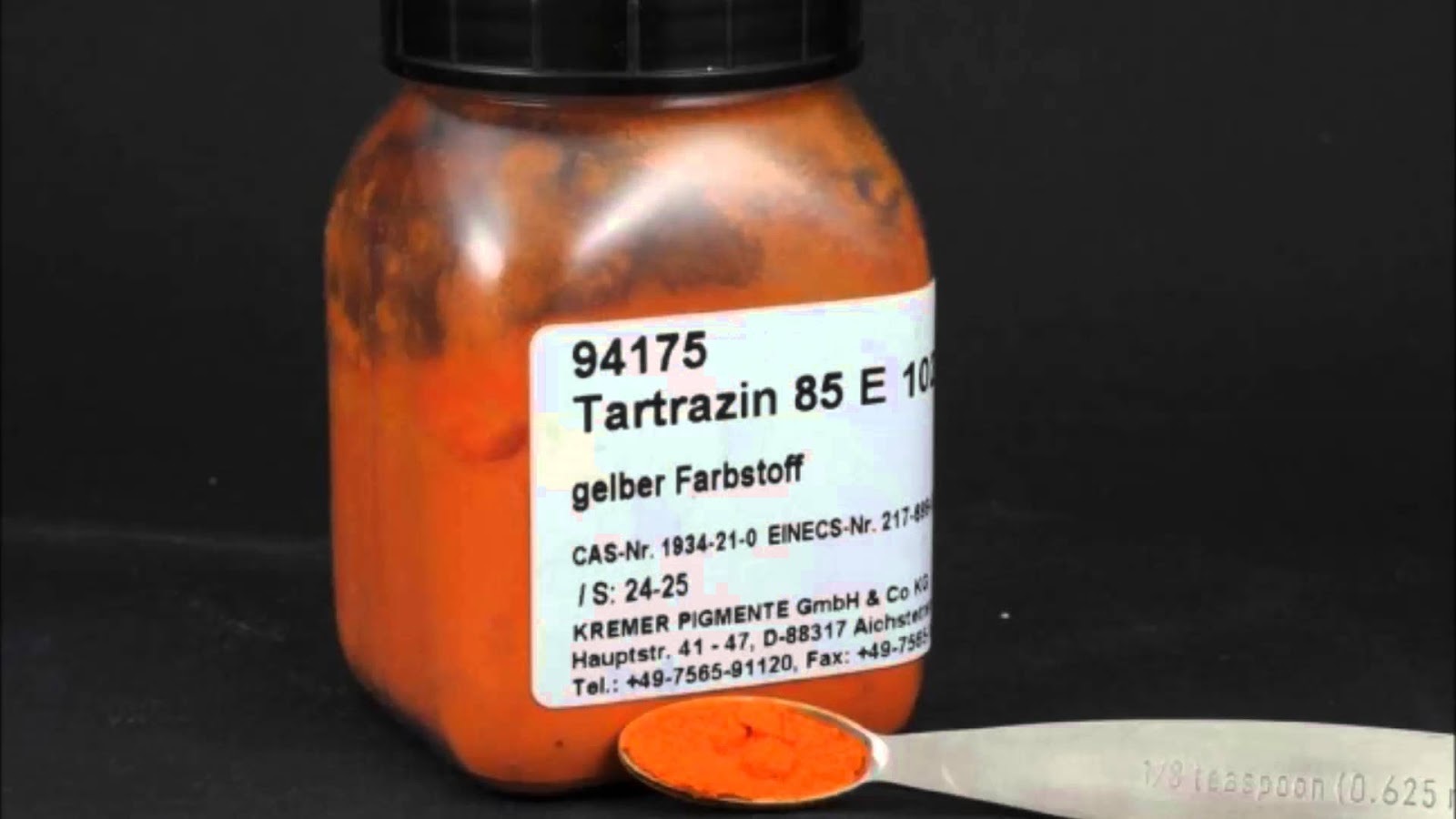
| Physical State (20°C) | Solid (yellow to orange-yellow powder or granules) |
| Odor | Odorless |
| Taste | Slightly characteristic |
SECTION 2: PHYSICAL AND CHEMICAL PROPERTIES
| Property | Value | Test Method |
|---|---|---|
| Appearance | Yellow to orange-yellow powder or granules | Visual |
| Odor | Odorless | Olfactometric |
| Solubility in Water (25°C) | Freely soluble (~260 g/L) | Gravimetric |
| Solubility in Ethanol | Slightly soluble | General Method |
| Solubility in Glycerol | Soluble | General Method |
| pH (1% solution, 25°C) | 6.0 – 8.0 (neutral) | pH Meter |
| Light Stability | Moderate (may fade under prolonged UV exposure) | ICH Q1B |
| Heat Stability | Good up to 150°C | TGA |
| Stability | Stable under normal conditions; sensitive to reducing agents and strong oxidizing agents | |
| Hygroscopicity | Low-Moderate | Visual |
SECTION 3: CHEMICAL PROPERTIES AND REACTIVITY
| Parameter | Information |
|---|---|
| Chemical Character | Synthetic azo dye (pyrazolone derivative); anionic water-soluble colorant |
| Stability | Stable under normal conditions |
| Decomposition Products (Heating) | Above 150°C: CO, CO2, NOx, SOx, Na2O |
| Incompatible Materials | Strong reducing agents (ascorbic acid, sulfites), strong oxidizing agents, strong acids |
| Reaction with Reducing Agents | Azo bond (-N=N-) may be cleaved causing color fading |
| Light Sensitivity | Moderate; prolonged UV exposure may cause photodegradation |
| Hazardous Polymerization | Does not occur |
SECTION 4: SYNTHETIC YELLOW FOOD COLORS COMPARISON
| Property | Tartrazine (E102) | Quinoline Yellow (E104) | Sunset Yellow (E110) |
|---|---|---|---|
| CAS Number | 1934-21-0 | 8004-92-0 | 2783-94-0 |
| Colour Index No. | 19140 | 47005 | 15985 |
| Chemical Class | Azo (pyrazolone) | Quinophthalone | Azo |
| Shade | Lemon yellow | Greenish yellow | Orange-yellow |
| Solubility in Water | ~260 g/L | ~100 g/L | ~190 g/L |
| Light Stability | Moderate | Moderate | Good |
| Heat Stability | Good up to 150°C | Good up to 150°C | Good up to 150°C |
| pH Stability | Good (pH 3-8) | Good (pH 3-8) | Good (pH 3-8) |
| Regulatory Status (EU) | E102 | E104 | E110 |
SECTION 5: FUNCTIONAL PROPERTIES AND MECHANISM OF ACTION
| Property | Description |
|---|---|
| Water-Soluble Colorant | Provides bright lemon-yellow shade; highly soluble in water for homogeneous distribution |
| Visual Appeal Enhancer | Increases consumer appeal by providing vibrant, consistent color to food and beverage products |
| Color Standardization | Ensures batch-to-batch color consistency in industrial food production |
| Versatile Application | Compatible with a wide range of food matrices (beverages, confectionery, dairy, bakery) |
| Blending Capability | Can be blended with other colors (e.g., Sunset Yellow E110, Brilliant Blue E133) to produce various green and orange shades |
| Heat Stability | Maintains color integrity during pasteurization and baking processes up to 150°C |
| Acid Stability | Stable in acidic food systems (pH 3-8) making it suitable for soft drinks and confectionery |
SECTION 6: PRIMARY APPLICATION AREAS
| Sector / Application | Use | Typical Concentration / Dosage |
|---|---|---|
| Beverages - Soft Drinks | Coloring (lemon, citrus, sports drinks) | 10 – 50 mg/L |
| Beverages - Powdered Drink Mixes | Coloring | 50 – 200 mg/kg |
| Confectionery - Candies, Gummies | Coloring | 50 – 300 mg/kg |
| Confectionery - Chewing Gum | Coloring | 50 – 300 mg/kg |
| Dairy - Yogurt, Flavored Milk | Coloring | 10 – 50 mg/kg |
| Dairy - Ice Cream, Puddings | Coloring | 30 – 100 mg/kg |
| Bakery - Cakes, Pastries | Coloring | 50 – 200 mg/kg |
| Breakfast Cereals | Coloring | 50 – 200 mg/kg |
| Jams, Jellies, Marmalades | Coloring | 50 – 200 mg/kg |
| Pickles, Processed Vegetables | Coloring | 50 – 300 mg/kg |
| Cosmetics - Makeup (Eye Shadow, Blush) | Coloring | 0.1 – 5% |
| Cosmetics - Lipsticks, Nail Polish | Coloring | 0.1 – 5% |
| Pharmaceutical - Tablets, Capsules | Coloring | 0.1 – 1% |
| Pharmaceutical - Syrups, Suspensions | Coloring | 10 – 50 mg/L |
SECTION 7: QUALITY SPECIFICATIONS (FOOD GRADE - E102)
| Parameter | Specification | Test Method |
|---|---|---|
| Appearance | Yellow to orange-yellow powder or granules | Visual |
| Purity (Total Dye Content) | ≥ 85.0% | Spectrophotometric |
| Loss on Drying (105°C, 2 hours) | ≤ 10.0% | Gravimetric |
| Water Insoluble Matter | ≤ 0.2% | Gravimetric |
| Chloride and Sulfate (as NaCl) | ≤ 5.0% | Titrimetric |
| Subsidiary Dyes | ≤ 1.0% | HPLC |
| Organic Compounds Other Than Coloring Matters | ≤ 0.5% | HPLC |
| Unsulfonated Primary Aromatic Amines | ≤ 0.01% (calculated as aniline) | HPLC |
| Ether Extractable Matter | ≤ 0.2% | Gravimetric |
| Heavy Metals (as Pb) | ≤ 40 ppm | ICP-MS |
| Lead (Pb) | ≤ 2 ppm | ICP-MS |
| Arsenic (As) | ≤ 3 ppm | ICP-MS |
| Mercury (Hg) | ≤ 1 ppm | ICP-MS |
| Cadmium (Cd) | ≤ 1 ppm | ICP-MS |
| Total Microbial Count | ≤ 1,000 CFU/g | ISO 4833 |
| Yeast and Mold | ≤ 100 CFU/g | ISO 21527 |
| E. coli | Negative in 10g | ISO 16649 |
| Salmonella spp. | Negative in 25g | ISO 6579 |
SECTION 8: TOXICOLOGICAL PROFILE
| Parameter | Value |
|---|---|
| Acute Oral Toxicity (LD50, Rat) | > 5,000 mg/kg (low toxicity) |
| Skin Irritation | Not irritating |
| Eye Irritation | Mild mechanical irritation (dust) |
| Respiratory Irritation | Inhalation of dust may cause mechanical irritation |
| Skin Sensitization | Low sensitization potential |
| Carcinogenicity | Not classified (IARC, NTP) |
| Mutagenicity | Negative in standard tests |
| Reproductive Toxicity | No known adverse effects at permitted levels |
| ADI (Acceptable Daily Intake) | 0-10 mg/kg body weight/day (JECFA, 2016) |
| Allergenicity | May cause allergic reactions in sensitive individuals (especially aspirin-sensitive) |
| Hyperactivity | Southampton study suggested possible link with hyperactivity in children (with other azo dyes) |
| EU Labeling Requirement | "May have an adverse effect on activity and attention in children" |
SECTION 9: GHS CLASSIFICATION AND LABELING
GHS Classification (compliant with 1272/2008/EC):
| Hazard Class | Category | H-Statement |
|---|---|---|
| Not classified | - | Not classified as hazardous according to current regulations |
Signal Word: No signal word (not classified as hazardous)
Hazard Pictograms: No pictograms required
Precautionary Statements:
| Code | Statement |
|---|---|
| P261 | Avoid breathing dust |
| P280 | Wear protective goggles (in dusty environments) |
| P305+P351+P338 | IF IN EYES: Rinse cautiously with water for several minutes |
SECTION 10: FIRST AID MEASURES
| Exposure Route | Action to Take |
|---|---|
| Inhalation | Move to fresh air. Seek medical attention if respiratory irritation persists. |
| Skin Contact | Wash with plenty of water and soap. |
| Eye Contact | Rinse immediately with plenty of water for at least 15 minutes. Remove contact lenses if present. Seek medical attention if irritation persists. |
| Ingestion | Rinse mouth with water. Drink plenty of water. Seek medical attention if you feel unwell. |
SECTION 11: FIREFIGHTING MEASURES
| Parameter | Information |
|---|---|
| Fire Hazard | Combustible organic powder; dust explosion risk |
| Hazards During Fire | CO, CO2, NOx, SOx |
| Suitable Extinguishing Media | Water mist, CO2, dry chemical powder, foam |
| Special Protective Equipment | Self-contained breathing apparatus (SCBA), full protective clothing |
| Special Precautions | Prevent dust accumulation; avoid sparks |
SECTION 12: STORAGE AND SHELF LIFE
| Parameter | Information |
|---|---|
| Storage Conditions | Cool (15-25°C), dry, well-ventilated area; protect from direct light |
| Container Requirements | Tightly closed, light-resistant containers |
| Keep Away From | Strong reducing agents (ascorbic acid, sulfites), strong oxidizing agents, strong acids |
| Shelf Life | 60 months (5 years) unopened original packaging under appropriate storage conditions |
| Stability Note | Moderate light sensitivity; may fade under prolonged UV exposure; protect from light |
SECTION 13: PACKAGING OPTIONS
| Packaging Type | Quantity | Material |
|---|---|---|
| Aluminum foil pouch (light-protective) | 1 kg | Laminated aluminum |
| Aluminum foil pouch (light-protective) | 5 kg | Laminated aluminum |
| Kraft bag with PE inner liner | 25 kg | Kraft paper + PE |
| Fiber drum | 25-50 kg | Fiberboard + PE |
SECTION 14: TRANSPORTATION INFORMATION
| Parameter | Information |
|---|---|
| UN Number | Not regulated (not hazardous) |
| Hazard Class | Not applicable |
| Packing Group | Not applicable |
| ADR/RID | Not regulated |
| IMDG Code | Not regulated |
| IATA (Air) | Not regulated |
| Marine Pollutant | No |
| Transport Temperature | Ambient; protect from light and moisture |
SECTION 15: REGULATORY STATUS
| Region / Authority | Status |
|---|---|
| European Union | Approved food color E102; specific labeling required (adverse effect warning) |
| USA (FDA) | FD&C Yellow No. 5; approved with certification; labeling required |
| JECFA (FAO/WHO) | ADI: 0-10 mg/kg body weight/day |
| Codex Alimentarius | Listed in GSFA; INS 102 |
| Turkey | Approved under Turkish Food Codex Regulation on Food Additives |
| Australia/New Zealand | Approved with restrictions |
| Halal | Available |
| Kosher | Available |
| Vegetarian/Vegan | Suitable (synthetic origin) |
SECTION 16: OTHER NAMES AND SYNONYMS
| Type | Name |
|---|---|
| Common Names | Tartrazine, E102, FD&C Yellow No. 5, Food Yellow 4, CI 19140 |
| Chemical Names | Acid Yellow 23, Trisodium 5-hydroxy-1-(4-sulfonatophenyl)-4-(4-sulfonatophenylazo)-1H-pyrazole-3-carboxylate |
| Other Language Names | Tartrazin, Tartrazina, Tartrazin Sarı, Sarı Gıda Boyası |
| CAS Number | 1934-21-0 |
| EC Number | 217-699-5 |
| Colour Index No. | 19140 |
SECTION 17: SUMMARY TABLE
| Parameter | Value |
|---|---|
| Product | Tartrazine (E102) |
| CAS Number | 1934-21-0 |
| Food Additive Code | E102 |
| Colour Index No. | 19140 |
| Molecular Formula | C16H9N4Na3O9S2 |
| Molecular Weight | 534.36 g/mol |
| Appearance | Yellow to orange-yellow powder or granules |
| Solubility in Water | ~260 g/L |
| pH (1% solution) | 6.0 – 8.0 |
| Primary Function | Synthetic water-soluble yellow food colorant |
| Shelf Life | 60 months (5 years) |
| GHS Signal Word | Not classified |
SECTION 18: CRITICAL WARNINGS AND BEST PRACTICES
CRITICAL WARNINGS:
-
EU Labeling: In the EU, products containing Tartrazine must carry the warning: "May have an adverse effect on activity and attention in children."
-
Aspirin Sensitivity: Individuals with aspirin intolerance or asthma may show cross-sensitivity to Tartrazine.
-
Reducing Agents: Contact with reducing agents (ascorbic acid, sulfites) may cause azo bond cleavage and color fading.
-
Light Sensitivity: Moderate light sensitivity; prolonged UV exposure may cause photodegradation and fading.
-
Dust Explosion Risk: Fine powder may form explosive dust-air mixtures; avoid dust accumulation.
BEST PRACTICE RECOMMENDATIONS:
-
Solution Preparation: Dissolve in water before adding to formulations for homogeneous distribution.
-
pH Stability: Optimal stability at pH 3-8; avoid strongly acidic (pH <2) or strongly alkaline (pH >10) environments.
-
Light Protection: Store in light-resistant containers; protect finished products from direct sunlight.
-
Allergen Labeling: Always declare on product labels per local regulatory requirements.
-
Blending: Can be blended with other certified colors to achieve desired shades; test stability in final formulation.
LEGAL DISCLAIMER:
The information provided in this document is presented in good faith based on our current knowledge and experience; however, since all usage conditions are beyond our control, it does not constitute a binding specification or warranty. This Technical Data Sheet is for informational purposes only. Users are obligated to test the suitability for their own applications. For complete safety, storage, handling, transportation, disposal, and regulatory compliance information, refer to the official Safety Data Sheet (SDS/MSDS) provided by the manufacturer/supplier.