We unleash your business potential by maximize the business innovation.
Send EmailMenthol, Mentyl Alcohol, 15356-70-4, 1490-04-6
Menthol: A Detailed Overview
Menthol is a fascinating organic compound with a unique set of properties that make it indispensable across multiple industries, from food and pharmaceuticals to cosmetics. This detailed analysis covers its identity, physical characteristics, mechanism of action, sources, and diverse applications.
1. Chemical Identity: Who is Menthol?
-
Molecular Formula: C₁₀H₂₀O
-
Molecular Weight: 156.26 g/mol
-
IUPAC Name: 2-Isopropyl-5-methylcyclohexanol (This name precisely describes its 3D structure).
-
Chemical Class: It is a cyclic terpene alcohol. The presence of the hydroxyl (-OH) group classifies it as an alcohol.
-
Other Names: Peppermint camphor, mint camphor.
-
CAS Numbers: The most common and naturally occurring form, (-)-Menthol, has the CAS number 1490-04-6. The racemic mixture (DL-Menthol) is identified by 15356-70-4.
2. Physical and Sensory Properties: The White Crystalline Magic
-
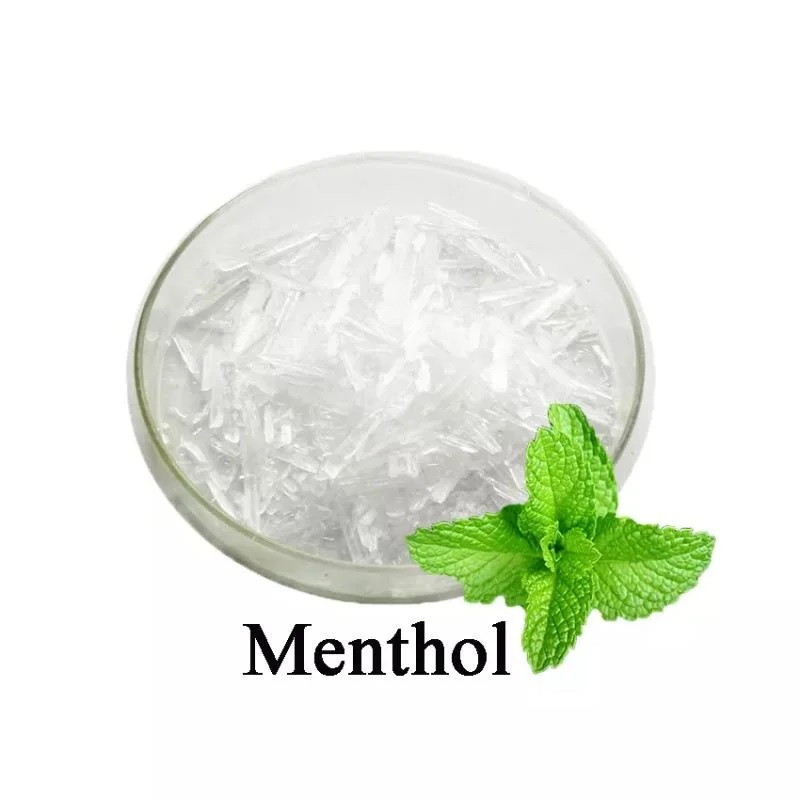
Appearance: At room temperature (20-25°C or 68-77°F), menthol is typically a white, crystalline solid, often forming needle-like structures. It can become a viscous liquid near its melting point.
-
Odor and Taste: It possesses a characteristic, refreshing, minty odor that is slightly sweet and pungent. Its taste is similarly minty, cooling, and produces a sensation of numbness.
-
Thermal Behavior:
-
Melting Point: 31-43 °C (88-109 °F), depending on isomeric purity. The most desirable L-Menthol form melts at around 42-43 °C (108-109 °F). This means it can melt upon contact with skin (approx. 37°C or 98.6°F).
-
Boiling Point: Approximately 212 °C (414 °F).
-
Sublimation: It sublimes readily at room temperature, meaning it can transition directly from a solid to a gas. This is why it must be stored in tightly sealed containers.
-
-
Density: Approximately 0.89 g/cm³ (in liquid form), making it less dense than water.
-
Solubility: It is poorly soluble in water (approx. 0.4 g/L at 25°C). However, it is highly soluble in organic solvents such as ethanol, chloroform, ether, hexane, and glacial acetic acid.
3. The Key Property: The Cooling Sensation (TRPM8 Receptor)
The most defining characteristic of menthol is its ability to create a distinct sensation of coolness without an actual drop in temperature. This mechanism, understood since the early 2000s, is a perfect example of molecular biology in action:
-
The Target: Menthol targets a specific ion channel on sensory neurons (nerve cells) in the skin and mucous membranes called TRPM8 (Transient Receptor Potential Melastatin 8), also known as the cold and menthol receptor 1 (CMR1).
-
The Action: When menthol molecules bind to the TRPM8 channel, they lower its activation threshold. Normally, this channel only opens at cooler temperatures (below ~25°C or 77°F). In the presence of menthol, the channel opens at much warmer temperatures, even as high as 30-35°C (86-95°F).
-
The Signal: The opening of the channel allows positively charged ions, particularly calcium (Ca²⁺) , to flow into the neuron. This influx of ions generates an electrical signal (action potential).
-
The Result: This signal travels to the brain, which interprets it as a sensation of cold, despite the skin's temperature being normal. This cooling sensation is often accompanied by a mild analgesic (pain-numbing) effect.
4. Stereoisomerism: Mirror-Image Molecules
Menthol has several stereoisomers (optically active forms), but the most significant are:
-
(-)-Menthol (L-Menthol): This is the most abundant form in nature and possesses the characteristic refreshing, minty, and cooling taste. It is the commercially most valuable isomer.
-
(+)-Menthol (D-Menthol): Less common, it has a different sensory profile, described as less cooling, more bitter, and with camphor-like notes.
-
(±)-Menthol (DL-Menthol or Racemic Menthol): An equal mixture of the L and D forms, with a weaker odor and taste profile.
For applications in food, medicine, and cosmetics, high-purity L-Menthol is the most sought-after form.
5. Source and Production: From Nature to Lab
-
Natural Source: Primarily obtained from the essential oils of mint plants, most notably Cornmint (Mentha arvensis) and Peppermint (Mentha piperita) . It is extracted through processes like steam distillation followed by cooling and crystallization.
-
Synthetic Production: Due to high demand, menthol is also produced synthetically from other chemical starting materials like thymol, citronellal, or petrochemical derivatives. However, natural menthol is often preferred for food and aromatherapy applications.
6. Applications: A Versatile Compound
A. Food and Flavoring Industry:
-
One of the most important flavoring agents globally, after vanilla and citrus.
-
Used to impart a minty flavor and cooling sensation in chewing gum, candies, chocolates, and beverages.
B. Pharmaceuticals and Medicine:
-
Topical Analgesic: Found in creams and gels for muscle and joint pain (often combined with methyl salicylate or camphor). It provides pain relief through cooling and mild local anesthesia.
-
Cough and Cold Remedies: Included in cough drops, syrups (as a mild expectorant), and nasal inhalers (to create a sensation of decongestion).
-
Oral Care: A key ingredient in toothpaste, mouthwash, and dental gels for its refreshing flavor, ability to combat bad breath, and soothing effect on oral irritations.
C. Cosmetics and Personal Care:
-
Added to aftershaves, shower gels, shampoos (especially anti-dandruff), lotions, and foot creams for its refreshing, cooling, and stimulating properties.
D. Other Industries:
-
Tobacco Industry: Used in menthol cigarettes to reduce the harshness of smoke and make inhalation easier.
-
Innovative Applications: Encapsulated in textiles (e.g., sportswear) to provide a gradual cooling effect during physical activity.
7. Safety and Toxicology
-
General Safety: Classified as Generally Recognized as Safe (GRAS) by the FDA for topical use and consumption in low concentrations.
-
Skin Sensitivity: In its pure form or at high concentrations, it can cause skin irritation, redness, or allergic contact dermatitis.
-
Ingestion: Ingesting pure menthol (e.g., several grams) can be toxic, leading to abdominal pain, nausea, and dizziness. It should never be applied to the face or chest of infants or young children, as it can cause respiratory distress.
-
Eye Contact: Causes serious irritation.